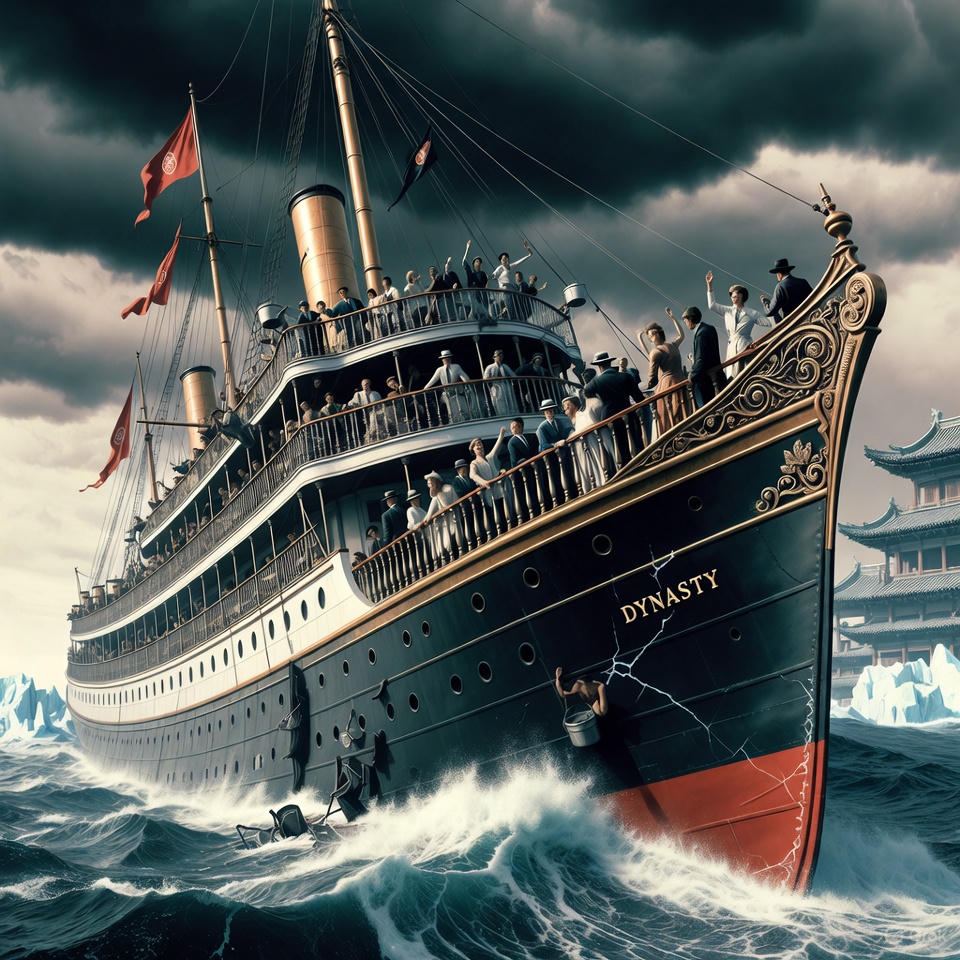
When a luxurious cruise ship named “Dynasty” crashes full speed into an iceberg, don’t panic, and don’t be afraid—this is merely history’s great iron wheel rolling over humanity once again. And as it keeps rolling, people eventually get used to it.
At such a critical moment in history, what do the ship’s captain and first officers usually do? Their first reaction—whether under normal or abnormal logic—is rarely to plug the leaks or right the tilting hull. Instead, they tend to do two things:
1. The First Move: Glossing Over the Crisis
They grab the loudspeaker and shout:
- “Everything is fine!”
- “This is just a small bump on our road from one victory to the next!”
- “Keep eating, drinking, and enjoying yourselves—nothing to worry about!”
And if passengers still don’t believe it, the “old masters” will even organize the ship’s security team to march in formation for entertainment, with My Heart Will Go On playing in the background, stirring passengers’ blood until they proclaim, “Our ship is invincible!”
This kind of farce has played out throughout history, from ancient dynasties to modern bureaucracies.
2. The Second Move: Pulling Resources Upward
Once they have secured their own safety, they will do everything possible to transfer life-saving equipment from the lower decks to the first-class cabins. Meanwhile, they will demand that ordinary passengers work harder to “save the ship”—for example, handing each person a bucket to scoop water.
“Peaceful days are unacceptable. Not striving is a crime.”
Anyone who dares to promote “lying flat” will be silenced immediately.
As long as the lower deck becomes more obedient, more overworked, more self-driven to stay late into the night, the grand narrative can maintain the illusion that this giant vessel will never sink.
But when the ship tilts more sharply and seawater rises to people’s thighs, they finally realize the truth:
All their devotion is merely fuel for a ship destined to sink; what they receive in return are empty promises.
So in this chaotic cabin, it is time to stop running around like headless flies.
It is time to reassess your own resources and goals—redirect your limited energy toward things that bring actual value to your life, instead of being consumed by the myth of an “unsinkable” narrative.
Today, let’s talk about how to walk out of self-exploitation and carve out a path of self-preservation for ordinary individuals.
I. The Deep Historical Roots of Self-Exploitation on This Land
Here, self-exploitation is not a modern invention.
It has deep historical roots.
Throughout the long agricultural era, the core contradiction was simple:
Land does not grow, but children do.
Therefore, “increasing yield per acre” became a life-or-death mandate for every family.
A thousand years ago, the farmer Old Wang bent over under the scorching sun to spread fertilizer. Skipping it even once might cost him several jin of grain—grain that could decide whether his children survived the winter.
A thousand years later, Old Wang’s Nth descendant sits in an air-conditioned office, staying late to revise a PowerPoint presentation. Perform slightly better and maybe he’ll get a raise next month—eat fewer instant noodles—barely make the mortgage payment.
The world has changed dramatically, yet the underlying rule seems unchanged:
Swap the farmland for a cubicle, the dung ladle for a keyboard, and self-exploitation remains the default survival tool for ordinary people.
What’s more ironic:
Almost everyone says they want to “resist the grind” or “lie flat,” yet their bodies behave very honestly—hovering over the boss’s social media posts, ready to like them instantly. Rest for a moment and they feel anxious; see others working overtime and instantly feel guilty.
This split between the left and right brain comes from three thousand years of collective consciousness:
Stop exploiting yourself even slightly, and you might lose your qualification to survive.
Thus, self-exploitation is not only imposed from above—it is the outcome of long-term, high-pressure environments. It evolved as the “optimal solution” for survival, a seamless fusion of external pressure and internal compulsion.
II. Why Is It Precisely Today That We Must Stop Self-Exploitation?
Not because pressure has disappeared.
In fact, the pressure today may be stronger than ever.
But society has undergone a version update.
The old logic no longer works.
During the golden era of the dynasty, squeezing yourself did bring real benefits—even if only crumbs from the cake dropped by those above. It was an era of growth. The entire society gently told you:
- Working overtime is a blessing.
- Losing hair is a sign of strength.
- Hard work guarantees success.
So everyone pushed themselves, sacrificed their health, and treated self-exploitation as the only route to success.
But now, the dynasty has entered its final years:
- Upward mobility is blocked
- Economic growth has stalled
- Competition over limited resources has turned brutal
Under such conditions, trying to squeeze yourself in hopes of clawing cake crumbs from someone else’s mouth is wishful thinking.
Hard work is not a master key—it is the most easily exploited trait of the system.
“Effort” is mythologized because it is:
- measurable
- endlessly demanded
- cost-free for those who impose it
“Didn’t succeed? Then you must not have worked hard enough.”
Like praying at a temple and blaming yourself for not being sincere when the wish doesn’t come true.
Since “sincerity” cannot be quantified, anything can be attributed to “not working hard enough.”
But an ordinary person’s success or failure is not a moral issue; it is a structural issue—an issue of how much cake the system allocates to the lower and middle classes.
To blame structural scarcity on individual laziness is pure magical realism.
Ordinary people who believe this narrative become like donkeys chasing a carrot—running endlessly, never catching it, only breathing harder, tiring more, and blaming themselves more harshly.
III. Lying Flat Is Unrealistic, and Grinding Hard Leads Nowhere. What Should Ordinary People Do?
Most people want to lie flat but can’t.
Nor can they become “work-warriors,” the perpetual-motion machines of capitalism.
So they hang awkwardly in midair:
unable to climb up, unable to come down, painfully stuck.
There is only one solution:
Direct your limited energy toward places that truly deserve it.
This requires an upgrade—from self-exploitation to self-preservation.
This is the hardest transformation in the dynasty’s late years because it means reinstalling your psychological operating system and abandoning old modes of survival.
The later the dynasty becomes, the more we must understand:
Time and energy are your most precious assets.
They cannot—must not—be endlessly drained.
Self-preservation can be broken down into three simple steps.
IV. Three Steps of Self-Preservation: Goals, Action, and Adjustment
Step 1: Goals Must Be Realistic, Bounded, and Finite
In a golden age, one can dream of reaching the stars.
In a declining era, one must stand firmly on the ground.
A goal must be:
- concrete
- sustainable
- clearly bounded
- actually accomplishable
For example:
“I want to learn daily English in three months—enough to order food, ask for directions, shop.”
This is a clear, finite goal.
But—
“I want to be bilingual, speak like a native Londoner”
—this is an infinite mode, with no endpoint, no closure.
In times like these, ordinary people need finite-goal systems more than ever.
Step 2: The Execution Process Must Give You Positive Feedback
No matter how good a goal is,
if the process gives you no sense of progress,
you will feel anxious and defeated.
You can only stick to things that create a positive mental loop:
- The process doesn’t hurt
- You can feel yourself advancing
- You can see small results
- You feel you’re “moving forward”
If instead you feel:
- drained
- anxious
- wanting to escape
- hollowed out
Then the problem is not you—it’s the wrong goal or the wrong path.
Step 3: If the Result Falls Short, Allow Yourself to Adjust or Quit
In the dynasty’s waning years, tolerance for failure is a necessary survival skill.
Failure is not a death sentence.
Ask instead:
- Can I adjust?
- Can I change direction?
- Can I try another method?
Not:
- “I’m worthless.”
- “I’m finished.”
When you stop exploiting yourself and begin preserving yourself,
you will experience a withdrawal phase—anxiety, emptiness, guilt.
But once you push through it, you’ll realize:
A person’s value does not need to be validated by busyness.
Stay away from “work-warrior” environments.
Stay close to people who quietly strengthen themselves and value their own lives.
You will walk more steadily.
V. The Material World Has Changed; the Mental Framework Has Not
Despite rapid material modernization, this old land has never undergone true intellectual enlightenment.
Its mental foundation still carries premodern characteristics:
- People are treated as tools, not ends
- “Sacrificing the individual for the greater good” is glorified
- Human life is cheap; manpower is disposable
Self-exploitation grows from this soil:
handing over your autonomy, treating yourself as something expendable,
using self-punishment to pray for the system’s approval.
Self-preservation, however, means reclaiming your right to choose—
building a personal fortress where you can survive regardless of how the system behaves.
The goal of self-preservation is not to score high on society’s leaderboard.
It is to quietly write your own rules.
In the final years of the dynasty, the greatest rebellion for an ordinary person is not shouting,
“Are nobles and kings born special?”
It is calmly saying:
“I’m sorry, but I’m not playing this game anymore.”
原文
请停止自我剥削:王朝末年的清醒之道
当一艘名为“王朝”的豪华游轮全速撞上冰山时,大家不要惊慌,也不要害怕——这不过是历史的巨轮又一次从所有人的头顶碾过。碾着碾着,人也就习惯了。
在这个历史的紧要关头,这艘游轮上的船长和大副会做什么呢?按正常情况来说——或者不正常来说——他们的第一反应不是堵住进水的船舱,也不是矫正倾斜的船体,而往往是两件事:
第一件:粉饰太平。
他们会拿起喇叭,大声告诉所有人——这不过是从一个胜利走向另一个胜利途中遇到的小波折。大家继续吃喝玩乐,“没什么大不了的”。如果你还不信,“老爷们”还会组织船上保安走队列助兴,背景音乐放着《我心永恒》,把乘客的热血激得沸沸扬扬,高喊“我船不可战胜”。这样的戏码,从古代到今天比比皆是。
第二件:资源上收。
在确保自己安全的前提下,他们会千方百计把救命设备从普通舱抽走塞进头等舱,同时要求普通乘客拼命救船——例如一人一个桶舀水。“岁月静好是不行的,不奋斗就是罪恶。”敢宣扬“躺平”立马封号。只要底层更听话、更内卷、更自觉地加班到深夜,这艘巨轮似乎就永远不会沉没。
然而,当船体倾斜得越来越厉害,当海水漫过大腿时,人们终于会意识到:
所有人的付出不过是在为这艘注定沉没的巨轮继续燃烧;给予我们的,只有虚幻的承诺。
因此,在这间混沌的船舱里,是时候停止无头苍蝇般的奔跑,重新审视自己的资源与目标,把有限的精力投入到真正能为自己带来价值的地方,而不是被“永不沉没”的宏大叙事消耗殆尽。
今天,我们就来聊聊如何走出自我剥削的内卷,找到属于普通个体的自我保全之路。
一、我们这一片土地上的自我剥削,有着三千年的历史底蕴
在这片土地上,自我剥削有着极深的历史根源。
在漫长的农业社会中,核心矛盾只有一个:土地不会变多,但孩子会变多。
因此,“提高亩产”就成了每个家庭的生死法则。
千年前,农民老王在烈日下弯腰施肥,少施一次肥就可能少收几斤粮,而这几斤粮很可能决定孩子能否挨过冬天。
千年后,老王的第 N 代孙子坐在恒温写字楼里,深夜还在改 PPT。表现好一点,也许下个月能加薪、少吃泡面、勉强还上房贷。
虽然世界已经天翻地覆,但规则似乎从未改变:
把田地换成工位,把粪瓢换成键盘,自我剥削仍旧是普通人赖以换取生存空间的默认选项。
更有意思的是,虽然几乎人人嘴上喊“反内卷”“要躺平”,但身体却很诚实地盯着领导朋友圈点赞。稍微休息一下就会焦虑;看到别人加班又立刻自责。
这种左右脑互搏般的分裂感,来自三千年的集体意识:
稍微停止剥削自己,就有可能失去生存资格。
因此,自我剥削并非完全来自上位者的规训,而是长期高压环境下,为了适应生存而进化出的“最优解”——外部压力与内部驱动的完美融合。
二、为什么偏偏在今天,需要停止自我剥削?
不是因为压力消失了,压力依然存在,甚至可能比过去更强。
但社会的版本更新了,旧逻辑已经失灵。
在王朝的黄金时代,压榨自己多少还是能换来实实在在的好处,哪怕只是蛋糕掉下来的几个渣。在那个增量时代,整个社会温柔地告诉你:
加班是福报,秃头是变强的证明,努力必定会成功。
于是大家拼命内卷、牺牲健康,把自我剥削当成功必经之路。
但现在,王朝步入末年:
- 上升通道堵塞
- 经济增量消失
- 存量竞争血流成河
此时还指望压榨自己从别人嘴里抠出蛋糕,听上去就不靠谱。
努力不是万能钥匙,而是最容易被制度无限压榨的那部分。
努力之所以被神话,是因为“努力”是唯一可控、可以无限要求、可无成本索取的指标。
“没成功?那就是你不够努力。”
像庙里许愿没灵验,就是你心不诚。
而“心多诚”不可能给你标准,所以什么都能归结到努力上。
实际上,一个普通人能否成功,是社会财富分配问题,是留给中下层的蛋糕有多少的问题。把结构性问题归因到“个人努力不够”,本质上是一种魔幻现实主义。
普通人相信了这一套,就像驴子追着胡萝卜,无休无止奔跑却永远吃不着,只会更喘更累、更自责。
三、躺平不现实,奋斗也卷不动,那普通人怎么办?
大多数人想躺又躺不平,也不可能像“奋斗狂”那样成为永动机。
结果就是挂在半空:上不去,下不来,窘迫至极。
解决方法只有一个:
把不多的能量投入更值得的地方。
这需要从自我剥削进化到自我保全——这是王朝末年最困难的一步,因为它要求你重装系统、抛弃旧模式。
越是王朝末年,越要意识到:
时间和精力是最宝贵的资产,不可无限透支。
我们要把自我保全的方法拆解成三个部分。
四、自我保全三步:目标、执行与结果
第一步:目标要现实、有边界、有终点
黄金时代可以做星辰大海的梦;末年时代要脚踏实地。
目标必须明确、可持续、有清晰边界,而不是模糊、无止境的无限模式。
例如:
“我要用三个月学会日常英语,能点餐、问路、购物。”
这是明确的目标。
但“我要成为双语者、英语母语水平、开口伦敦口音”,那就是无尽模式,永远无法完成。
末法时代,普通人更需要这种“有路线、有终点”的目标。
第二步:执行过程必须能给你正反馈
目标再好,如果执行过程中没有正反馈,就会有强烈的焦虑与挫败感。
真正能坚持的事情,是让你每走一步都能感到哪怕微小的成就感,形成“精神正循环”:
- 做着不痛苦
- 能感觉到进度
- 能看到一点点成果
- 感到自己“在前进”
反之,如果你在执行过程中:心累、焦虑、想逃、感觉人生被掏空——那就是目标或路径错了。
第三步:结果不理想,要允许自己调整或放弃
在末年时代,提高失败容错率是每个人的必修课。
失败不是死罪。
失败需要的是:
- 能不能调整?
- 能不能换路?
- 能不能换方法?
而不是陷入“我是垃圾”“我完了”的自我攻击。
当你停止自我剥削,开始自我保全时,前期会有戒断反应:焦虑、失落、觉得自己堕落了。但只要挺过这段,你会发现:
人的价值不需要用忙碌来证明。
远离“奋斗狂”圈子,多靠近那些重视生活、默默增强自身力量的人,你会走得更稳。
五、思想底色未变,最该改变的是我们对自己的态度
这片古老土地上虽然物质更新迅速,但从未经历真正的思想启蒙,因此思想底色依然带着前现代的色彩:
- 人被当作手段,而不是目的
- “为了大局牺牲个人”被视为理所当然
- 人命不值钱,人力可随意消耗
自我剥削正是建立在这种思想土壤上:
把自己当成可以牺牲的工具,交出人生选择权,用自虐祈求系统赏赐。
而自我保全,则是重新收回人生选择权,为自己建立一个无论系统好坏都能活下去的堡垒。
自我保全的追求不是在排行榜上卷出高分,而是 悄悄编写一套属于自己的游戏规则。
在王朝末年,对普通人来说,最大的叛逆不是“王侯将相宁有种乎”,而是平静地说:
“不好意思,这个游戏,我不玩了。”