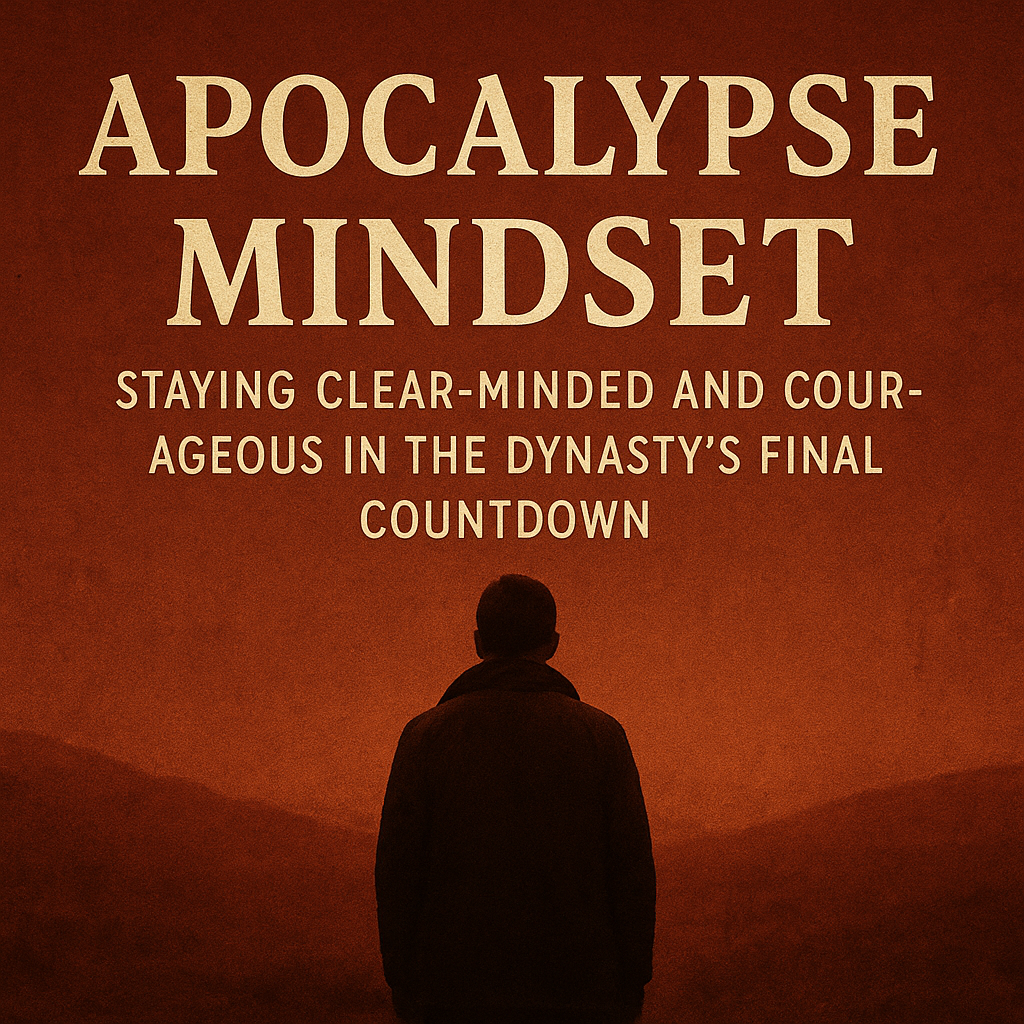
When a dynasty’s body temperature begins to drop, the first to sense the change are always its capillaries. More and more local governments begin to enforce strict attendance checks, count how many sheets of printer paper you used in a day; holiday benefits quietly shrink; even the toilet paper becomes as thin as cicada wings.
These tiny, often overlooked details measure an era more accurately than any loud GDP growth curve. Even the most illiterate farmers of ancient times understood this: when those “above” start tightening their belts, a hungry dynasty’s wail has already become the dominant background sound of the age.
What does it feel like to live in a society that “will collapse sooner or later”?
Do we live in constant sorrow, cry every night, and drag ourselves through each day?
Not necessarily. And definitely not recommended.
Even when we know the world is bad—and likely worsening—it does not stop us from living positively within the acceptance of reality.
This is the mindset of a “pessimistic optimist.”
It is not a clinical symptom of split personality, but a mental state inevitable in turbulent times: a seemingly contradictory but absolutely essential dual-mode mindset.
Like the designer’s eternal paradox: “Make the logo bigger—no, smaller. Move the title up—also down.”
In today’s language, this is the state of being both fired up and depressed at the same time—what I call the “dual nature of blaze-and-blues.”
I. What Is the “Blaze-and-Blues” Mindset?
“Blaze-and-blues” is not simply “either burnout or lying flat.”
Its essence is this:
Use pessimism to assess the macro future.
Use optimism to handle the micro present.
In simpler terms:
- Strategically depressed: plan for the worst
- Tactically inspired: live every day with your best energy
This is like securing your lifeboat on a sinking ship while also brewing yourself a cup of coffee.
It is the more advanced—and more adaptive—way to survive in the dynasty’s final years.
II. Why Is “Blaze-and-Blues” a More Advanced Mindset?
Because it contains the two most essential qualities needed in a crumbling era:
- Blues = clarity, defense, the firewall against illusions
- Blaze = courage, momentum, the fire that keeps order alive
1. The “Blues” = strategic clarity
The “blues” helps you see that the system’s rules are rotting. It helps you understand:
- Following the rules no longer guarantees reward
- Hard work does not necessarily lead to fairness
- Grand narratives can throw you into the boiler at any moment
“Blues” is the ability to keep distance, resist brainwashing, and see the big trend clearly.
It starts from the worst possibilities:
unemployment, instability, chaos.
2. The “Blaze” = courage built on clarity
The “blaze” means:
Even when you know the environment offers no hope, you still live your life sincerely.
One skill.
One meal.
One relationship.
All grand narratives are composed of these small, micro-level details.
To live seriously when the world is collapsing is a silent form of resistance.
3. You must have both
Only “blues” → clarity turns into numbness; action collapses; the storm eliminates you.
Only “blaze” → you get brainwashed by “work as blessing” narratives; or manipulated into meaningless sacrifice.
Thus, blaze + blues = pessimistic courage.
III. How Do We Cultivate the Blaze-and-Blues Mindset?
Earlier, we discussed: Why be pessimistic? Why is the environment worsening? Why is the trend irreversible?
Now we talk about the “blaze” side:
- Why be inspired?
- How to be inspired?
- Where does the courage come from?
The first step is this:
Change your value system and your evaluation system.
IV. Change the Value System: Withdraw Value From External Judgment
In a stable society, individual value is determined by external metrics:
- A respectable job
- A high income
- A prestigious degree
People consider themselves “valuable” and “successful” because external rewards validate them. And they overwork themselves to win these rewards.
But in the dynasty’s final years, this system is collapsing.
You must extract your sense of worth from external judgment and redefine success.
Otherwise, it’s like grinding for in-game gold overnight, only to log in one day and find:
Server closed.
That is why in the previous article, we discussed:
Do not keep overworking inside a system that is about to shut down.
V. When the System Becomes Unreliable, You Must Become Your Own Last Line of Defense
In a functioning society, individuals rely on institutions—government, companies, social welfare—to provide security.
But reliance always comes with a price.
Especially in the last years of a dynasty.
Two things make reliance dangerous:
- The regime will sacrifice you for its own survival
- Even if the system wants to protect you, it may no longer have the capacity
Your job, insurance, pension—may evaporate along with the structure that supports them.
So, smart people do not place all their eggs in a basket that may break at any moment.
When external safety nets disappear, the only things that will not betray you are:
- Your character
- Your abilities
- Your accumulated resources
VI. Step One in Building Your Defense: Examine What You Rely On
This is not to create anxiety, but to identify risks:
- Does your professional identity still hold when removed from the platform?
- Is your income heavily dependent on a single employer?
- Are your information sources dependent on authorities or algorithms?
- Can you independently gather and verify information?
These questions help you see clearly where your “eggs” are placed—and which baskets may break first.
VII. Second Line of Defense: Resource Redundancy & Risk Buffers
In times of prosperity, people believed the future would be better—so they leveraged themselves to the limit.
In times of decline, doing the same is simply a faster way to die.
Now you must reverse the strategy:
- Reduce rigid expenses
- Prepare at least one year of cash buffer
- Build more than one income stream
- Have Plan B for all major aspects of life
- Allocate part of assets to “hard currency” (cash, foreign currency, precious metals, crypto)
You must also acquire skills that survive regardless of the system:
- Medical basics
- Repair & maintenance
- Writing
- Foreign languages
Some corporate skills—like writing flattering speeches for superiors—lose value instantly once the system changes.
If hard skills feel too difficult, that’s okay.
Certain soft skills are universally valuable:
- Independent thinking
- Insight
- Coordination & communication
VIII. Third Line of Defense: Trust Networks & Character Assets
This is often overlooked, but absolutely crucial in chaotic times.
When systems crumble, trust becomes extremely scarce.
At that moment, what protects you is:
The character and credibility you’ve built over years.
Most social relationships are transactional. But in uncertain times, what truly matters is:
- Who will pull you up in a crisis
- Who you would trust with your back
- Who shares your values and worldview
This is not about drinking buddies.
It’s about:
Small, complementary, trust-based alliances.
Like forming a dungeon team:
Warrior — Mage — Healer.
Each with their strengths.
Each indispensable.
Only with this foundation can you face any environment with confidence.
IX. The Final Awakening: Take Back the Meaning of Life From the System
This is not just a survival strategy—it is a spiritual transformation:
- From external validation → to internal construction
- From chasing growth → to ensuring continuity
- From blind networking → to strategic alliances
This is the shift from being a battery for the system to becoming an independent terminal.
The ultimate victory is not isolation.
It is this:
When the system collapses, I remain intact.
When the system recovers, I can sprout from the ashes.
This is the true survival confidence in the dynasty’s final years.
原文
末世心态学:在王朝倒计时中保持清醒与勇气
当王朝的体温逐渐下降,最先感知到变化的往往是毛细血管。各地的州府县衙突然开始严抓考勤,仔细统计一天用了多少张打印纸;节假日的福利悄然缩水;连厕所里的卫生纸都薄得像要透光。
这些不起眼的小细节,比GDP里震耳欲聋的增长曲线,更能真实反映一个时代的温度。连古代的文盲都明白——当“人上人”们开始勒紧裤腰带时,一个饥饿王朝的哀鸣已经成了时代背景音。
那生活在一个“迟早要完”的社会里,是怎样的体验?
整日郁郁寡欢、以泪洗面、混一天算一天吗?
倒也不至于,也不应该如此。
即便我们知道世界正在变糟,甚至还会继续变糟,这并不妨碍我们在接受现实的基础上,依然选择积极地生活——成为一个“悲观的乐观主义者”。
这并非精神分裂,而是动荡时代的必备心态——一种看似矛盾,却异常必要的“双极状态”。就像设计师永恒的噩梦:“把logo放大一点……再缩小一点”,“标题往上移……但同时又往下移”。
如果用今天的语言来概括,那就是一种 又燃又丧 的状态。
或者更准确地说,是一种 “燃丧二象性”。
一、什么是“又燃又丧”的心态?
“又燃又丧”绝不是“要么内卷,要么躺平”的二选一,而是一种更精细、更成熟的应对方式。
它的核心是:
在宏观层面,用悲观的态度接受最坏的可能性;
在微观层面,用乐观的态度处理每一个当下。
换句话说:
- 战略上极度丧:以最坏的预期规划未来
- 战术上极度燃:用最好的心态过好每天
这是一种边扎救生筏、边给自己泡杯咖啡的生活方式。
也是王朝末年最适应环境的高级活法。
二、为什么说“又燃又丧”更高级?
因为这种心态包含了末世生存中最重要的两种能力——清醒与勇气。
丧,是清醒,是防守,是抵御幻觉的防火墙。
燃,是勇气,是行动力,是维持秩序的火种。
1. 丧:是战略清醒
“丧”让你看见系统规则正在腐坏,让你明白:
- 遵守规则未必换来奖励
- 努力不必然带来回报
- 宏大叙事随时可能把你推进锅炉
因此,“丧”不是消极,而是 保持距离、拒绝被洗脑、认清大势的能力。
2. 燃:是在清醒之上的勇气
燃,是即便看清了现实,仍然认真对待生活:
- 一项技能
- 一段关系
- 一顿用心的晚餐
所有宏大的生存,都由这些具体的小事构成。
在崩塌的世界里认真生活,本身就是一种静默的反抗。
3. 两者缺一不可
- 只有丧,会清醒过度、麻木不仁,最终在风暴中被淘汰
- 只有燃,容易被“福报论”或虚假光环推上无意义的牺牲
所以,“燃”与“丧”必须共存——
它是一种 悲观的勇气。
三、如何做到“又燃又丧”?
前面我们反复讨论过:为什么要丧?大环境为何变糟?趋势为何不可逆?
但真正关键的问题来了——
- 为什么要燃?
- 如何燃?
- 燃的底气从哪里来?
答案的第一步是:
改变价值体系与评价体系。
四、改变价值体系:把价值从外部抽离出来
在一个正常社会里,人们的价值往往由外部体系决定:
- 体面的工作
- 优渥的收入
- 名校学历
于是,人为了这些外部勋章拼命内卷,以为这就是“成功”。
但在王朝末年,这套体系正在加速崩坏。
你必须把价值感从外部剥离,重新定义自己的成功。
否则就像在游戏里熬夜打金币,结果某天登入时发现——
服务器关服了。
这就是之前讨论的重点:
不要在即将退场的系统里竭力内卷。
五、当系统不再可靠:你必须成为自己的最后一道防线
一个健康的社会会为个人提供基本的安全感(政府、公司、社保)。
但任何依赖都有代价。
尤其在王朝末年,依赖系统变得愈发危险,有两个原因:
- 系统为了自保,会把你当燃料往锅炉里丢。
- 即使它愿意照顾你,它也已经力不从心。
工作、医保、养老金……都可能随着体系坍塌而蒸发。
所以聪明人从不把全部鸡蛋放在一个随时会裂的篮子里。
当外部底线不再可靠,唯一不会背叛你的,是:
- 你的品格
- 你的能力
- 你持续积累的资源
六、第一道防线:盘点你对系统的依赖
不是制造焦虑,而是看清风险。
问自己:
- 离开平台,我还剩下哪些可迁移能力?
- 收入是否完全依赖单一雇主?
- 判断信息是否依赖官方或算法?
- 是否具备独立获取与验证信息的能力?
只有盘清这些,你才知道:
你的鸡蛋在哪些篮子里,哪些篮子正在开裂。
七、第二道防线:资源冗余与风险缓冲
繁荣时代,人们相信未来更好,于是大胆加杠杆;
而现在继续加杠杆,就是加速奔向悬崖。
你需要反向操作:
- 减少固定支出
- 准备至少一年的生活冗余
- 收入不能只有一条管道
- 培养第二收入
- 所有重要选择必须有 plan B
- 资产配置增加“硬通货”(现金/外币/贵金属/加密资产)
另外,要掌握那些 不会因制度变迁而被淘汰的硬技能:
- 医疗
- 维修
- 写作
- 外语
写领导的稿子和大厂里的某段代码,离开系统就严重贬值。
如果你觉得硬技能难,不必焦虑——
独立思考、洞察力、协调沟通
这些软技能在任何环境都具备价值。
八、第三道防线:人际信任与品格资产
这一点常被忽视,却在末世尤为关键。
系统崩塌后,最大的稀缺品不是资源,而是“信任”。
能真正救你的,是你过去积累的 品格与信用。
绝大多数社交是交易型的,但在动荡年代,真正重要的是:
- 谁会在绝境中拉你一把?
- 你愿意把后背交给谁?
- 谁与你共享价值观?
这不是酒桌上的兄弟,而是:
小规模、能力互补、彼此信任的同盟。
像打副本一样:战士、法师、牧师,各有所长。
这种关系,比任何“庞大的人脉”都更可靠。
九、最终的觉醒:把人生意义从系统手中夺回来
这不仅是生存策略,更是一次心灵重塑:
- 从依赖外部评价 → 转向内部建设
- 从追求增长速度 → 转向确保存续质量
- 从广泛社交 → 转向精准结盟
你从“系统电池”变成“独立终端”的那一刻,才算真正觉醒。
最终的胜利不是与世隔绝,而是:
系统崩塌时,我安然无恙。
系统复苏时,我依然能在灰烬中发芽。
这,就是王朝末年的真正底气。