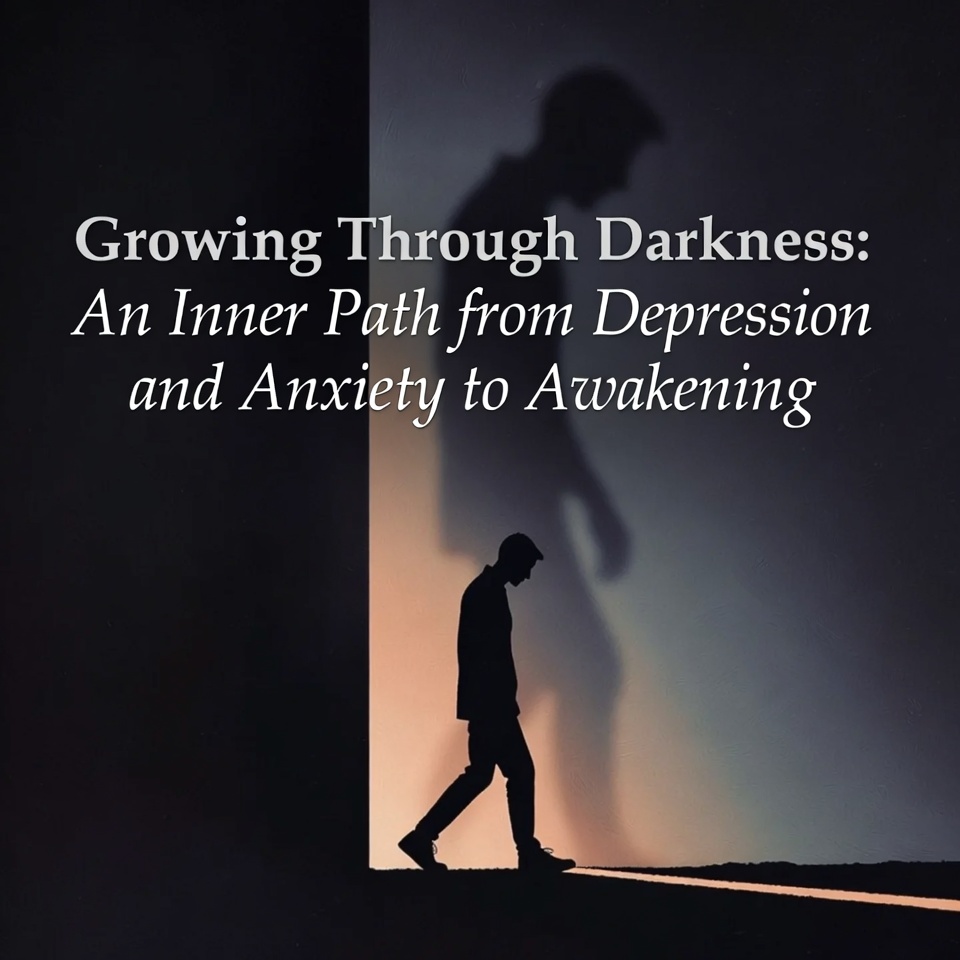
If you are currently experiencing the dual impact of depression and anxiety, I want to begin by telling you something honest and important: you are not broken. You are standing at one of the most difficult—yet also most meaningful—points in your life.
What you are facing is not merely a crisis. It may be the threshold of a profound inner awakening. From a psychological perspective, when depression and anxiety coexist, it often signals that a person has been pushed to the limits of their old cognitive and emotional patterns. And it is precisely at the limit that real transformation begins.
I. Dark Vitality: Rebuilding After Collapse
Why can the coexistence of depression and anxiety be a precursor to growth?
Because it means your inner conflicts have accumulated to a breaking point. You can no longer survive by telling yourself to “endure a little longer” or “let it go.” Life is forcing you—through intensity and pain—to confront what is real.
In psychology, there is a concept known as “dark vitality.” It refers to the strength that emerges after a person has endured extreme sorrow, repression, and suffering. From these depths often arise greater resilience, sharper insight, and a more stable sense of self. This is not a romanticization of suffering, but a recognition of human endurance.
Dark vitality is the capacity to rebuild order from ruins—a rare gift that can only be earned by passing through darkness.
So why do so many people remain trapped in depression and anxiety for so long?
One crucial reason is a fracture in time perception.
Depression anchors people in the past—unfinished regrets, relentless self-questioning, endless “if onlys.”
Anxiety, on the other hand, pulls people into the future—fear of the unknown, dread of losing control.
When both states coexist, they are often accompanied by a shared trait: excessive self-reflection.
You repeatedly dissect your past, filling your mind with self-criticism. You fixate on outcomes, making every uncertainty about the future feel threatening. Over time, your thinking becomes a closed loop:
- Replaying past “mistakes” again and again
- Amplifying feelings of helplessness
- Reducing every problem to “I am not good enough”
This internal cycle quietly drains your confidence in the future.
II. Escaping the Mental Trap: Returning Life to the Present
What sustains suffering is not emotion itself, but being pulled away from the present moment.
And the present is the only place where you can truly live—and truly change.
What is the present?
It is your breath right now. The sensations in your body. Your awareness of your inner state. It is the simple, undeniable fact that you are alive in this moment.
The past cannot be revised. The future has not yet arrived. The present alone contains all possibilities.
Therefore, healing does not require eliminating depression or anxiety. It requires freeing these emotions from obsession with the past and fear of the future, and gently returning your attention to now.
When you return to the present, pain no longer exists solely to consume you. It begins to transform into energy for rebuilding. Emotional lows can become the foundation for a new departure.
III. Practical Paths: Self-Compassion and Healthy Expression
If all practices were reduced to their core, only two principles would remain:
Deep self-compassion, and appropriate outward expression.
1. What Is True Self-Compassion?
Many people believe self-compassion simply means “being nicer to yourself.” In reality, it goes much deeper.
True self-compassion is not indulgence, nor is it avoidance. It means:
- Accepting your imperfections
- Ending relentless self-punishment
- Standing on your own side, even when you fail
Psychologist Kristin Neff writes, “Self-compassion is not self-indulgence or self-pity, but a deep form of understanding and acceptance toward oneself.”
As you practice self-compassion, you may notice:
- The harsh inner voice softening
- Greater permission to make mistakes
- A growing sense of kindness toward yourself
This is the first—and most essential—step from anxiety and depression toward awakening.
2. Why Healthy Outward Expression Matters
Many people burdened by emotional pain share a common habit: turning aggression inward.
- Blaming yourself for others’ failures
- People-pleasing to maintain a sense of safety
- Suppressing emotions to preserve surface harmony
Ask yourself honestly:
When you are already struggling, are relationships that require constant self-erasure truly worth maintaining?
Does your silence lead to understanding—or does it simply become expected?
Healthy outward expression means:
- No longer making excuses for everyone
- No longer absorbing all responsibility
- No longer forcing yourself into the role of the “good” or “understanding” one
This is not selfishness or coldness. It is boundaries. You do not need to hurt yourself to prove your kindness.
IV. The Power of Stillness: Resisting the Urge to Rush
As you practice these ideas, you may encounter a universal obstacle of modern life: impatience.
The urgency to heal quickly. To change immediately. To see results now.
At its core, impatience often hides a subtle form of greed—the desire for rapid transformation.
But real growth never happens in haste.
Ancient wisdom emphasizes deep focus on a single path, because only sustained attention allows one to enter a state of flow. In this state, the brain forms new neural connections, and genuine cognitive restructuring occurs.
Impatience is wasted energy.
The most valuable action is simple:
Bring your attention back. Choose one meaningful pursuit. Work on it steadily, day by day, without clinging to outcomes.
V. Patience and Trust: Letting Change Unfold
Remember this: your inner state and external reality are fundamentally aligned.
As your cognitive level evolves, your environment will quietly shift as well.
Many people spend their lives repeating the same struggles, feeling trapped by fate. Often, the true constraint is not circumstance, but an unchanged cognitive system.
Sink deeper. Build a higher-dimensional view of life.
Thought guides action; action validates thought. They refine each other.
Find one pursuit worthy of long-term devotion. Seek wise guidance. Place yourself in a supportive environment. Over three to five years, your brain will undergo real structural change—and that change enables genuine transformation.
To settle is to take root. And only when rooted can life grow.
VI. A Final Note: You Already Carry the Answers
Dear friend, trust this: what has not destroyed you will become your strength.
“Only when the heart reaches its end does the path begin.” Many awakenings are born from profound suffering.
Depression and anxiety may return, but each time you will recognize them more clearly, and relate to them with greater ease. That process itself is clarity and growth.
A calm heart resists countless illnesses; a quiet mind understands all things.
In a restless world, allow yourself to move at your own pace. Measure growth against your past self, not against imagined futures.
Change is not a miracle. It is a daily choice.
May you remember to breathe deeply in every difficult moment, and offer yourself gentle affirmation whenever doubt arises.
You are already on the path—and every step counts.
原文
在黑暗中生长:从抑郁与焦虑走向觉醒的内在之路
如果你此刻正经历着抑郁与焦虑的双重冲击,我想先对你说一句实在的话:你并不是“坏掉了”,你只是走到了人生中一个极其艰难、却也极其重要的节点。
很多时候,这不仅仅是一场困境,更可能是一扇通往深层觉醒的门。从心理学的角度来看,当抑郁与焦虑同时出现,往往意味着一个人已经被推到了旧有认知和情绪模式的极限——而极限,恰恰是蜕变真正开始的地方。
一、黑色生命力:在破碎中重建自己
为什么说抑郁与焦虑并存,反而可能是成长的前兆?
因为这意味着你内在的情绪冲突已经累积到了顶点。你再也无法用“忍一忍”“算了吧”来糊弄自己,生命在用最强烈的方式逼你直面真实。
心理学中有一个概念,叫**“黑色生命力”**。它指的是:一个人在经历过极度的悲伤、压抑和痛苦之后,反而发展出更强的心理韧性、更深刻的理解力和更稳定的自我感。这不是对苦难的歌颂,而是对生命韧性的尊重。
它是一种从废墟中重新搭建秩序的能力,是在穿越黑暗之后,才可能获得的馈赠。
但现实中,为什么仍有那么多人被抑郁和焦虑长期困住?
一个重要原因在于时间维度的撕裂。
抑郁,常常把人困在过去——那些未完成的遗憾、反复咀嚼的“如果当初”;
焦虑,则把人拖向未来——对未知的恐惧、对失控的担忧。
当这两种情绪同时存在时,往往伴随着一个共同特质:过度内省。
你习惯反复审视自己的过去,于是大脑被反思和自责填满;你过度在意结果,于是对未来的任何变化都充满不安。久而久之,思维开始形成封闭回路:
- 一遍遍回放过去的“错误”
- 不断放大自己的无力感
- 将所有问题指向“是我不够好”
这种内在循环,会悄无声息地消耗掉你对未来的信心。
二、走出思维陷阱:把生命拉回当下
真正让人持续痛苦的,并不只是情绪本身,而是你被它们带离了当下。
而当下,恰恰是你唯一能够真正触碰、也唯一能够改变的地方。
当下是什么?
是你此刻的呼吸,是你身体的感受,是你对内心状态的觉察;是你此时此刻,真实地活着。
过去已经无法修改,未来尚未发生,唯有当下,承载着一切可能性。
因此,疗愈的关键,并不是“消灭”抑郁和焦虑,而是:
- 不再被对过去的执念牵着走
- 不再被对未来的恐惧支配
- 把注意力重新收回到此刻的内在力量上
当你开始回到当下,痛苦就不再只是消耗,它会慢慢转化为重建自我的能量。情绪的低谷,也可能成为重新起航的基石。
三、可行的路径:自爱,与健康的自我表达
如果要把所有实践方法浓缩成核心,那只有两点:
深度的自爱,和适度的向外表达。
1. 什么才是真正的自爱?
很多人以为自爱就是“对自己好一点”,但真正的自爱,远不止如此。
真正的自爱,并不是纵容,也不是逃避问题,而是:
- 接纳自己的不完美
- 停止无休止的自我惩罚
- 在犯错时,依然站在自己这一边
心理学家克里斯汀·内夫曾说:“自爱不是自私,而是一种深刻的自我理解与自我接纳。”
当你开始练习自爱,你会发现:
- 内心苛责的声音变小了
- 允许犯错的空间变大了
- 对自己的慈悲逐渐增强
这是从焦虑与抑郁走向觉醒的第一步,也是最基础、却最重要的一步。
2. 为什么一定要学会向外表达?
许多情绪困扰者,都有一个共同习惯:向内攻击。
- 用否定自己,来承担他人的问题
- 用讨好,来换取关系的安全感
- 用压抑情绪,维持表面的和谐
但你需要诚实地问自己:
当你已经如此艰难时,那些必须靠你不断牺牲自我才能维系的关系,真的值得吗?
你的退让,真的会换来理解,还是只会被视为理所当然?
适度的向外表达,意味着:
- 不再为所有人找借口
- 不再把所有责任揽到自己身上
- 不再勉强扮演“永远懂事”的角色
这不是冷漠,更不是自私,而是一种边界感。你不需要通过伤害自己,来证明善良。
四、沉静的力量:对抗“急”的本能
在实践这些方法的过程中,你很可能会遇到一个现代人共有的障碍:急躁。
急着好起来,急着改变,急着看到结果。
而“急”的背后,往往藏着一种隐秘的贪——对快速见效的渴望。
但真正的成长,从来不发生在匆忙中。
古人讲“一门深入”,因为只有当你真正沉下心,把一件事做深、做透,才能进入专注的“心流”状态。在这种状态下,大脑会形成新的神经连接,认知结构才会发生实质性的改变。
急,是最无效的能量消耗。
真正有价值的行动只有一个:
把心收回来,选定一件事,每天踏实地去做,暂时放下对结果的执着。
五、耐心与信任:让改变自然发生
你需要记住一件事:内在状态与外在环境,本质上是统一的。
当你的认知层级提升,所处的现实环境也会随之变化。
许多人一生都在重复相同的困境,感觉命运被锁死,往往不是运气的问题,而是认知系统始终没有被打破。
沉下去,建立更高维度的人生观。
思想引导行为,行为反过来验证思想,二者相互打磨。
找到一件值得长期投入的事,寻找良好的引导者,进入支持性的环境。持续三到五年,你的大脑结构会发生真实的改变,而这种改变,才会带来真正意义上的脱胎换骨。
定下来,才能扎根;扎根了,生命才会生长。
六、最后的寄语:你本就拥有答案
亲爱的朋友,请相信:没有击垮你的,终将成为你的力量。
“心不死,道不生。”许多真正的觉醒,都发生在最深的痛苦之后。
焦虑与抑郁也许会反复出现,但你会一次比一次更熟悉它们,更从容地与之共处。这个过程本身,就是清醒与成长。
心平,能御三千疾;心静,可通万事理。
在这个喧嚣而急切的世界里,请允许自己慢一点,用自己的节奏前行。与过去的自己比较,而不是与想象中的未来对标。
改变不是奇迹,而是日复一日的选择。
愿你在每一个艰难的时刻,都记得深呼吸;在每一次自我怀疑时,都能对自己说一句:
我已经在路上了。