Have you ever noticed something strange?
So many things supposedly have official procedures, public service windows, and clearly stated rules — yet somehow, it always feels like:
if you don’t know the right people, nothing really works.
School enrollment.
Hospital appointments.
Job opportunities.
Government paperwork.
Even something as ordinary as renovating a house or joining a club.
Someone will eventually whisper:
“You should probably find someone.”
At first, this feels unfair.
If rules already exist, why should relationships matter?
But over time, you realize something unsettling:
The problem is not that the system is broken.
The problem is that, for many people,
the inefficiency is the business model.
Because if every process became transparent, efficient, and predictable,
then “connections” would immediately lose their value.
And for some people, their greatest asset is not skill.
It is simply:
the ability to make others depend on them.
01 Every Bottleneck Eventually Becomes a Toll Booth
Most people assume complicated systems exist because of incompetence.
But often, that’s not true at all.
Many bottlenecks survive because they are profitable.
The more confusing the process,
the more valuable the middleman becomes.
Think about how many procedures could easily be simplified today:
Technology isn’t the problem.
Resources often aren’t the problem either.
The real issue is this:
If the process became simple, entire layers of influence would disappear.
Take a common example.
A prestigious training program advertises:
“Open lottery admission. Fair and transparent.”
Parents submit applications and wait months.
No luck.
Later, another parent quietly tells you:
“There’s an alternative admission channel.”
But to enter that “priority pool,” you first need to purchase an expensive preparatory course.
Then someone suggests buying additional materials.
Then maybe attending a special event.
You keep paying, because you’ve already invested too much to stop.
And eventually, you discover that families with genuine connections bypassed the entire process from the beginning.
One message. One phone call.
Done.
That’s when you realize:
The complexity was never about fairness.
It was about filtering people.
Filtering who is willing to spend more.
Filtering who is willing to keep negotiating.
Filtering who is willing to enter the relationship game.
The most complicated systems are often the most profitable ones.
Which means:
“Using connections” is not a bug in the system.
It is often the system itself.
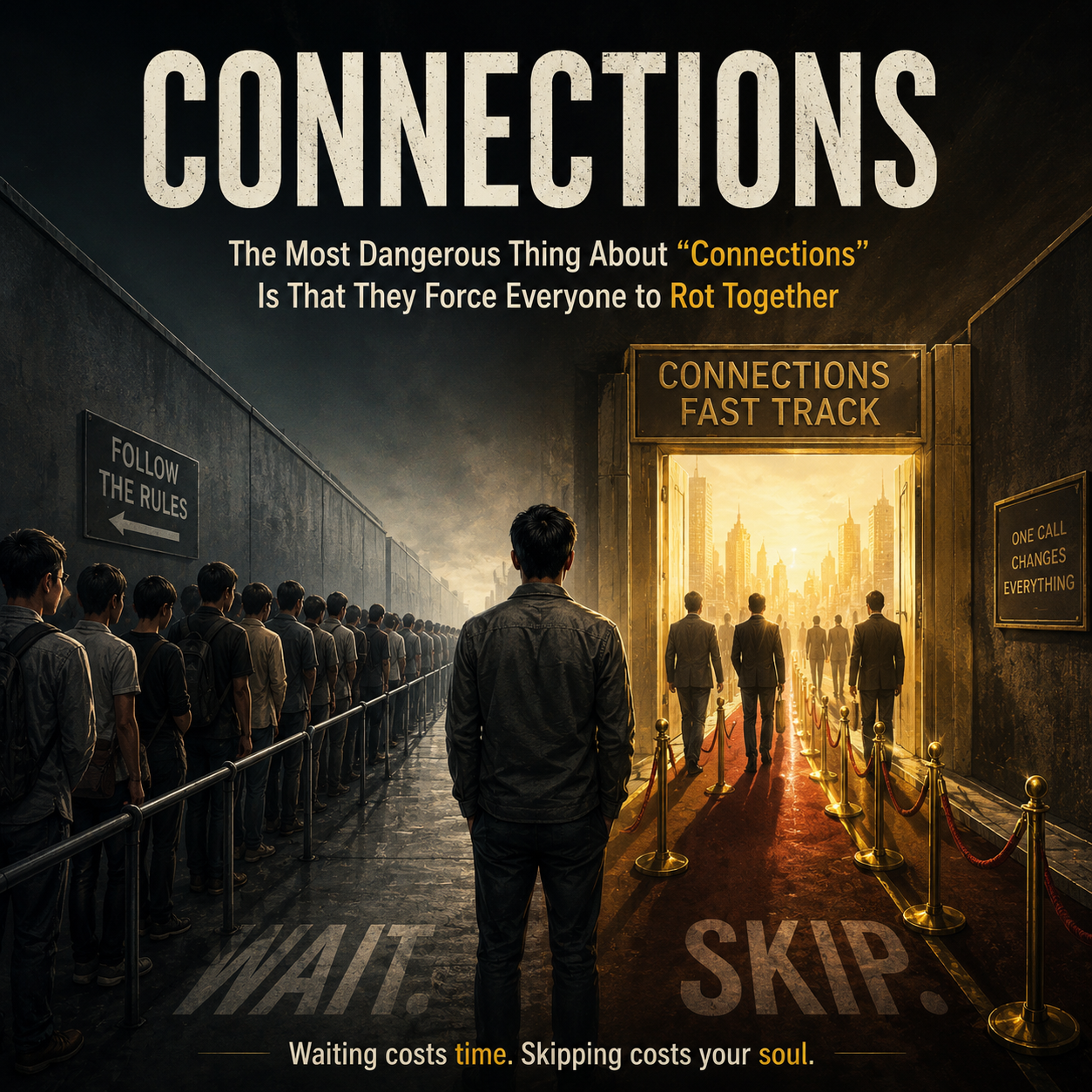
02 People Waiting in Line Keep Waiting
People With Connections Keep Skipping the Line
After enough experiences like this, everyone learns the same lesson:
It’s not that people want to rely on connections.
It’s that refusing to play the game feels like volunteering to lose.
So eventually, almost everyone joins in.
And once enough people participate, something important happens:
The system no longer needs to force itself onto society.
Society begins defending it voluntarily.
Parents start telling their children:
“This is just how the world works.”
Which really means:
“Learn how to survive inside relationship networks.”
And once a society accepts this logic deeply enough,
the cycle becomes self-sustaining.
03 The Real Nature of “Connections”
At its core, connections are not magic.
They are simply:
the private distribution of scarce resources.
The scarcer the opportunity,
the more valuable the network controlling access becomes.
That’s why relationship-based systems naturally create endless layers of gatekeeping.
You need A to introduce you to B.
B wants approval from C.
C requires participation in D.
Every new barrier serves the same purpose:
Selection.
Selecting people willing to pay higher costs.
Selecting people willing to persist longer.
Selecting people willing to submit.
And once you’ve already crossed several barriers, your own mind starts working against you:
“I’ve come this far. I can’t stop now.”
Without realizing it, you begin rationalizing the system that trapped you.
04 The Rise of “Performative Networking”
But perhaps the strangest part is this:
Many people are no longer using connections for practical benefit.
They’re using them symbolically.
Imagine a relative visiting a major hospital in the city.
You help arrange an appointment through an acquaintance.
In reality, the wait time is almost identical to the normal process.
Yet your relatives still feel impressed.
Because the point was never efficiency.
The point was proving:
“You know people.”
Connections become a form of social performance.
And once that performance begins, society starts expecting it everywhere.
If you don’t use connections for your child’s school, people think you’re incapable.
If you don’t rely on networks when changing jobs, people think you’re socially isolated.
Even when personal referrals are more expensive or less efficient, people still prefer them.
Why?
Because the real fear is no longer losing money.
The real fear is:
being excluded from the network itself.
05 Eventually, Relationship-Based Societies Begin Consuming Themselves
When rules stop feeling reliable,
people stop trusting systems.
Then slowly, they stop trusting each other too.
Everyone starts protecting themselves:
keeping backup plans,
building circles,
testing loyalties,
avoiding vulnerability.
Because everyone understands one thing:
The real danger is not the problem itself.
It’s whether or not someone powerful stands behind you.
And once a society reaches this stage, everything becomes more expensive:
Trust becomes expensive.
Cooperation becomes expensive.
Communication becomes expensive.
People spend less energy creating value —
and more energy navigating invisible social terrain.
06 The Tragic Part: Victims Often Become Defenders
Most young people initially hate systems like this.
They ask:
Why does everything require connections?
Why can’t rules function normally?
Why are some people always allowed to bypass the line?
But the truly dangerous part is what happens later.
Once someone finally gains access to influence,
they often start protecting the very system they once criticized.
Because now, the system benefits them.
Their relationships become their competitive advantage.
And naturally, they stop wanting transparency.
They stop wanting simplification.
They stop wanting equal access.
The cycle reproduces itself.
Former victims slowly become gatekeepers.
07 The Greatest Cost Is Not Inefficiency
It’s Moral Decay
Most people think the biggest problem with relationship-based systems is inefficiency.
But inefficiency is only the surface.
The deeper damage is psychological.
Over time, these systems train everyone to adapt morally downward.
Honest people become cynical.
Principles become negotiable.
Rules become secondary to personal ties.
Eventually, society stops believing:
“Following rules is the right thing to do.”
And starts believing:
“Without connections, nothing is possible.”
That is the moment corruption becomes cultural instead of institutional.
Because once enough people internalize the logic,
the system no longer needs enforcement.
People will defend it themselves.
And eventually, they’ll teach it to the next generation.
08 The Final Question
Criticizing “connections” is easy.
The harder question is this:
If one day you gain the power to make others depend on you —
would you remove the bottlenecks,
or preserve them?
Because preserving them benefits you.
Removing them costs you.
And that’s where the real conflict begins.
Not between good people and bad people.
But between:
fairness and self-interest.
Most people believe they hate unfair systems.
But often, what they really hate is simply:
not being the one allowed to skip the line.
原文
关系真正可怕的地方,是它会逼所有人一起腐烂
你不是在破坏规则,你是在被规则筛选。
你有没有想过:为什么明明很多事都有正常流程、公开窗口、规定时限,可你永远觉得——不找关系,就办不成?
答案很扎心:因为有人需要你走关系。
如果所有事情都按规章制度办得清清楚楚、明明白白、顺顺利利,那“关系”还有什么价值?那些靠关系吃饭的人——中间人、掮客、各种“打一个电话就能搞定”的能人——他们还怎么活?更重要的是,某些层级上的人,手里最大的资源就是“能卡你一下”的权力。如果这个权力消失了,他们的存在感、价值感、收益,统统归零。
一、堵点,就是变现点
你会发现一个有意思的现象:很多单位、很多流程、很多事情,永远不可能被彻底简化。
不是技术上做不到,是利益上不允许。
简化了,谁还来找我?没人来找我,我还是那个“谁”吗?
表面上你看到的是办事流程,实际上流程里的每一个堵点,都是某些人设计好的“收费闸口”。你想快一点?找关系。你想稳一点?找关系。你怕被刁难?还是找关系。
举个例子。
你给孩子报一个热门培训班,官网上写得清清楚楚:公开摇号,公平公正。你老老实实填了信息,等了两个月——没中。
后来你听别的家长说,这个班开课前一周会有一个“补录名额”。怎么拿到?你得认识培训机构的课程顾问。顾问会告诉你:先报一个8000块的“预备营”,才能进“优先补录池”。你交了8000。顾问又说:最近名额紧张,最好再买一套机构自己的教材,3888。
你花了将近12000,终于进了补录池。
然后你发现:人家真正有关系的人,根本不用走这套流程。机构的联合创始人是某小学的退休副校长,一个微信,孩子直接插班。
如果培训机构一开始就把名额明码标价——一个名额5万块,它敢吗?不敢。家长会举报,物价局会查。
但设计一套复杂的规则——摇号 → 补录 → 预备营 → 优先池 —— 你就说不出什么了吧?
- 你没摇中?运气不好。
- 你没进补录池?不够积极。
- 你没买教材?不舍得花钱。
每一步都是你“自愿”的,但每一步都在筛选。
筛选谁?筛选那些愿意继续花钱、继续找关系的人。
最麻烦、最曲折、最需要人指路的流程,就是最赚钱的环节。
所以,找关系不是这个系统的 bug —— 找关系,就是这个系统的商业模式。
二、排队的人永远在排队,插队的人永远在插队
不找关系的人,永远在排队。
找关系的人,永远在插队。
几次下来,所有人都明白了:不是我想找关系,是我不找关系就活该被欺负。
于是所有人都开始找关系。需求被制造出来了,市场形成了。
但真正的、高层的既得利益者,他们不只在具体的事情上获利。他们获利的方式更高级——
他们让你相信:这个世界就是这样的,你逃不掉的,你必须按这套规则玩下去。
当你相信了,你就成了规则的一部分。
当你成了规则的一部分,你就会反过来维护这套规则。
你甚至会告诉你的儿子:“社会就是这样的,要学会找关系。”
于是,这个游戏可以永远玩下去。
三、关系的本质:稀缺资源的非公开分配
关系的本质是什么?
稀缺资源的非公开分配权。
当越来越多的人想通过关系获取资源,而资源的数量没有增加的时候,获取关系的成本就会不断上涨,直到大多数人都买不起。
这就是为什么你会遇到各种各样的“门槛”:
- 你得先认识 A,A 才告诉你去找 B;
- B 说要看你有没有 C 的推荐;
- C 说你先买个 D 的产品……
这是筛选。
筛选出那些愿意付出最大代价的人,筛选出那些不会轻易放弃的人,筛选出那些“值得被帮助”的人。
而你每跨过一个门槛,都会告诉自己:
“没关系,已经走到这一步了,再坚持一下。”
你有没有发现?你已经被这套逻辑 PUA 了。
四、表演性找关系:你不演,别人说你没本事
更狠的是什么?是“表演性找关系”。
你老家亲戚来大医院看病,你找不找医院的关系?
你不找,亲戚嘴上不说,心里想:“这孩子在大城市混开了,连个人都不认识了。”
你找人帮忙挂个号,哪怕跟普通排队一模一样的时间,亲戚也高兴。因为你“找了关系”,说明你“有本事”。
这就是表演性找关系。你一旦开始表演,所有人都会期待你继续表演。
- 你儿子上学,你不找关系,别人会说“他妈没本事”。
- 你换工作,你不找关系,别人会说“这人太孤僻了”。
- 你买房子装修,你都得找熟人介绍装修队,哪怕那个熟人介绍的比外面还贵。
为什么?
因为你不敢打破这个共识。
那个共识就是:找关系是正常的,不找关系才是不正常的。
五、屠龙者终成恶龙
其实,这套逻辑是可以被打破的。
但打破它的人,一开始打破了,后期往往又会成为下一个建立它的人。
那句话怎么说?屠龙者终成恶龙。
如果有一天,你通过某种方式搞定了所有关系,拿到了你想要的东西,你会怎么说?
你会转头告诉别人:“我是靠自己努力啊,我是运气好。”
你会暴露你的捷径和方法论吗?不会。
你会保护你的关系,因为那才是你的核心竞争力。
于是新来的人又开始摸索,又开始碰壁,又开始相信“不找关系办不成事”。
问题在于:大的利益分配上找关系,我也就认了。
可很多小事情上,也要找关系。
你办个证件,排了三个小时队,黄牛从旁边走过,说“500块,半小时出证”。
你入职一个新公司,HR 说“我们这边很看重团队融合”,后来你发现“融合”的意思就是下班后跟领导喝酒到半夜。
你甚至去医院做个常规体检,都要问一句“有没有认识的人”——
我们已经活成了这个样子。
六、我们为什么活成了这个样子?
从两千年前的宗法制、儒家伦理,到今天的酒桌文化、校友文化、圈子文化——
我们从来没有真正学会跟陌生人公平合作。
我们只学会了把陌生人变成“自己人”,再合作。
这套系统养活了无数的中间人、掮客,也让无数老实人寸步难行。
但我不打算只在这里抱怨。
我想问你最后一个问题:
如果有一天,你站在了那个“能卡别人一下”的位置上 ——
你是选择简化流程,还是选择保留堵点?
如果你选择简化,你可能会被身边的人排挤。
如果你选择保留,你就成了你曾经最讨厌的人。
没有简单的答案。但至少,我们可以先看清楚:我们到底在玩一个什么样的游戏。
看清了,才有可能不玩。
不找关系的人永远在排队,找关系的人永远在插队。
但排队的代价是时间,插队的代价是灵魂。
你呢,你选哪个?