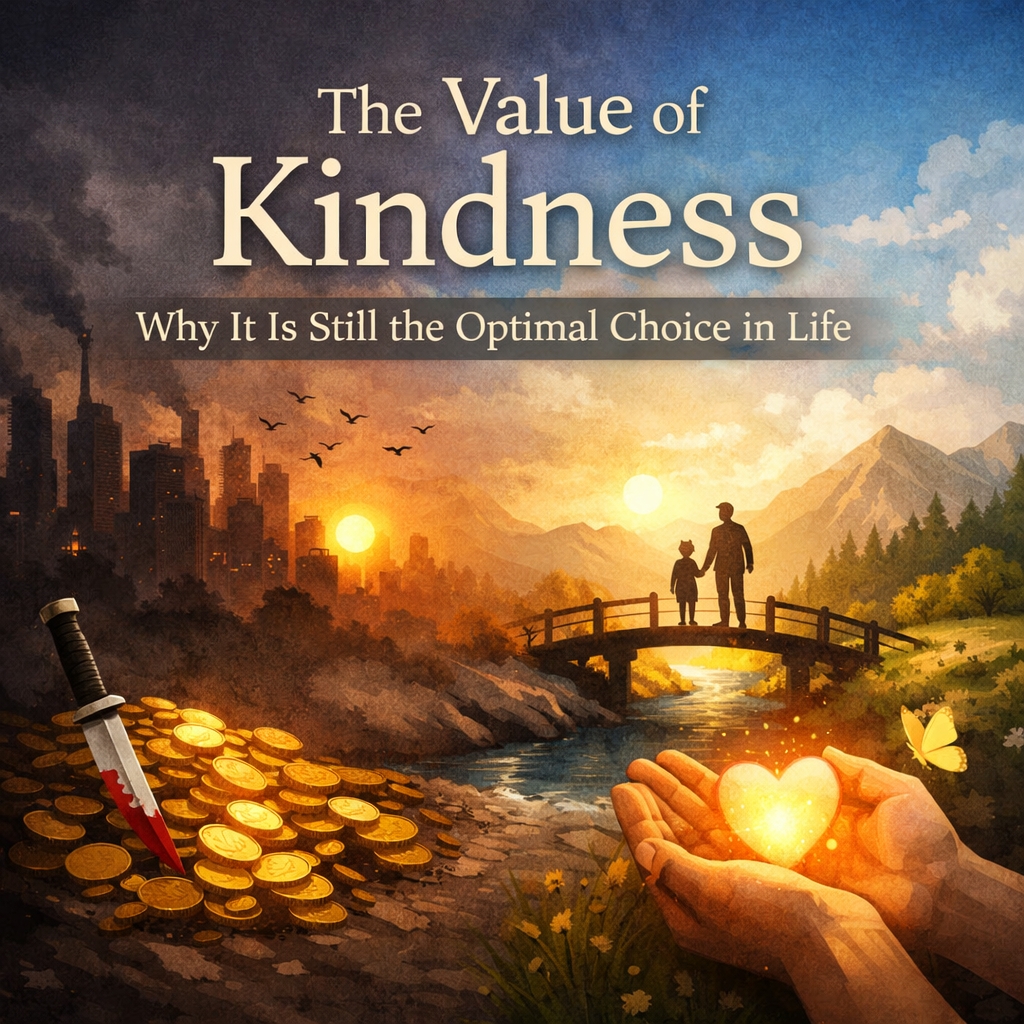
Society often tells us that “nice guys finish last.”
In Chinese folklore, there is an old saying:
“Those who kill and burn grow rich, while those who build bridges and repair roads die unburied.”
There is also the familiar phrase: “Kind people are easily bullied.”
Taken together, these sayings seem to point to the same conclusion: kindness is not only useless, but harmful. Good people are not only taken advantage of while alive, but may even end up forgotten after death.
Naturally, this leads many to ask: if kindness only holds us back from reaching our own “stars and oceans,” then why should anyone choose to be kind?
In my view, this line of thinking is based on a fundamental misunderstanding of what kindness actually is. In many cases, it is nothing more than a conceptual sleight of hand. Today, I want to talk about what kindness really means—and why, even from a purely self-interested perspective, kindness remains the optimal choice for most people.
1. What Kindness Really Is
At its core, kindness is altruism grounded in empathy.
Imagine this scene: on a cold street, you see a stranger who is hungry, freezing, and penniless. Most people would not hesitate to spend a small amount of money to buy that person a meal. Objectively speaking, this action brings no material benefit to ourselves.
So why do we do it?
Because we can feel their suffering.
This capacity is called empathy.
Empathy is not something forcefully instilled through moral education; it is part of human nature. Even very young children can feel distress when they see others in pain. As people grow, they gradually learn to anticipate which actions may harm others, and instinctively restrain themselves from causing such harm.
This empathy-driven concern for others is what we call kindness.
2. Why Kindness Has an Evolutionary Advantage
From an evolutionary standpoint, kindness is not a burden—it is a survival strategy.
Once our ancestors descended from the trees and entered the age of gathering and hunting, solitary survival became increasingly difficult. Human beings are physically limited; cooperation was often essential to securing food and staying alive.
So the question becomes: who is worth cooperating with?
Beyond physical strength and experience, one factor matters greatly:
Is this person willing to sacrifice others for personal gain?
No one wants to collaborate with someone who is constantly calculating, exploiting, or ready to stab others in the back. In contrast, a person capable of empathy and altruism signals safety—a reliable member of the group.
Within early human communities, caring for the elderly, the weak, and children was also crucial for maintaining cohesion. All of this depended on empathy and kindness. Over the long course of evolution, individuals lacking empathy were more likely to be filtered out.
In modern society, we even have a term for extreme empathy deficits: antisocial personality. The name itself reveals how society views such individuals.
From the dawn of humanity to the present day, cooperation has always been central to individual survival and collective continuity.
3. Why We Instinctively Gravitate Toward Kindness
When choosing a partner—whether in work, friendship, or life—you are unlikely to pick someone who might exploit you, deceive you, or betray you at any moment.
This is where kindness plays a critical role: it dramatically lowers the cost of trust.
This preference is not purely rational; it is deeply instinctual. We cry during movies that depict acts of kindness, even though we know the characters are fictional and the events have nothing to do with us personally. This emotional response reflects humanity’s innate attraction to goodness.
For most ordinary people, this means:
- You do not need to be exceptionally handsome or beautiful.
- You do not need extraordinary talent or brilliance.
- You do not need rare skills or special advantages.
Simply being kind allows you, in many cases, to earn goodwill and trust—opening the door to cooperation.
Kindness is a low-barrier, low-cost, yet long-term competitive advantage.
4. Is “Being Bullied” Really Caused by Kindness?
If kindness is so valuable, why is it so often portrayed as a weakness?
The answer lies in a subtle but common conceptual substitution.
- You lose an argument because you cannot articulate your thoughts: “I’m just too kind.” That is not kindness—it is poor communication skills.
- You get scammed: “I trusted people too easily because I’m kind.” That is more likely a lack of experience.
- You are repeatedly mistreated: “Kind people are always bullied.” More often, the root cause is weakness, lack of boundaries, or insufficient courage to resist.
Many people subconsciously prefer to blame kindness for their failures because admitting personal shortcomings is painful. Kindness becomes a convenient psychological shield.
5. Does Kindness Come at a Cost?
Yes—kindness is not always free.
Buying food for a homeless person is a small but real financial loss. Acting kindly toward strangers when information is incomplete may increase the chance of short-term disadvantage.
But there is a crucial counterbalance:
Deception and calculation are extremely difficult to sustain over time.
People who rely on manipulation face growing risks of exposure. Once revealed, cooperation ends, reputations suffer, and future interactions become more costly.
Scheming is inherently short-term in nature.
Some may argue: “I only care about short-term gains.” That is possible—but being a villain is far more demanding than being a good person. Pretending to be good while acting selfishly requires constant vigilance, emotional labor, and risk management.
Even if successful, the reward is temporary.
For most people, this path is neither efficient nor sustainable.
6. The Real Cost of Being Unkind
Being unkind carries heavy social and psychological costs.
Take the Jiang Ge case in China as an example. One individual involved did not violate the law, but a series of actions widely perceived as deeply unkind resulted in lasting public condemnation. Even changing names failed to erase the stigma.
Living under such scrutiny would be unbearable for most people.
Kind individuals, at the very least, do not have to bear this burden.
7. Kindness Is Not a Cure-All
Some may ask:
“If I’m kind, why is my life still a mess?”
The answer is simple: kindness is necessary for a good life, but it is not sufficient.
Being kind does not guarantee:
- Passing exams
- Promotions or raises
- Professional success
Kindness reduces trust costs and increases opportunities for cooperation, but it cannot replace competence, knowledge, or skill.
Blaming all failures on kindness is itself a misjudgment.
8. Kindness and How We Raise Children
Some adults, wounded by society, teach their children to be calculating and cunning, believing this will protect them from harm.
But those who lack kindness often become people who bully the weak and fear the strong.
And the first victims of such behavior are usually the parents themselves.
This mindset underestimates the complexity of society and overestimates the long-term effectiveness of small tricks—often at the cost of a child’s future.
9. Conclusion: Preserve Kindness, Learn Discernment
In summary:
- Kindness is rooted in empathy
- It is a trait preserved through human evolution
- It significantly lowers the cost of trust and cooperation
- For most people, it is the highest-return life strategy available
This does not mean being naïve.
We must learn discernment, establish boundaries, and resist injustice when necessary—without abandoning kindness.
The world contains both light and darkness. Do not let the existence of darkness erase the fundamental color of life.
Even if our lives ultimately prove unremarkable, at least the journey itself can remain kind and warm.
原文
善良的价值:为什么它仍然是人生的最优解
社会常常告诉我们:人善被人欺,马善被人骑。但这,真的是善良的错吗?
在《增广贤文》有句广为流传的话:“杀人放火金腰带,修桥补路无尸骸。”民间也有“人善被人欺,马善被人骑”的说法。这些话似乎在反复强调一个结论:善良不仅无用,甚至有害——好人不但容易被欺负,还可能落得下场凄惨。
于是,很多人开始怀疑:如果善良只会阻碍我们走向“星辰大海”,那做人到底为什么要善良?
但在我看来,这些说法更多是一种对善良的误解,甚至是偷换概念。今天我们就来聊一聊:什么是善良,以及为什么哪怕站在“利己”的角度,善良依然是绝大多数人的最优选择。
一、什么是真正的善良
善良最核心的特质,是建立在共情基础上的利他。
设想这样一个场景:在寒冷的街头,你看到一个身无分文、又冷又饿的陌生人。大多数人,都会愿意花一点钱,给他买一份食物。这件事对我们本人没有任何现实收益,却仍然愿意去做——原因很简单:
因为我们能感受到他的痛苦。
这种能力,叫做共情。
共情并不是后天教育强行灌输的道德说教,而是人的一种本能。一个很小的孩子,就已经能对同类的痛苦产生反应。随着成长,人会逐渐学会判断:什么样的行为会伤害他人,并本能地减少这些行为。
这种源于共情、指向他人的品质,就是善良。
二、善良为何有“进化优势”
从进化的角度看,善良并非负担,而是一种生存策略。
自从人类的祖先走下树木,进入采集与狩猎时代,单打独斗往往意味着失败。人类受限于自身的体能和速度,必须通过合作才能获得足够的资源。
那么,什么样的人值得合作?
除了体力和经验,更重要的是:
他会不会为了多拿一点好处,不择手段地牺牲你?
没有人愿意与一个只顾自己利益、随时可能背刺队友的人合作。相反,一个具备共情能力、愿意在关键时刻利他的个体,会被视为“安全的同类”。
在族群内部,照顾老弱、妇孺,同样依赖共情与善良。这种品质,保证了族群的凝聚力,也决定了谁更可能被长期接纳。
也正因为如此,在漫长的进化过程中,缺乏共情能力的人更容易被淘汰。到了现代社会,我们甚至给这种极端缺乏共情的人一个明确的名字:反社会人格。从这个称呼本身,就能看出社会的态度。
三、为什么我们会本能地亲近善良
当你选择一个合作对象时,你几乎不可能主动选择一个:
- 可能占你便宜
- 可能利用你
- 甚至可能在背后捅你一刀的人
善良,在这里的作用非常直接——它显著降低了信任成本。
而这种偏好不仅是理性的判断,更是一种本能。我们在电影中看到感人的好人好事,明知道是演员演出来的、与自己毫无关系,却仍然会被感动得泪流满面。这正是因为,人类对善良有着天然的情感回应。
因此,对绝大多数普通人来说:
- 你不需要玉树临风
- 不需要才高八斗
- 也不需要身怀绝技
只要你是一个善良的人,就已经能在很大程度上赢得他人的好感与信任,从而获得合作机会。
善良,是一种低门槛、低成本,却长期有效的竞争优势。
四、“人善被人欺”,真的怪善良吗?
那么问题来了:
既然善良这么有价值,为什么现实中却常常把它描述得如此“糟心”?
在我看来,这里发生了一次典型的概念偷换。
- 吵架时说不出话,被人按在地上摩擦:
“哎,都是因为我太善良。”
其实这不是善良,而是表达能力不足。
- 被人骗了:
“我就是太善良,太容易相信人。”
这更可能是社会经验不足。
- 被人长期欺负:
“人善被人欺。”
实际原因往往是软弱、缺乏边界感或反抗能力。
很多时候,我们更愿意把失败归咎于“善良”,而不是直面自己的短板。因为承认不足是痛苦的,而把善良当作挡箭牌,心理成本更低。
五、善良真的没有代价吗?
当然要承认:善良并非永远零成本。
比如,你出于同情给流浪汉买了一份食物,这笔钱大概率不会有任何回报。从短期看,确实是一次损失。
再比如,在完全不了解对方为人的前提下,善良的一方,在博弈中吃亏的概率,可能会更高。
但问题在于:
算计,是一种极其难以长期维持的行为。
喜欢算计他人的人,随着时间推移,暴露风险会越来越高。一旦被识破,轻则合作终止,重则名誉受损,后续合作成本成倍增加。
算计,本质上追求的是短期收益。
有人可能会说:“我就喜欢短期狠狠干一票。”可以,但现实是:
- 做坏人的难度,远高于做个好人
- 伪装成好人的坏人,难度更是指数级上升
你需要时刻戴着面具,机关算尽,还要承受随时翻车的风险。即便成功,也只换来一次性的收益。
对绝大多数普通人而言,这并不划算,也不现实。
六、恶人的真实代价
恶人并不好当。
以江歌案中的刘鑫(后改名)为例。他并未触犯法律,却因一系列明显违背基本善良的行为,被长期钉在道德的耻辱柱上。哪怕试图改名,也迅速被识破,承受着长期的社会谴责。
这种代价,远比一次吃亏要沉重得多。
善良的人,至少不必承受这样的精神与社会成本。
七、善良不是万能药
有些人会问:
“我这么善良,为什么生活还是一地鸡毛?”
这里必须说清楚一点:
善良是好好生活的重要前提,但它不是全部。
这就好比:
- 善良 ≠ 考试一定及格
- 善良 ≠ 一定升职加薪
善良能降低信任成本,增加合作机会,但不能替代能力、认知、专业水平。
把一切失败都归因于善良,本身就是一种误判。
八、关于孩子与善良的教育
有些人在社会中受过伤,就会在教育孩子时,刻意教他们算计、耍心眼,认为这样才能“不被欺负”。
但真正缺乏善良的人,往往:
- 恃强凌弱
- 欺软怕硬
而第一个承受这种后果的,往往正是父母自己。
这种教育,既低估了社会的复杂性,也高估了小伎俩的长期价值,最终可能害了孩子一生。
九、结语:守住善良,也学会判断
归根结底:
- 善良建立在共情之上
- 是人类被长期选择下来的品质
- 能显著降低合作中的信任成本
- 对绝大多数人而言,是性价比最高的人生策略
当然,这并不意味着天真。
我们要学会判断、学会设立边界、学会对不公正进行反抗,但不必因此放弃善良。
面对复杂的世界,别因为看见阴暗,就否定光明。
即便人生最终乏善可陈,至少它的过程,仍然是善良而温暖的。