From childhood, we are taught to be good, to be kind, to be honest, and to respect authority.
Yet no one explains the other side of the story:
Human nature is far more complex than moral slogans.
It contains no pure good and no pure evil—only shifting states influenced by context, incentives, and pressure.
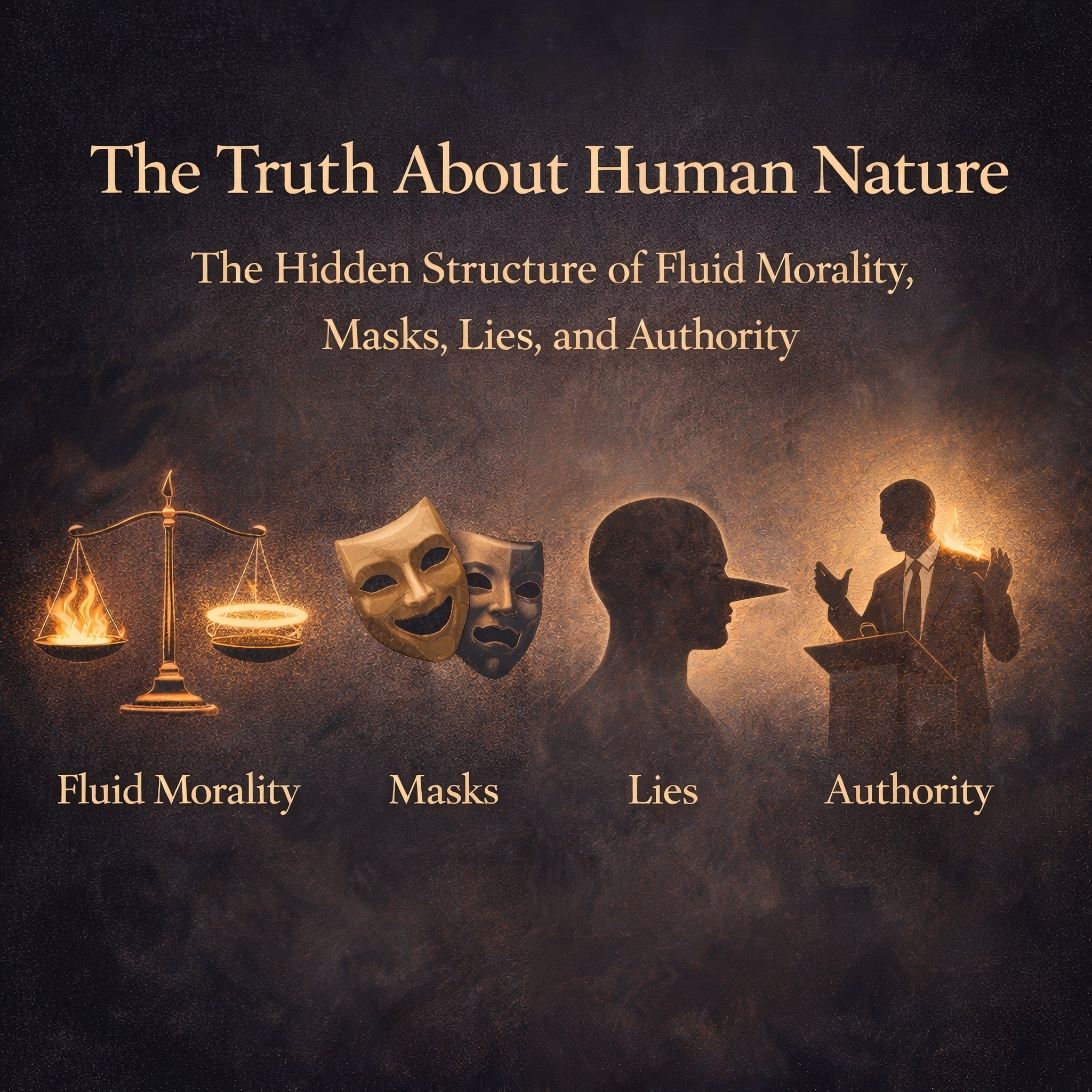
This article approaches human nature through four dimensions rarely discussed in public education:
- Fluid Morality (善恶的流动性)
- The Masks We Wear (人性的多面具)
- The Inevitability of Lies (人人都会说谎)
- The Trap of Authority (权威与服从)
I. Fluid Morality: Good and Evil as Shifting States
There are no purely good people or purely bad people.
Most individuals are neither saints nor villains, but situational beings whose behaviors change based on incentives, stress, or social pressure.
Consider the following case:
- Person A gives up their seat to a pregnant woman → “good person”
- Person B steals copper wire to buy food → “bad person”
- Person C jumps into a frozen lake to save a stranger → “good person”
- Person D breaks into homes to steal → “bad person”
But what if A, B, C, and D are the same individual?
Suddenly, all moral labels fall apart.
One person can be:
- Kind in the morning
- Desperate at noon
- Heroic in the afternoon
- Criminal at night
This is not fiction—it is human nature.
Example: The Train Station Experiment
When a train is about to depart and the queue is longer than the ticketing capacity, behavior divides by position:
- Front 1–30: follow rules, no cutting
- Back 41–60: higher tendency to cut the line
- Middle 30–40: oscillate between the two behaviors
The determining factor is not morality, but:
- Immediate benefit
- Social cues
- Emotional climate
Therefore:
Human beings are not defined by moral identity, but by situational incentives.
II. Masks: The Social Persona vs. the Real Self
Psychologist Carl Jung called this the Persona—the mask we wear in public to gain acceptance and avoid conflict.
We see this every day:
- Different tones for bosses vs. friends
- Obedience when watched, indifference when not
- Smiling while internally collapsing
- Pretending to agree to avoid confrontation
People are not hypocritical by preference—
they are strategic by necessity.
Showing sorrow is socially expensive.
Showing anger is risky.
Showing doubt invites pressure.
Thus society becomes a balancing act between authenticity and safety.
As La Rochefoucauld observed:
“We are all masked to leave the impression we believe most suitable.”
Masks are not moral failures—they are social survival mechanisms.
III. Lies: A Civilizational Strategy, Not a Moral Flaw
No human can be completely honest.
Lying is not only common—it is functional.
Major motives for lying include:
- Avoiding conflict
- Preserving dignity
- Gaining advantage
- Escaping punishment
- Protecting others
- Politeness
- Managing relationships
Research shows that nearly one quarter of lies are altruistic.
Two everyday examples:
A: “How are you lately?”
True answer: “Depressed, confused, broke, anxious.”
Actual answer: “I’m okay.”
Or:
A: “Good morning!”
True feeling: “Not good at all.”
Actual answer: “Good morning.”
If everyone spoke with raw honesty, society would collapse into:
- Constant conflict
- Fractured relationships
- Emotional chaos
- No social buffering
Thus:
Lies are a by-product of civilization, not a symptom of decay.
Our job is not to eliminate lies, but to classify them:
- Malicious lies → must be confronted
- Destructive lies → must be resisted
- Defensive lies → must be understood
- Elegant lies → maintain social order
This perspective is maturity.
IV. Authority: The Hidden Danger of Obedience
Perhaps the most underestimated feature of human nature is:
The instinct to obey authority.
Yale’s 1961 Milgram Experiment demonstrated that 66% of ordinary people were willing to administer dangerous “electric shocks” to strangers under authoritative instruction.
They complied not out of cruelty, but:
- Authority pressure
- Diffused responsibility
- Habitual obedience
This explains:
- Why scammers pose as “experts” or “officials”
- Why advertisements use “professional endorsements”
- Why masses follow emotional leaders
- Why tragedies happen in hierarchies
In aviation, studies show:
20% of crashes occur because co-pilots won’t challenge the captain.
The key insights are:
- Authority is not equal to correctness
- Authority can be manufactured
- Authority frequently makes poor decisions
- Authority amplifies compliance
- Authority requires humility to be safe
Blind obedience is not virtue—it is structural danger.
Conclusion: Understanding Human Nature Is Self-Protection
When we peel back the moral slogans, four truths emerge:
- Humans are morally fluid
- Everyone wears social masks
- Everyone lies to maintain order
- Most people obey authority instinctively
This is not pessimism.
This is realism.
There is a crucial difference between the two:
Pessimism is fear of the world.
Realism is understanding the world to survive it.
And finally, remember this:
You can choose not to harm others—that is conscience.
But you must learn not to be harmed—that is skill.
Understanding human nature is not for manipulation,
but for protection and maturity.
原文
人性真相:善恶流动、面具、谎言与权威的隐秘结构
关于“人性”,我们从小接受的教育往往是:
要做一个好人,要善良,要诚实,要尊重权威。
但父母不教,学校不讲,社会不提醒的是:
人性远比这些道德标签复杂得多。
它没有绝对的好与坏,而是不断在不同情境中切换的状态。
本文从四个部分走入你从未被告知的人性真相:
- 善恶的流动性
- 人性的多面具现象
- 人人都会说谎的必然性
- 权威的陷阱与服从心理
一、善恶不是标签,而是状态
世界上没有绝对意义的“好人”或“坏人”。
大多数人既不是圣人,也不是恶魔,而是在不同情形下呈现不同面貌。
一个经典案例可以说明这一点:
- A 在公交上给孕妇让座 → 你会说他是好人
- B 偷电缆换饭吃 → 你会说他是坏人
- C 冬天跳湖救人 → 你会说他是好人
- D 入室行窃伤人 → 你会说他是坏人
但当我们得知 ABCD其实是同一个人,
所有道德判断瞬间崩塌。
原来一个人可以:
- 某时善良
- 某时自私
- 某时勇敢
- 某时犯罪
所以,善恶更接近于状态,而不是身份。
心理学实验同样揭示这一点。
火车站排队实验
当火车发车在即,且排队人数大于出票速度时,不同排位的人会出现不同行为倾向:
- 排前 1〜30 位的人 → 遵守规则,不插队
- 排后 41〜60 位的人 → 出现插队冲动
- 排 30〜40 位中间区 → 在善恶之间摇摆
而真正决定行为的不是道德,而是:
利害关系 + 外部示范 + 群体氛围
所以,人性的底层是:
人不是绝对善恶,而是根据环境权衡利弊的生物。
二、每个人都在戴面具:虚假的自我与真实的防御
现实生活中,每个人都拥有多张“人格面具”。
荣格称之为 Persona(人格面具):
是我们向外展示、为了获得认可的那一面。
它体现为:
- 见人说人话
- 见鬼说鬼话
- 领导在 → 勤恳努力
- 领导不在 → 摸鱼松懈
- 讨厌老师 → 仍表现乖巧
- 内心崩溃 → 仍笑着社交
我们并非喜欢虚伪,而是害怕真实的代价。
因为:
- 把悲伤写脸上 → 会弱势
- 把愤怒表达出来 → 会冲突
- 把质疑直接说出 → 会付代价
所以社会最终变成:
虚伪与真实的动态平衡。
法国思想家拉罗什福科说:
“所有人都试图向他人留下自己认为最合适的印象,因此人人都在伪装。”
这不是道德问题,而是社会生存机制。
三、人人都会说谎:不是道德堕落,而是进化策略
没人能完全做到绝对诚实。
因为说谎本身就是一种心理与生存策略。
研究显示,人们说谎的常见动机包括:
- 避免尴尬
- 保护面子
- 获得利益
- 避免惩罚
- 满足虚荣
- 社交礼仪
- 维护关系
更惊讶的是:
超过 1/4 的谎言是为他人着想。
例如:
A:早上好!
B(真实想说):一点也不好,我被情绪和工作压着喘不过气。
但 B 最终会选择:
→ “还不错。”
再例如:
A:你最近过得怎么样?
真实回答可能是:
→ “焦虑、沮丧、穷、迷茫。”
但我们更常回答:
→ “还行吧。”
因为如果人人都绝对真实,这个世界会变成:
- 矛盾爆炸
- 冲突不断
- 社会失序
所以:
谎言是人类文明维持秩序的副产品。
我们能做的不是消灭谎言,而是:
- 识别恶意谎言
- 抵制破坏性谎言
- 理解防御性谎言
- 学会承担说谎成本
四、权威的陷阱:服从是一种危险的本能
觉醒后你会发现:
人类有一种被低估的危险弱点——盲目服从权威的倾向。
1961年耶鲁大学的米尔格拉姆实验揭示:
66% 的普通人愿意在权威命令下对陌生人施以极端“电击”。
他们之所以服从,不是邪恶,而是:
- 权威压力
- 责任外迁
- 服从惯性
这解释了:
- 为什么骗子喜欢包装成“专家”“大师”“教授”
- 为什么广告喜欢请“权威人士背书”
- 为什么群众容易被操控
- 为什么灾难中副手不敢反抗上位者
航空统计甚至显示:
20%的空难是副驾驶不敢纠正机长导致。
最终结论是:
- 权威不等于真理
- 权威有时是包装出来的
- 权威可以犯荒唐的错
- 权威是一把双刃剑
- 真正的权威需谦逊与克制
盲从权威不仅愚蠢,也危险。
结语:认识人性才能保护自己
当我们重新理解人性时,会有三个重要顿悟:
- 人人都是潜在的善与恶的混合体
- 人人都戴面具以适应社会
- 人人都会说谎以维护秩序
- 人人都会在权威前失去判断
这不是悲观主义,而是现实主义。
最后送你一句非常重要的话:
你可以选择不害人,那是你的良知;
但你必须具备不被人伤害的能力,那是你的本事。
理解人性不是为了玩弄别人,
而是为了不被别人玩弄。