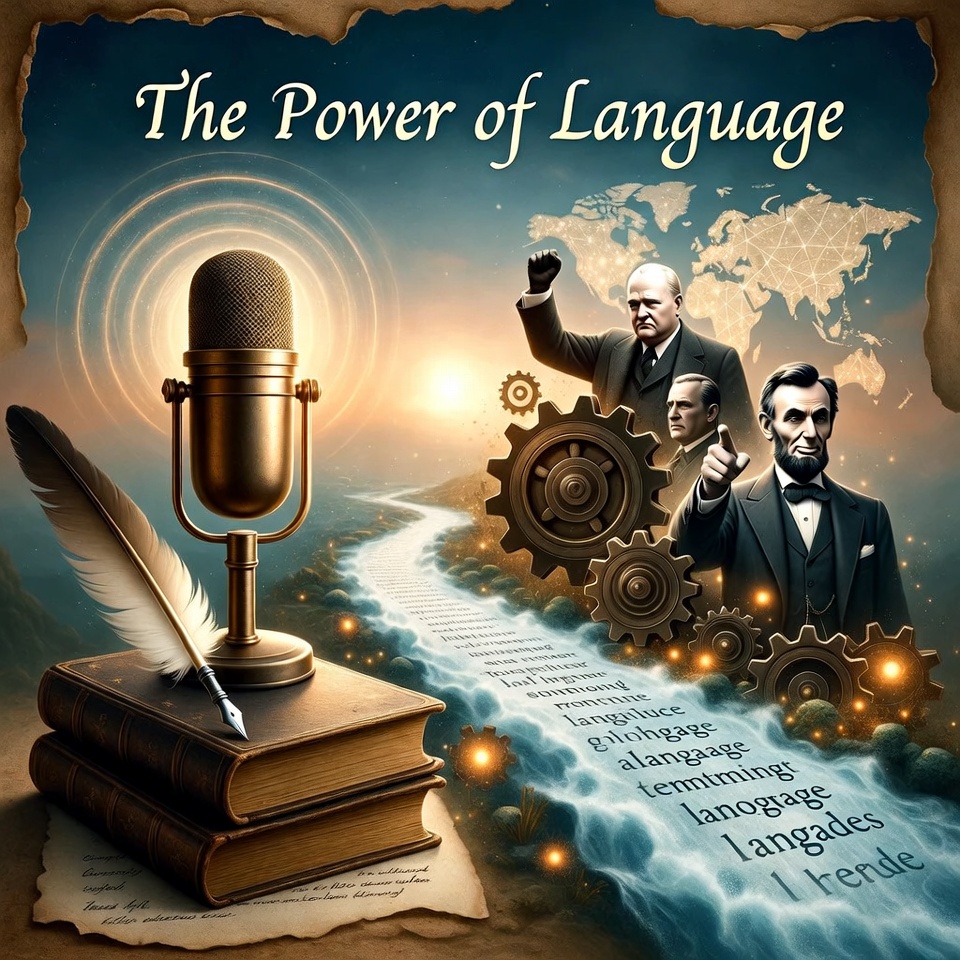
Accuracy, Logic, and Restraint: Three Steps to Training Clear Thinking
In a world without magic, language might be one of the most underestimated powers an ordinary person can possess.
1. Magic in a Low-Magic World
We live in what you might call a low-magic world.
What does that mean?
Simply put, it’s a world where supernatural powers are almost nonexistent.
When you leave your house in the morning, you don’t have to worry about someone around the corner suddenly summoning a fireball the size of a bathtub and throwing it at your face. No one is going to destroy the moon with a burst of energy just because they’re in a bad mood.
Most people’s lives unfold within ordinary, mundane, sometimes even slightly dull realities.
But if there is one ability that ordinary people can cultivate that comes close to something like magic, I believe it is this:
Language.
In other words — speaking.
Language carries a kind of authority. It is a form of power.
At this point, someone might say:
“Come on. Are you exaggerating? Words can’t possibly have that kind of power.”
So let me ask a question.
How did Hitler rise to power?
Anyone even slightly familiar with history knows the answer:
Public speeches.
Through relentless and highly emotional speeches, he mobilized massive social sentiment within just a few years — eventually dragging an entire nation, and then the world, into catastrophe.
Leaving aside moral judgment for a moment, one fact remains undeniable:
Language can change the world.
Language can provoke war.
Language can bring peace.
It can push people into the abyss —
or send them soaring to unimaginable heights.
As the old saying goes:
A single sentence can build a nation.
A single sentence can destroy one.
2. The Most Powerful Weapon in History
History offers countless examples of language shaping reality.
In 1940, much of Europe had already fallen under Nazi control. France was on the brink of surrender. Britain stood alone, and even within the country there were voices suggesting negotiation with Germany.
At that critical moment, British Prime Minister Winston Churchill delivered one of the most famous speeches in history:
“We shall fight on the beaches,
we shall fight on the landing grounds,
we shall fight in the fields and in the streets,
we shall fight in the hills;
we shall never surrender.”
Objectively speaking, those words did not change Britain’s military strength.
But they changed something far more important:
The nation’s spirit.
A society on the verge of despair was suddenly unified again.
Another example is Abraham Lincoln.
In 1863, during the darkest period of the American Civil War, Lincoln delivered a speech at the dedication of the Soldiers’ National Cemetery in Gettysburg.
The speech contained only 272 words.
Yet one sentence from it became immortal:
“Government of the people, by the people, for the people.”
With just a few minutes of speaking, Lincoln redefined the political ideal of an entire nation.
Many speeches last for hours and are quickly forgotten.
But those 272 words have endured for more than a century.
The reason is simple:
The clearer the language, the greater its power.
3. True Eloquence Is Not About Tricks
When people talk about communication skills, they often focus on techniques:
- How to refuse someone politely
- How to agree smoothly in conversation
- How to compliment others without sounding insincere
- How to appear emotionally intelligent
These techniques can be useful.
But many people overlook the most fundamental principle:
Say things clearly.
Here, “clearly” does not mean clear pronunciation.
Pronunciation matters, of course — but some people simply aren’t born with ideal speaking conditions.
For example, I happen to have what doctors call a short lingual frenulum — essentially a tongue that’s a bit short and thick.
When I record audio, I often have to articulate every word very deliberately, and sometimes I need several takes to get a sentence right.
If clarity were only about pronunciation, I probably wouldn’t have much hope.
But clarity here refers to something else:
Clarity of expression.
That means:
- Clear information
- Clear logic
- Clear purpose
Earlier we said that intelligence is essentially a habit of thinking.
So here’s an interesting question:
If we consciously train our way of expressing ideas, could language in turn reshape the way we think?
The answer is yes.
People who can express themselves clearly are very often people who think clearly.
Language is, in many ways, a shortcut to clear thinking.
And the path toward it can be broken down into three simple steps.
4. Step One: Use Precise Words
Precision in language is the foundation of clear expression.
For example, imagine I say:
“After reading this article, feel free to leave a comment.”
That works perfectly well.
But if I were to use a slightly different word that only roughly means the same thing, the sentence might still be understandable — yet subtly less precise.
Many people would shrug and say:
“The meaning is basically the same. Why be so picky?”
But here’s the issue:
Precision in language trains precision in thought.
If someone habitually speaks in vague terms, their thinking often becomes vague as well.
There is even a common style of storytelling that I like to call “verbal car-crash narration.”
Someone might explain an event like this:
“So I went to see that guy about that thing, and then it kind of turned into… you know… that situation, and I felt kind of… well, you know…”
Whenever I hear this, I feel a strong urge to finish their sentences for them.
5. Step Two: Make Your Logic Visible
The word “logic” often intimidates people.
But it doesn’t have to be complicated.
Here is a very simple technique:
Use connective words.
Words like:
- because
- therefore
- although
- however
- if
- then
- not only… but also
When you develop the habit of structuring sentences with these connectors, logical flaws become immediately noticeable.
These words function like the skeleton of language.
They force your brain to organize ideas before expressing them.
6. Step Three: Eliminate Verbal Noise
The final principle sounds simple but is surprisingly difficult:
Stop saying unnecessary things.
Many people produce large amounts of verbal noise without realizing it.
Once, I saw a woman at a subway service counter trying to exchange a ticket. She explained her situation like this:
“My husband is waiting for me over there, and he keeps calling because he’s worried, and I’m really anxious right now…”
It sounded reasonable.
But from the perspective of the staff member, only two pieces of information actually matter:
- What problem you have
- What you want them to do
Whether her husband was waiting, or how anxious she felt, was irrelevant.
Even if she said:
“The Jade Emperor is waiting for me.”
It still wouldn’t change the ticket policy.
The more irrelevant details we include, the harder communication becomes.
Some people speak as if they were machines that continuously dump information garbage into other people’s minds.
But effective communication is often extremely simple:
“I bought the wrong ticket. Could you help me exchange it for this one?”
One sentence is enough.
7. Language Is the Shell of Thought
Speaking seems simple.
Anyone can open their mouth and make sounds.
But from another perspective, speaking is a deeply complex activity.
It is:
- the structure of logic
- the outer shell of thought
- a projection of how we understand the world
Many people study communication techniques.
But if their speech is filled with:
- imprecise wording
- chaotic logic
- endless verbal clutter
Then no matter how eloquent they sound, something will always feel slightly off.
Because the purpose of language is not performance.
It is two things:
To be understood.
And to be accepted.
When a person begins to deliberately train their expression —
using more precise words,
building clearer logic,
and removing unnecessary noise —
something interesting happens.
What changes is not only the way they speak.
What changes is the way they think.
Clearer expression leads to clearer thinking.
More disciplined language leads to more rational judgment.
Over time, the way a person perceives the world begins to change.
In this world without magic, many people spend their entire lives searching for some force that might transform their fate.
Some hope for talent.
Some hope for opportunity.
Some hope for luck.
Yet one ability has always been within reach.
It is simply this:
The ability to speak clearly.
Language may not be the most glamorous power.
But it may be one of the most overlooked — and one of the most powerful.
Because the real difference between people often lies not in how hard they work.
But in this:
Who understands the world more clearly.
And
Who can articulate that understanding.
In a low-magic world like ours, if ordinary people truly possess a power that resembles magic,
it is probably this:
Language.
Yet most people spend their entire lives speaking,
without ever truly learning how to express themselves.
原文
说话,是普通人最强的“超能力”
——准确、逻辑、克制:三步训练清晰思维
在这个没有魔法的世界里,语言或许就是普通人最容易被忽视的一种力量。
一、低魔世界里的“魔法”
大家都知道,我们生活的世界,是一个低魔世界。
什么叫低魔世界?
简单来说,就是超凡力量几乎不存在的世界。
你早上出门,不用担心有人在街角突然搓出一个洗脚盆大小的火球砸到你脸上;也不会因为谁心情不好,就憋个龟派气功把月亮轰下来。
绝大多数人的人生,都在普通、平淡,甚至有些乏味的现实中度过。
但如果说,在这样一个世界里,普通人还能修炼出某种接近“魔法”的能力,我认为还是有的。
那就是——语言。
也就是说话。
语言是一种可以带着权柄的力量。
看到这里,可能有人会说:
“你这不是在满嘴跑火车吗?说个话还能说出魔法效果来?”
那我反问一个问题。
当年的希特勒,是靠什么起家的?
稍微熟悉历史的人都知道——
演说。
他通过一次又一次极具煽动性的公开演讲,在几年时间里聚集了巨大的社会情绪,最终把整个国家拖入战争,也把世界拖进了一场灾难。
我们暂且不讨论价值观,只看一个事实:
语言,真的可以改变世界。
语言可以挑动战争,也可以带来和平;
可以让人坠入深渊,也可以让人一飞冲天。
所谓:
一言兴邦,一言丧邦。
二、历史上最有力量的“武器”
历史上,语言改变世界的例子并不少见。
1940年,欧洲几乎已经被纳粹德国席卷。法国即将投降,英国孤立无援,国内甚至出现了“是否应该与德国谈判”的声音。
就在这个时候,英国首相丘吉尔发表了一段后来被历史反复引用的演讲:
我们将在海滩作战,我们将在登陆场作战,我们将在田野和街道作战,我们将在山丘作战。
我们绝不投降。
客观来说,这段话并没有改变英国的军事实力。
但它改变了一件更重要的事情:
整个国家的精神状态。
一个濒临崩溃的社会,被重新凝聚了起来。
再比如美国总统林肯。
1863年,美国南北战争最惨烈的时候,林肯在葛底斯堡阵亡将士公墓发表了一次演讲。
这次演讲只有272个词。
但其中一句话却成为历史名言:
Government of the people, by the people, for the people.
民有、民治、民享的政府。
林肯只用了几分钟,却重新定义了一个国家的政治理念。
很多演讲长达几个小时,没有人记住。
而这272个词,却被历史记住了一百多年。
原因其实很简单:
越清晰的语言,越有力量。
三、真正的口才,不是技巧
很多人一提到口才,就会想到各种说话技巧,比如:
- 拒绝别人时应该怎么说才委婉
- 聊天的时候要顺着对方的话
- 赞美别人要怎么说才不显得油腻
- 如何说话显得情商高
这些技巧当然有用。
但很多人忽略了最基础的一点:
把话说清楚。
这里的“清楚”,并不是指吐字清晰。
虽然吐字清晰也很重要,但有些人天生条件确实一般。比如我自己,天生就长了一条又短又胖看起来还有点萌的舌头——医学上叫“先天性舌系带过短”。
所以我录音的时候,经常需要刻意把每个字咬得很清楚,一段话往往要录好几遍。
如果说“说清楚”只是指发音,那我这辈子大概没什么希望。
但这里说的清楚,其实是另一件事:
表达清楚。
也就是:
- 信息清楚
- 逻辑清楚
- 目的清楚
我们之前说过:
聪明,本质上是一种思维习惯。
那么反过来想一个问题:
如果我们刻意训练自己的表达习惯,能不能让语言反过来塑造思维?
答案是:可以。
那些真正能够把话说清楚的人,往往也是思维清晰的人。
语言,其实就是一条通往清晰思维的捷径。
而走上这条路,我把它简单分成三步。
四、第一步:用词准确
准确用词,是清晰表达的基础。
比如我说:
看完这篇文章,大家有什么想说的,可以留言评论。
这没有问题。
但如果我说:
看完这篇文章,大家可以留言评价。
虽然大家也能听懂,但其实并不准确。
很多人觉得:
“反正意思差不多,干嘛那么较真?”
但问题在于——
精准表达是一种思维训练。
如果一个人长期习惯模糊表达,他的大脑也会习惯模糊思考。
生活中还有一种非常典型的表达方式,我称之为:
车祸现场式表达。
比如有人讲事情:
“当时我就去找那个谁办那个事情,然后后来就那样了,我心情就很那个,你说这人是不是就那个……”
每当听到这种表达,我都有一种强烈冲动:
想帮他把句子补完整。
五、第二步:让语言有逻辑
一提到逻辑,很多人就开始头疼。
其实没有那么复杂。
有一个非常简单的小技巧:
多用连接词。
比如:
因为、所以
虽然、但是
如果、那么
不但、而且
当你习惯用这些词表达时,如果逻辑不通顺,你会立刻感觉到不对劲。
连接词就像是语言的骨架。
它会迫使你的大脑把思路整理清楚。
六、第三步:少说废话
最后一个原则,听起来简单,但很难做到:
少说废话。
很多废话,说的人自己完全没有意识到。
有一次我从地铁站出来,看见一位阿姨在服务窗口换票。她大概买错了车票,于是对工作人员说:
“这些票我也搞不清楚,我老公在那边等我,他一直打电话催我,我现在特别着急……”
听起来好像很合理。
但如果你是工作人员,你真正需要的信息其实只有两件事:
- 你遇到了什么问题
- 你希望我帮你做什么
至于她老公在不在等她,她有多着急,其实都没有关系。
哪怕她说:
玉皇大帝在等她。
该换不了票,还是换不了。
废话越多,沟通成本越高。
很多人说话的时候,就像一台机器:
不断往别人脑子里倒垃圾信息。
而真正有效的表达,其实很简单:
“我买错票了,需要换成这一班,可以帮我处理吗?”
一句话就够了。
七、语言,是思维的外壳
说话这件事,看起来非常简单。
上下嘴唇一碰,谁都会。
但从另一个角度看,说话其实是一件非常复杂的事情。
它不仅仅是声音的组合,更是逻辑的体现,是思维的外壳,是一个人认知世界方式的投影。
很多人练习口才,只关注表达技巧:
如何说得好听,如何说得漂亮,如何说得有气势。
但如果:
- 用词不准
- 逻辑混乱
- 废话一堆
再华丽的表达,也只会让人隐约感觉到一件事:
哪里不太对劲。
因为语言的真正目的,从来不是炫技。
而是两件事:
让别人理解。
让别人认同。
当一个人开始刻意训练自己的表达——
让用词更准确,
让逻辑更顺畅,
让内容更克制,
慢慢地,他会发现一件有意思的事情:
改变的并不仅仅是说话方式。
更重要的是思考方式。
表达越清晰,思维越清晰;
语言越克制,判断越理性。
久而久之,一个人看待世界的方式,也会发生改变。
在这个没有魔法的世界里,大多数人终其一生都在寻找某种能够改变命运的力量。
有人寄希望于天赋,有人寄希望于机会,有人寄希望于运气。
但有一种能力,其实一直握在我们自己手里。
那就是——
把话说清楚。
语言也许不是最耀眼的能力,但它却是最容易被忽视、却又最强大的能力之一。
因为很多时候,人与人之间的差距,并不在于谁更努力。
而在于:
谁能更清楚地理解世界。
以及,
谁能把这种理解,说出来。
在这个低魔世界里,如果普通人真的拥有某种接近“魔法”的能力。
那大概就是——
语言。
只是大多数人,一辈子都在说话,
却很少真正学会表达。