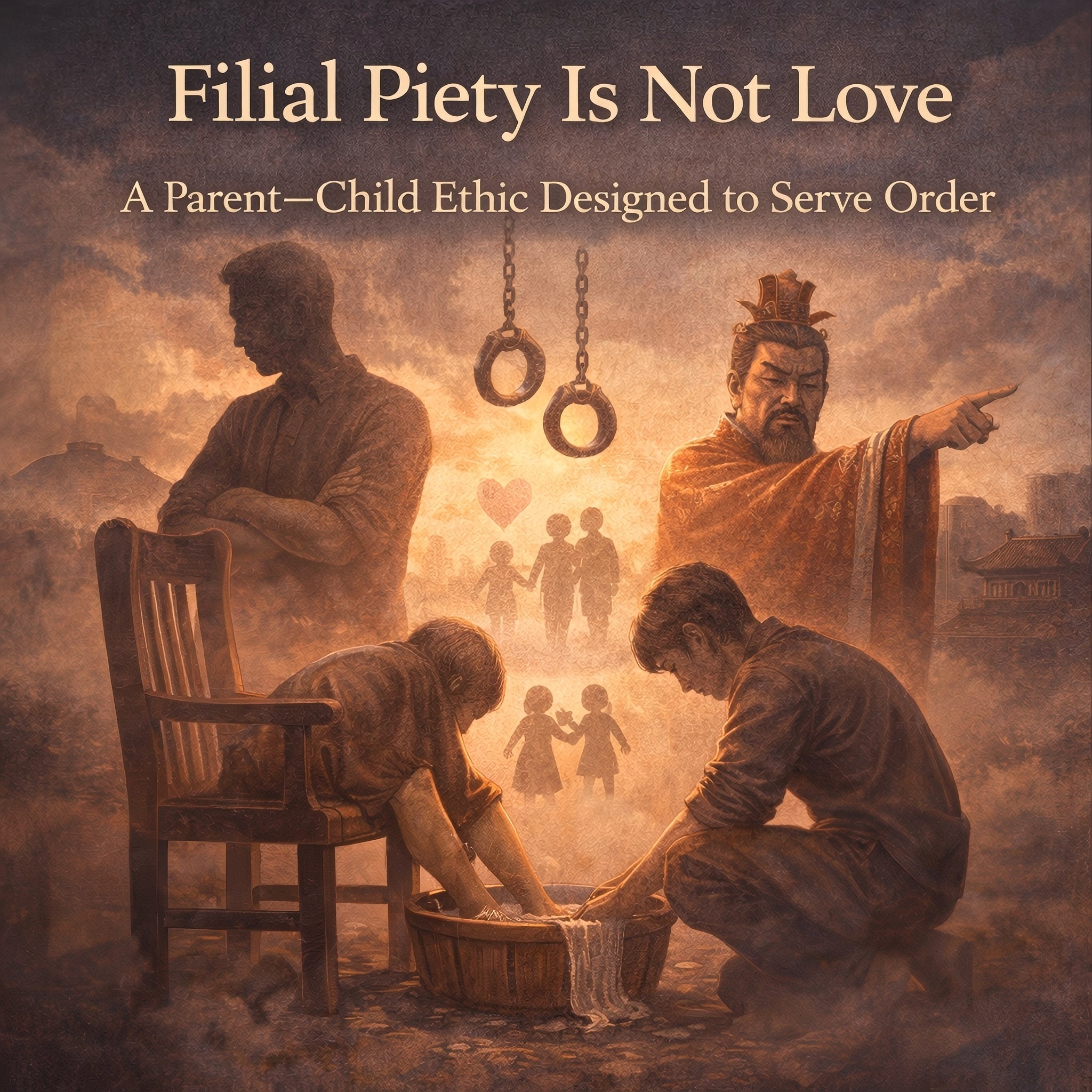
A Parent–Child Ethic Designed to Serve Order
Before we begin, let us ask two seemingly simple questions:
Do parents love their children?
Do children love their parents?
From human instinct alone, or from the emotional bonds built through years of living together, the answers appear obvious.
In most human relationships, mutual care is enough to make the relationship healthy. Yet in parent–child relationships, “love” is often deemed insufficient. Love is seen as too equal, too horizontal, too lacking in hierarchy to properly reflect parental authority.
Thus, “filial piety” is introduced as a higher moral requirement.
Children are told not merely to love their parents, but to be filial.
This raises several critical questions:
- What exactly is filial piety?
- Why is it so insistently promoted?
- And what purpose does it truly serve?
I. The Essence of Filial Piety: Personal Dependence Disguised as Gratitude
On the surface, filial piety appears to be a behavioral norm—a moral guideline for how children should treat their parents and elders.
Structurally, however, it is not an ordinary interpersonal ethic.
Most healthy human relationships rest on two basic principles: equality and reciprocity. Filial piety explicitly rejects both.
Within the discourse of filial piety, children are not equal participants in a relationship, but subordinates expected to obey.
In this sense, filial piety is not love at all.
It is a form of personal dependence, carefully wrapped in the language of gratitude.
Its core is not care, but obedience.
II. Why Filial Piety Is Promoted: A Logic of Governance, Not Emotion
Filial piety has been emphasized throughout history not because it is emotionally profound, but because it dramatically lowers the cost of social governance.
The family is the smallest unit of society, and it is inherently full of conflict:
- Between parents and children
- Between spouses
- Between in-laws
These disputes are notoriously difficult to adjudicate fairly—hence the saying, “Even an honest official cannot resolve family matters.”
When conflicts are constant and right and wrong are difficult to determine, rulers require a solution that is simple, crude, yet effective.
Thus emerged doctrines such as “the father as the guiding authority, the husband as the guiding authority.”
Here, “guidance” does not mean moral example, but structural hierarchy:
- Who holds authority
- Who must submit
The subordinate does not need to judge—only to obey.
Under this logic, family conflict no longer requires moral reasoning. One only needs to identify rank.
III. The Twenty-Four Filial Exemplars: Moral Models Stripped of Humanity
To make filial piety concrete and enforceable, historical culture constructed explicit behavioral templates.
The most notorious is The Twenty-Four Filial Exemplars.
Among them, the story of Guo Ju Burying His Son is particularly revealing.
Facing poverty, Guo Ju decides to bury his three-year-old son alive so that his mother might have more food. While digging the grave, he miraculously discovers gold, allowing him to save the child and earn praise as a paragon of filial virtue.
This story was canonized and taught for generations.
Yet it contains virtually no trace of love.
Other tales are no less disturbing:
- A wife expelled for insufficient reverence toward ancestral tablets
- A daughter-in-law dismissed for serving water too slowly
- Feats involving bodily self-harm or supernatural endurance
These narratives are deeply distorted and profoundly anti-human.
Their purpose is not to teach love, but to produce an ideal subject of unconditional obedience.
IV. Filial Piety and Elder Care: Its Limited Practical Function
Under historical conditions lacking social security systems, filial piety did serve a practical role:
It reduced the social risk of elderly abandonment.
However, this stability came at the cost of fairness.
Within the filial framework:
- Moral correctness is irrelevant to seniority
- In any disagreement, the younger party is automatically wrong
The essence of filial piety lies in the word “obedience.”
To disobey is to be immoral.
The Analects even instruct that if parents refuse correction, the child must continue to obey respectfully, without resentment.
The structural result is clear:
- Those below must accept the permanent correctness of those above
- Those above are rarely subject to challenge
Over time, people are divided into two categories:
Those who are expected to kneel,
and those who are entitled to be knelt before.
V. From Filial Piety to Loyalty: How Private Ethics Become Political Tools
When individuals are conditioned within the family to obey authority unconditionally, extending that logic to society becomes effortless.
Thus emerges a crucial analogy:
The ruler as the father.
If one kneels to parents at home, kneeling to the emperor outside becomes natural.
The phrase “loyal officials come from filial sons” is not a coincidence—it reflects the same obedience logic applied in different arenas.
Loyalty and filial piety are structurally identical.
VI. The Myth of Parental “Indebtedness”
Defenders of filial piety often argue:
“Your parents gave birth to you and raised you. Is that not an immense debt?”
The flaw in this reasoning is simple:
Children never consent to being born.
Bringing a life into the world without its consent cannot, by itself, constitute moral credit.
Failing to raise a child is criminal negligence.
Raising a child is a responsibility, not a benevolent gift.
Caring for offspring is biological instinct; even wild animals do it.
To frame parental obligation as a lifelong debt imposed on the child is moral coercion.
VII. When Parenthood Becomes a Debt Relationship
Under the rhetoric of gratitude, parent–child relationships are quietly transformed into financial metaphors:
- Parents become creditors
- Children are born as debtors
For some parents, children become the only legitimate subordinates they will ever possess.
Control, intrusion, and emotional extraction are rebranded as love and sacrifice.
The most symbolic ritual of this hierarchy is washing one’s parents’ feet.
Feet are culturally associated with dirt. Washing them signifies humiliation and self-lowering.
This is not care—it is a performance of status.
VIII. True Reciprocity Comes from Love, Not Moral Coercion
None of this denies a simple truth:
If parents genuinely give their children authentic love and respect,
children will naturally reciprocate later in life.
But the key condition is this:
Such care must not be self-dramatized or transactional.
Love does not require moral clubs.
A healthy parent–child relationship should look like this:
- Parents as guides and protectors
- Children as independent individuals and continuations of life
Parents earn respect through their character, not through authority.
Conclusion: Filial Piety Is Not Natural—It Is Constructed Order
Parents and children do share a profound natural bond.
But filial piety is not natural instinct—it is a constructed institutional tool.
It is unrelated to love, and exists to stabilize unequal hierarchies.
A society built upon filial obedience is inherently unjust.
Parent–child relationships deserve to be rooted in love, not shackled by moral obligation.
As a widely circulated text once put it:
I did not raise you as a favor, but out of instinct and blood.
Therefore, you owe me nothing.
I thank you, because your presence made my life more complete.
We are companions in each other’s lives,
not creditors and subordinates.
原文
孝顺不是爱:一套为秩序服务的亲子伦理
在开始之前,我们先问两个看似简单的问题:
父母会爱自己的孩子吗?孩子会爱自己的父母吗?
无论从人的天性,还是从长期相处中积淀的情感来看,这两个问题的答案都显而易见。
在一般的人际关系中,只要双方彼此关爱,关系本身就已经是良性的。但在亲子关系中,很多人却并不满足于“爱”本身。他们认为,仅用爱来维系亲子关系显得过于平等,无法体现父母的地位与长辈的权威。
于是,“孝顺”被提出,作为对亲子关系的更高要求。
子女对父母,不该谈爱,而应该谈孝。
那么问题来了:
- 什么是孝顺?
- 为什么要被反复提倡?
- 提倡孝顺,真正的目的是什么?
一、孝顺的本质:被感恩包装的人身依附
从表面上看,孝顺是一种行为规范,是子女对父母与长辈应有的态度。
但从关系结构上看,它并不是一种普通的人际关系。
一般的人际关系,至少遵循两个基本原则:平等与对等。而孝顺恰恰相反,它要求对子女彻底否定这两点。
在孝道语境中,子女的位置不是“对等的关系者”,而是被期待顺从的一方。
因此,孝顺并不是爱,而是一种在“感恩”话术下完成的人身依附。它的核心不是关怀,而是服从。
二、为什么要提倡孝顺:统治逻辑而非情感逻辑
孝顺在历史上之所以被高度强调,并不是因为它有多么动人,而是因为它极大降低了社会治理成本。
家庭是最小的社会单位,而家庭内部必然充满矛盾:
- 父母与子女
- 夫妻
- 婆媳
这些纠纷几乎不可能被逐一公平裁决——所谓“清官难断家务事”。
当是非难辨、冲突不断时,统治者需要一个简单、粗暴但有效的解决方案。
于是,“父为子纲、夫为妻纲”被抬了出来。
这里的“纲”,并不是道德榜样,而是一种依附关系的设定:
- 谁是主位
- 谁是附属
附属者不需要判断,只需要服从。
在这种逻辑下,家庭内部的冲突不再需要讨论是非,只需要确认辈分。
三、《二十四孝》:去人性的“道德样板”
为了将孝顺具体化、可操作化,古人甚至专门编造了一整套行为范本,《二十四孝》便是其中最典型的代表。
其中“郭巨埋儿”的故事尤为荒谬:
因家境贫困,为了让母亲吃饱,郭巨计划将三岁的儿子活埋。就在挖坑时,意外挖出黄金,于是既保住了儿子,又得到了“至孝”的美名。
这个故事被堂而皇之写进教科书,号召天下人学习。
但在这里,我们几乎看不到任何“爱”的痕迹。
类似的故事还有:
- 因对木雕祖先不够恭敬而被休弃的妻子
- 因端水稍晚而被休掉的儿媳
- 用体温融冰、徒手斗虎等近乎超自然的表演
这些故事充满人格扭曲与反人性设定,早已超出正常人类的理解范围。
它们存在的意义,不是为了教人如何相爱,而是为了塑造一种无条件服从的理想人格。
四、孝顺与养老:有限的正面功能
在社会保障几乎不存在的历史条件下,孝顺确实承担过一个现实功能:
降低老无所养所带来的社会风险。
但这种稳定,是以牺牲公平为代价的。
因为在孝道体系中:
- 辈分高低与观点正确与否无关
- 一旦发生分歧,晚辈天然处于错误位置
“孝”的关键,在于“顺”。
不顺,就是错。
《论语》中甚至明确要求:
父母之意,谏之不从,仍须恭敬,不得违逆,不得怨怼。
这种结构带来的直接后果是:
- 在下位时,必须接受上位者永远正确
- 一旦上位,几乎永远无需被质疑
久而久之,人被分成两类:
一类是应该下跪的人, 一类是理应被跪的人。
五、从孝到忠:私人关系如何被国家挪用
当人们在家庭中被反复训练为无条件服从父母, 将这种逻辑平移到社会层面,便显得顺理成章。
于是出现了一个关键类比:
君父。
皇帝被塑造成“天下之父”,
既然在家要跪父母,出门自然要跪皇帝。
“求忠臣于孝子之门”, 并非巧合,而是同一套服从逻辑的不同应用场景。
忠与孝,本质上是一回事。
六、亲子关系中的“恩情神话”
很多人为孝顺辩护时,都会提到一个理由:
父母生你养你,难道不是天大的恩情吗?
但问题在于:
孩子的出生,从来不是孩子自己的选择。
未经同意,将一个生命带到世上,本身并不能构成“恩情”。
生而不养是犯罪, 抚养孩子本就是义务,而非施恩。
照顾幼崽,是生物本能,野生动物也能做到。
将义务包装成孩子一生都还不完的恩情, 本身就是一种道德绑架。
七、当亲子关系被降格为债务关系
在“感恩”话术下,亲子关系往往被悄然转化为一笔交易:
- 父母成为债权人
- 孩子一出生便成为债务人
对某些人而言,孩子甚至是他们一生中唯一可以合法控制的下级。
控制、索取、干预,被包装为爱与牺牲。
而最具象征性的表演,便是“给父母洗脚”。
脚被视为肮脏之物,洗脚意味着卑微与自我压低。
这并非关怀,而是一种地位展示。
八、真正的回馈,来自爱而非道德
当然,如果父母真正给予了孩子充分而真实的爱, 子女在未来回馈父母,是极其自然的事情。
但前提是:
那不是自我感动式的付出。
爱无需道德大棒。
真正健康的亲子关系,应当是:
- 父母作为引路人与保护者
- 孩子作为独立个体与生命延续
父母以自身的人格与努力,赢得孩子发自内心的尊重。
结语:孝顺不是天性,而是被建构的秩序
父母与孩子之间,确实存在天然而深刻的情感联结。
但孝道不是天性,而是后天灌输的制度工具。
它与爱无关,而是为建立不平等秩序服务。
以孝顺为核心构建的社会,天然包含不公平。
亲子关系,更应该以爱为纽带,而不是以孝为枷锁。
正如那封广为流传的文字所说:
我养育你,并非恩情,只是血缘与本能; 因此你无需报答我。 我感谢你,因为有你的参与,我的生命才更加完整。 我们只是彼此生命中的同行者, 而非债主与附属。