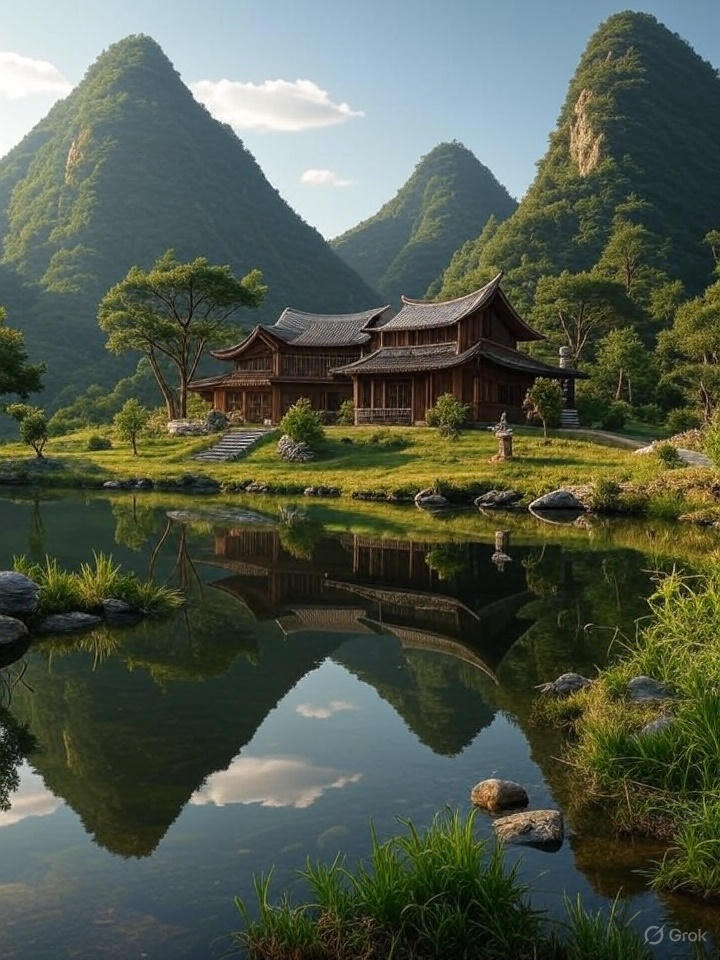
The quality of one’s life is largely influenced by five key factors, often summarized as: first fate, second luck, third feng shui, fourth good deeds, and fifth learning.
“Fate” refers to the innate blueprint you’re born with, like a starting hand of cards. “Luck” represents the cyclical ups and downs we experience – sometimes smooth sailing, other times stumbling blocks. When we say “fate” or “destiny” in everyday language, we’re often combining these two concepts.
So, what about “Feng Shui”? It ranks third, yet its importance is often greater than we imagine. Many people hear “Feng Shui” and think of superstition. But put simply, Feng Shui is about whether your living environment and the spaces around you support your well-being.
For example:
If you live on the first floor with a busy, noisy street right outside your window, leading to poor sleep, that’s considered “bad Feng Shui.” But if you live in a south-facing apartment on a higher floor, blessed with winter sunlight and cool summer breezes, making it quiet and comfortable, you naturally feel better and more energized. That’s “good Feng Shui.” It’s quite straightforward, isn’t it?
The core principle of Feng Shui, as summarized by the ancients, is encapsulated in eight words: “Shelter from wind, gather energy, obtaining water is best” (藏风聚气,得水为上).
This means a favorable spot should block harsh winds, retain positive energy (qi), and ideally have water presence. You can understand it this way: strong winds can scatter energy, while water symbolizes wealth and resources that tend to accumulate and stay.
Therefore, Feng Shui isn’t about mystical charms or spells; it’s wisdom derived from the ancients’ observations of nature and life experience. People in the past, without modern scientific concepts, knew from experience that a location with mountains blocking wind from the north and sunlight exposure from the south would be warmer in winter and cooler in summer – simply more comfortable to live in. In modern terms, it’s about “geographical location + climatic conditions + living comfort.”
Furthermore, Feng Shui isn’t just a relic of the past; it’s arguably even more relevant in modern society. People are increasingly concerned with practical issues: whether their home feels secure, their work goes smoothly, and if their environment supports their life. Take a real-world example: In China, Feng Shui is most emphasized by people in southern regions, particularly in Hong Kong. There’s logic behind this – coastal cities often prioritize market rules and contractual spirit, whereas some inland areas might be perceived as having limited development opportunities due to systemic or environmental issues. Many parents prefer sending their children to coastal cities for development, believing the environment there is more “auspicious” (顺) and offers more opportunities. This, in a broad sense, is Feng Shui.
Hence, some argue: if Feng Shui were completely baseless, why would high-ranking officials, tycoons, and the world’s wealthiest people bother with it? My personal understanding is this: Feng Shui encompasses both scientific aspects of environment and climate, as well as psychological and spiritual elements. In other words, Feng Shui is not just about “whether a place is good to live in,” but also relates to broader conditions like local government integrity, social stability, and the well-being of the people – where the elderly are cared for, the young educated, the poor supported, and those in difficulty aided. This is the truest form of good Feng Shui.
Of course, Feng Shui isn’t a cure-all. What truly shapes one’s life remains “accumulating good deeds” and “continuous learning.” Feng Shui can help you go with the flow, but character and action are the foundation.
In Summary
Ultimately, Feng Shui isn’t about obsessing over which direction a ornament faces or whether to hang a BaGua mirror by the door. It’s a reminder that our environment influences us, and sometimes choice is more important than effort alone.
Finding a comfortable place to live and choosing a suitable environment for your growth is itself an application of Feng Shui. Couple that with self-improvement through learning, accumulating kindness, maintaining a positive mindset, and staying on the right path – this is the most reliable way to cultivate “good luck.”
In a nutshell: Good Feng Shui adds icing on the cake, but being a good person and doing solid work is the cake itself – the essential foundation.
So, rather than worrying about whether Feng Shui is accurate, focus first on living your life with clarity and purpose.
原文
一命二运三风水:风水真的影响命运吗?
人这一辈子,过得好不好,大体上有这么五个因素:一命、二运、三风水、四积德、五读书。
“命”是天生的格局,像一张底牌;“运”是阶段性的起伏,有时候顺风顺水,有时候磕磕绊绊。我们平常说“命运、命运”,其实就把这两个词合在一起了。
那“风水”呢?它排在第三,却常常比我们想象的重要。很多人听到风水,会觉得是迷信,其实换句话说,风水讲的就是:你住的环境、你身边的空间,对你的生活有没有帮助。
举个例子:
你住在一楼,窗外就是马路,车来车往很吵,晚上也睡不好,这就是“风水不好”。可如果你住在南向的高层,冬天有阳光,夏天有风穿堂,安静舒适,人自然精神爽利,这就是“风水好”。是不是很简单?
古人总结风水的核心就是八个字:“藏风聚气,得水为上。”
意思是说,好地方要能挡风、能留住气场,还最好有水。你可以理解为:风太大,能量容易被吹散;有水,就像财富和资源,会留下来,不至于流失。
所以风水并不是“神神叨叨的符咒”,而是古人观察自然和生活经验总结出来的智慧。过去的人没有科学的概念,但能凭经验知道:北边有山挡风,南边有阳光照射,这地方冬暖夏凉,人住着更舒服。换成现代说法,就是“地理位置+气候条件+居住舒适度”。
而且,风水并不是过去的老黄历才讲,在现代社会反而更受关注。大家更在意的是实际问题:住得安不安稳,工作顺不顺心,环境对生活有没有帮助。举个现实的例子:在中国,最讲究风水的是南方人,南方人里又以香港人最为突出。这其实背后有道理——沿海城市更强调市场规则和契约精神,而一些地方因为制度或环境问题,让人觉得发展受限。很多家长宁可把孩子送去沿海城市发展,也不愿留在老家,原因就是那里环境更“顺”,机会更多。这其实就是广义的“风水”。
所以有人说,如果风水一点道理没有,那些高官巨富、世界顶级富豪,吃饱了没事干,干嘛还折腾风水?我自己的理解是:**风水既包含环境与气候的科学因素,也掺杂着精神层面的寄托。**换句话说,风水不仅是“住的地方好不好”,更是一个地方政府的诚信、社会的安定、百姓的安居乐业。老有所养、幼有所教、贫有所依、难有所助——这才是真正的好风水。
当然,风水不是万能的。真正能影响一生的,还是“积德行善”和“不断学习”。风水能让你顺势而为,但做人做事才是根本。
小结
说到底,风水并不是让你整天琢磨摆件朝哪,门口要不要挂个八卦镜,而是提醒我们:环境会影响人,选择比努力更重要。
找个舒服的地方住,选个适合的环境发展,本身就是一种风水。再加上自己多读书、多积德,心态正、路子正,这才是最靠谱的“好运气”。
一句话:好风水是锦上添花,但做人做事才是雪中送炭。
所以与其纠结风水准不准,不如先把自己的人生过得敞亮。