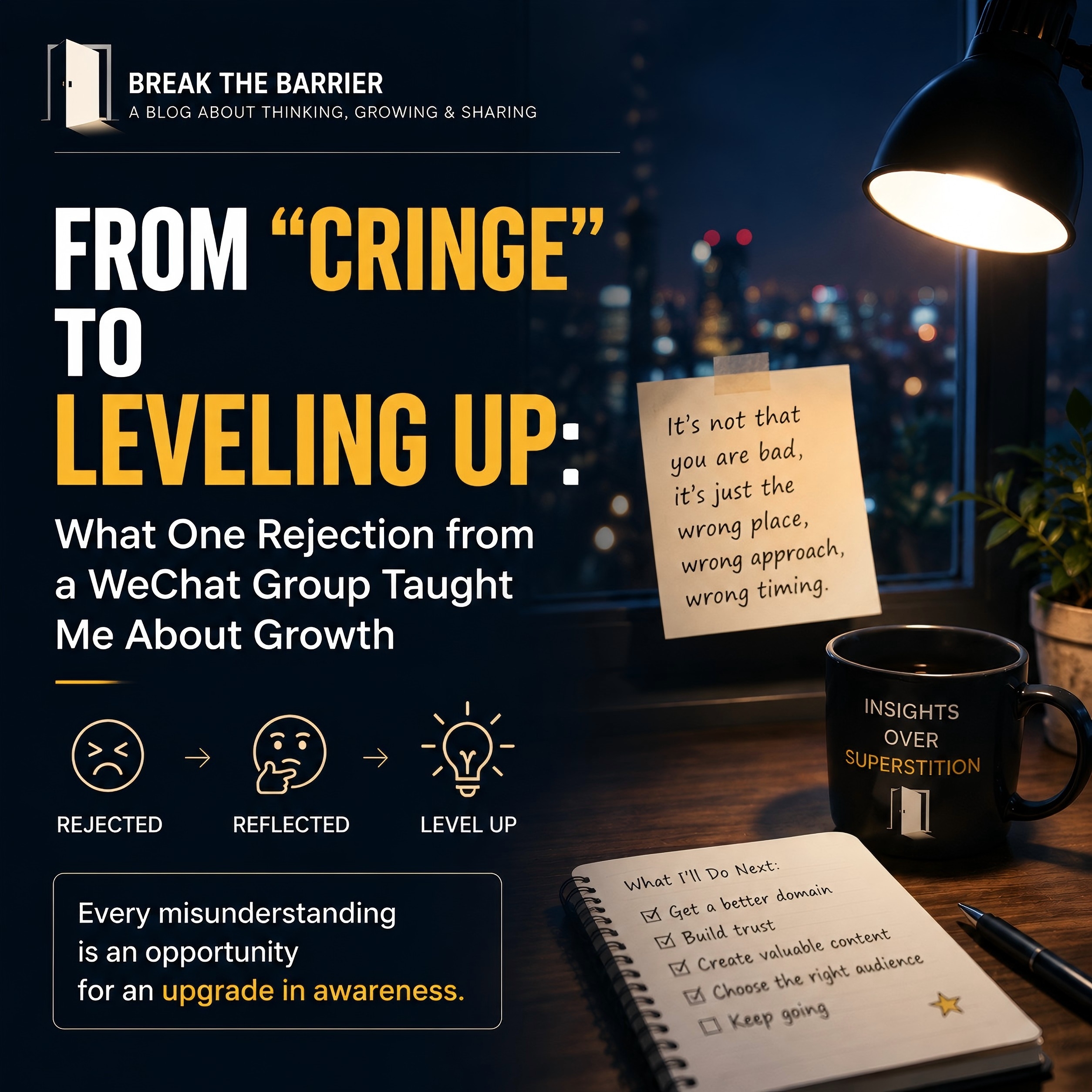
What I Learned After Being Publicly Shamed by a Group Admin
01 The Night I “Died Socially”
It was a little past 8 PM. I sat in front of my computer, staring at my newly revamped blog.
After several late nights, I had rebranded the site from “Fortune-Telling and Feng Shui” to “Breaking Cognitive Barriers” – rethinking the positioning, changing the homepage title, tweaking the layout. Looking at the fresh look, I felt a small sense of pride.
“This time should be different,” I told myself.
I decided to share it in a community group I was in – a WeChat group of several hundred homeowners in my neighborhood. Normally people talk about property management, kids, or new shops nearby. Not too lively, but not dead either. I thought, we’re neighbors. Sharing a small website can’t be that bad.
I carefully wrote a message:
“I was lost for a while and got into some superstitions. Later I realized that what really changes life is understanding the logic behind things. Recently I’ve been tinkering with a small website. The idea is simple: take complex, misunderstood, or information-gap knowledge and write it in plain language. Not for money – just to share some practical tools, like a social security calculator. The site just got revamped – a bit rough, but the content is my real thinking. If you’re ever confused about social phenomena or life decisions, feel free to drop by and give feedback.
👉 https://oracle.sqfan1992.cloudns.biz”
I read it three times. Sincere, not flashy, with a little self-deprecating humor about being “rough.” Should be fine.
Deep breath. Sent.
The message landed like a pebble in a pond – ripples, then… silence.
One minute, two minutes, five. No reply. The group kept chatting about tomorrow’s trash pickup schedule.
I started to feel uneasy. But worse was coming.
About ten minutes later, a message popped up – not from a group member, but from the admin:
“Please do not post such content in this group.”
Immediately after, the group announcement was updated:
“Please do not click on links from unknown sources. Thank you.”
My heart sank.
At that moment, I felt a very physical, visceral embarrassment – my cheeks burned, my fingers went cold. I wanted to retract the message immediately. But it had been over two minutes. I couldn’t.
I stared at the screen with one thought:
“I’m socially dead.”
02 From Resentment to Anger to Self-Doubt
The first few minutes were resentment.
“I meant well.” “I’m not selling anything or scamming anyone – just sharing my thoughts for free. Why is it a ‘link from an unknown source’?” “You didn’t even look at it – how can you judge?”
Resentment quickly turned into anger.
“What a closed-minded group.” “I’ve shared in other groups and gotten thank-yous.” “It’s just a neighborhood group – acting like some censorship bureau.”
I even started drafting a rebuttal in my head. But reason told me: don’t. That would be arguing, and arguing means burning bridges. Awkward encounters in the elevator later.
With no outlet, the anger collapsed inward into something deeper and heavier – self-doubt.
“Is my website really that bad?” “Does that domain really look like a scam?” “Am I just not cut out for this?”
I remembered friends saying, “Who’s even going to read your blog?” Family gently hinting, “You could spend that time resting instead.” I thought of the late nights I’d put into the redesign.
“What am I even doing?”
03 Cooling Down, Shifting Perspective
About half an hour later, the emotional storm began to subside. I got up, poured a glass of water, and stood on the balcony for some air.
The night breeze was cool. The neighborhood was quiet. Someone was walking their dog downstairs. The convenience store in the distance was still lit. Everything was normal. My “social death” – no one cared except me.
That thought suddenly made me feel lighter.
Back at the computer, I reopened the group chat and read the admin’s announcement again:
“Please do not click on links from unknown sources. Thank you.”
“Unknown sources.” I read those words again.
If I were a regular group member and saw a link like oracle.sqfan1992.cloudns.biz, would I click it?
Honestly? No.
That domain looks strange. What is cloudns.biz? What does sqfan1992 mean? Is it a phishing site? Will my account get stolen if I click?
What I saw as “my personal character,” others saw as a risk signal.
And what is the admin’s job? To protect the majority. In a group of several hundred people, the admin cannot – and is not obligated to – vet every link for good intentions. The safest, most responsible approach is a blanket rule: ban all links from unknown sources.
Once I understood that, the resentment and anger dissolved.
It wasn’t personal. It wasn’t even about distrust. In a public space without pre-existing trust, rules must prioritize safety over individual goodwill.
It’s a cold, but completely rational logic.
04 Lesson One: Don’t Mask “Promotion” as “Sharing”
The first thing this experience taught me is a subtle distinction:
“Promotion” and “sharing” – both involve showing something to others, but the underlying logic is completely different.
- Promotion: I have something and I want people to know about it. The goal is reach.
- Sharing: I find something valuable and I think you might like it. The goal is resonance.
They sound similar, but in practice, the difference is huge.
A promotion mindset makes me impatient. I think, “Send it to a few more groups – a few more views is a win.” I treat the link as a checkbox – post it and wait for results.
A sharing mindset makes me cautious. I first ask, “Does this person really need it?” “Is this the right context?” If I’m not sure, I’d rather not post and wait for a more natural moment.
When I posted in the neighborhood group today, I was using the actions of promotion to wrap an intention of sharing – I was lying to myself.
I told myself “I’m just kindly sharing,” but the carefully crafted message, the timing choice, even the thought of sending a red envelope to warm up the group – those actions exposed my real mindset: I was promoting, not sharing.
Nothing wrong with promotion. But promotion requires the right channels, trust endorsements, and a targeted audience. A neighborhood group didn’t have any of that.
05 Lesson Two: “Unknown Source” Isn’t Discrimination – It’s a Cost
The second lesson was about re-understanding those words: “unknown source.”
When I was rejected, I felt “unknown source” was discriminatory – why is my link an “unknown source”? I’m a real person with a name, an apartment number, and genuine intentions!
But later I realized: “Unknown source” is not a moral judgment on a person. It’s a security assessment of information.
To everyone else in the group, my link was no different – in form – from a Pinduoduo “click to help” link, a “Congratulations, you’ve won” phishing link, or a “Shocking!” rumor link.
It’s all just a blue clickable string.
A black box – no one knows what’s inside.
Group members have no obligation to distinguish “this link comes from a good person” from “this link comes from a bad person.” Their first reaction is simply: “Don’t know what it is. Not clicking.”
And the admin’s responsibility is to block that “don’t know what it is” at the door.
That wasn’t a rejection of me. That’s the basic logic of online communities: in an age of information overload, safety trumps curiosity, and rules trump individuals.
Once I understood that, I even felt a bit of gratitude toward the admin. He taught me something more directly and deeply than any “community management guide” ever could.
06 Lesson Three: Truly “Breaking Cognitive Barriers” Starts with Breaking My Own Arrogance
My blog’s tagline is “Break cognitive barriers, eliminate information gaps.”
Nice slogan.
But today made me realize: I am the first person who needs to be “broken.”
I was arrogant enough to think that if my content was good enough and my intentions pure enough, people would welcome me.
I was arrogant enough to ignore that no one is obligated to understand my “intentions.”
I was arrogant enough to forget that trust takes time, context, and intermediaries to build.
The first step in “breaking cognitive barriers” is not breaking others’ – it’s breaking your own.
Break your “I assumed.”
Break your “of course.”
Break your “victim narrative.”
When I was rejected, my first reaction was “the admin is wrong” and “the group members are冷漠 (cold)” – a textbook cognitive bias: self-serving bias (attribute success to yourself, failure to the environment).
Someone who truly wants to “eliminate information gaps” must, every time they face a setback, ask themselves one question:
“Was there something I did wrong here?”
If yes, fix it.
If not, then look at others’ problems.
Today, there clearly was. And it wasn’t small.
07 What I’m Going to Do Next
After that whole night’s ordeal, I set some new rules for myself:
First: change the domain.oracle.sqfan1992.cloudns.biz – technically fine, but in terms of “trustworthiness,” it’s a negative.
A clean, memorable, “legitimate-looking” domain is the first step in building trust.
Second: stop seeking validation on other people’s turf. Build trust on my own ground.
08 Writing This Down, I Suddenly Feel at Peace
It’s now past 11 PM.
I’ve written down everything that happened tonight from beginning to end. As I wrote, my mood slowly lifted, and my thoughts became clear.
I suddenly realized that this rejection may be the best gift I’ve received since my blog’s transformation.
It told me, in the most direct and merciless way:
- Your domain isn’t good enough
- Your promotion method isn’t good enough
- Your understanding of “trust” is too naive
But at the same time, it gave me an invaluable opportunity to test whether I truly “walk the talk.”
My blog says “break cognitive barriers.”
If I can’t even break the cognitive barrier of my own rejection, how can I help others?
Today, I broke it.
From “resentment and anger” to “reflection and understanding,” from “self-doubt” to “making new rules” – that process itself was a cognitive upgrade.
I’m even a little grateful to that admin. Though he’ll probably never know that his one sentence – “Please do not post such content in this group” – became the most important lesson I’ve learned since starting my blog.
09 To Anyone Who Made It This Far
If you’re also an independent blogger, or if you’ve ever tried to share something in a community and been rejected, I want to say this to you:
- It’s not that you’re no good – it’s that your approach was wrong.
- It’s not that your content lacks value – it’s that trust hasn’t been built yet.
- It’s not that others are cold – it’s that you haven’t given them a reason to click.
Don’t give up. Don’t let one rejection make you doubt yourself.
Change your domain. Change your copy. Change your channels. Change your mindset. Step by step.
This world doesn’t lack content. What it lacks is trustworthy content.
And you – you’re on your way to becoming that “trustworthy” one.
Finally, I’ll close with a sentence I learned tonight:
“Free service isn’t because it’s cheap – it’s because it’s precious. Precious things need to be given to the right people, in the right way.”
Thank you to the admin who rejected me.
And thank you to myself – for not giving up.
Good night. I’ll keep writing.
原文
被群主当众“处刑”后,我想明白的三件事
01 那个让我“社死”的夜晚
晚上八点多,我坐在电脑前,盯着刚改版完的博客。
花了几个晚上,我把网站从“Fortune-Telling and Feng Shui”改成了“打破认知壁垒”——重新梳理定位、修改主页标题、调整排版。看着焕然一新的界面,心里多少有点小得意。
“这次应该不一样了吧。”我对自己说。
我决定把它分享到所在的一个社区群——几百号业主的微信群。平时大家聊物业、聊孩子、聊周边新开的店,气氛不算热络,也不算冷清。我想,都是邻居,分享一个小网站,总不至于被讨厌吧。
我精心准备了一段话:
“之前有段时间我比较迷茫,相信过一些玄学,后来发现,真正能改变生活的其实是看清事物背后的逻辑。前阵子我捣鼓了个小网站,初衷很简单:就是把一些复杂、被误解、或者存在信息差的知识,用大白话写出来。不为了赚钱,就为了和大家分享一些实用计算工具,比如社保缴费问题。网站刚改版,有点简陋,但内容绝对是我的真实思考。如果大家平时对某些社会现象、生活决策感到困惑,欢迎来踩踩,也请多提意见!
👉 https://oracle.sqfan1992.cloudns.biz”
反复读了三遍。嗯,真诚,不浮夸,还有一点自嘲的“简陋”——应该没问题。
深呼吸,点击发送。
消息像一颗石子投进水面,涟漪荡开,然后……沉寂。
一分钟,两分钟,五分钟。没人回复。群里依然在讨论明天垃圾清运时间调整的通知。
我开始有点不安。但更不安的事情还在后面。
大约过了十分钟,一条消息弹出来——不是群友的回应,而是群主:
“请不要在本群发布此类信息。”
紧接着,群公告更新了:
“请大家不要点击不明来历的链接,谢谢!”
我的心猛地往下一沉。
那一瞬间,我感受到了一种非常具体的、生理性的窘迫——脸颊发热,手指发凉,甚至想立刻把那条消息撤回。但超过两分钟了,撤不回了。
我盯着屏幕,脑子里只有一个念头:
“完了,社死了。”
02 从委屈到愤怒,再到自我怀疑
最初的几分钟,我感受到的是委屈。
“我明明是好意啊。”“我又不卖东西,又不骗钱,就是想免费分享一点思考,怎么就成了‘不明来历的链接’?”“群主你看都没看,凭什么就定性了?”
委屈很快发酵成一丝愤怒。
“什么破群,一点包容心都没有。”“我在别的群分享还被人感谢过呢。”“不就是个业主群吗,搞得跟审查机构似的。”
我甚至已经在脑海里起草反驳的话。但理智告诉我:不能发。发了就是抬杠,抬杠就是撕破脸,以后在小区遇到多尴尬。
愤怒没了出口,开始向内坍缩,变成了一种更深、更沉的情绪——自我怀疑。
“是不是我的网站真的很差?”“是不是那个域名看起来就像骗子网站?”“是不是我这个人就不适合做这种事?”
我想起朋友说过的话:“你做这个博客,谁会看啊?”想起家人委婉的提醒:“有这时间不如多休息。”想起自己为了改版熬的几个夜晚。
“我到底在干什么?”
03 冷静下来,换一个角度
大概过了半个小时,情绪的风暴渐渐平息。我起身去倒了一杯水,站在阳台上吹了会儿风。
夜风微凉,小区里很安静。楼下有人在遛狗,远处的便利店亮着灯。一切如常。我的“社死”,除了我自己,其实没有人在意。
这个念头突然让我轻松了一些。
回到电脑前,我重新打开群聊,认真看了群主的公告:
“请大家不要点击不明来历的链接,谢谢!”
“不明来历” ——这四个字,我重新读了一遍。
如果我是一个普通群友,看到一个叫 oracle.sqfan1992.cloudns.biz 的链接,我会点吗?
说实话,我不会。
这个域名看起来确实很奇怪:cloudns.biz 是什么?sqfan1992 是什么意思?会不会是钓鱼网站?一点进去会不会被盗号?
这些疑问,在我自己看来是“我的个人特色”,在别人看来,就是风险信号。
而群主的职责是什么?是保护群里大多数人的安全。在一个几百人的群里,群主不可能、也没有义务去逐一甄别每个链接的“善意”。最稳妥、最负责任的做法,就是一刀切——所有来历不明的链接,一律禁止。
想通这一点,我心里的那点委屈和愤怒,突然就散了。
不是群主针对我。甚至不是群主不信任我。而是在缺乏信任基础的公共空间里,规则必须优先于个体善意。
这是一个冷冰冰的、但完全合理的逻辑。
04 想明白的第一件事:不要用“推广”的心态去做“分享”
这次经历让我想明白的第一件事,是一个很微妙的区别:
“推广”和“分享”,看上去都是把东西给别人看,但底层的逻辑完全不同。
- 推广:是我有一个东西,我想让别人知道。目标是“触达”。
- 分享:是我觉得这个东西有价值,我觉得你可能会喜欢。目标是“共鸣”。
听起来差不多,但实际操作中,区别巨大。
推广的心态,会导致我急功近利。我会想着“多几个群发一发”“多几个人看到就是赚到”。我会把链接当成一个“完成动作”,发完就等结果。
分享的心态,会让我更谨慎。我会先判断“这个人真的需要吗?”“这个场合合适吗?”如果不太确定,我宁可不发,等一个更自然的时机。
今天我在社区群发链接,本质上是用“推广”的动作去包装一个“分享”的初衷——我自己骗了自己。
我告诉自己“我是好心分享”,但当我精心编辑文案、选择活跃时间、甚至考虑过要不要发个红包预热的时候,这些动作已经暴露了我的真实心态:我在做推广,不是在做分享。
推广没有错。但推广需要渠道,需要信任背书,需要精准人群。一个业主群,不具备这些条件。
05 想明白的第二件事:“不明来历”不是歧视,是成本
第二件事,是关于“不明来历”这四个字的重新理解。
被拒绝的时候,我觉得“不明来历”是一种歧视——凭什么我的链接就是“不明来历”?我明明是一个有名字、有房号、有真诚意图的真实人类!
但后来我想明白了:“不明来历”不是一个对人的道德判断,而是一个对信息的安全评估。
对于群里的其他人来说,我的链接和拼多多砍一刀链接、和“恭喜您中奖”钓鱼链接、和“震惊!XX官员落马”谣言链接,在形式上没有任何区别。
都是一个蓝色的可点击字符串。
都是一个不知道点进去会看到什么的“黑箱”。
群成员没有义务去分辨“这个链接是好人发的还是坏人发的”。他们的第一反应只能是:“不知道是什么,别点。”
而群主的责任,就是替大家把这个“不知道是什么”的东西,直接拦在门外。
这不是对我的否定。这是互联网社区运转的基本逻辑:在信息过载的时代,安全优先于好奇,规则优先于个体。
想通了这一点,我甚至有点感谢那个群主。他教给我的东西,比任何一篇“社区运营指南”都更直接、更深刻。
06 想明白的第三件事:真正的“打破认知壁垒”,要先打破自己的傲慢
我的博客定位是“打破认知壁垒,消除信息差”。
多好听的口号。
但今天这件事让我意识到:我自己,就是那个需要先被“打破”的人。
我傲慢地认为,只要我的内容够好、初衷够善,别人就应该欢迎我。
我傲慢地忽略了,别人没有义务去了解我的“初衷”。
我傲慢地忘记了,信任是需要时间、需要场景、需要中间介质去建立的。
“打破认知壁垒”的第一步,不是去打破别人的,而是打破自己的。
打破自己的“我以为”。
打破自己的“想当然”。
打破自己的“受害者叙事”。
当我被拒绝的那一刻,我的第一反应是“群主不对”“群友冷漠”——这是多么典型的认知偏误:成功归因于自己,失败归因于环境。
而一个真正想要“打破信息差”的人,首先要做的,是在每一次受挫时,问自己一句:
“这件事里,有没有我的问题?”
如果有,就改。
如果没有,再去看别人的问题。
今天这件事,显然有。而且不小。
07 接下来,我打算怎么做?
经过这一个晚上的折腾,我给自己定了新规则:
第一:域名必须换oracle.sqfan1992.cloudns.biz 这个域名,在技术上是没问题的,但在“信任感”上,是负分。
一个清晰的、好记的、看起来“正经”的域名,是建立信任的第一步。
第二:不在别人的地盘上求认可,在自己的地盘上建立信任池。
08 写到这里,我突然释然了
现在是深夜十一点多。
我把今天晚上发生的事,从头到尾写了一遍。写的时候,情绪从低谷慢慢回升,思路从混乱变得清晰。
我突然发现,这次被拒绝,可能是我的博客转型以来,收到的最好的一份“礼物”。
它用最直接、最不留情面的方式,告诉我:
- 你的域名不行
- 你的推广方式不行
- 你对“信任”的理解太天真
但同时,它也给了我一个极其宝贵的实践机会,去检验自己是否真的“知行合一”。
我的博客说要“打破认知壁垒”。
如果连自己被拒绝这件事的认知壁垒都打破不了,还谈什么帮助别人?
而今天,我打破了。
从“委屈愤怒”到“反思理解”,从“自我怀疑”到“制定新规则”——这个过程,本身就是一次认知升级。
我甚至有点感谢那个群主了。虽然他可能永远不会知道,他那句“请不要在本群发布此类信息”,成了我写博客以来最重要的一课。
09 给看到这里的你
如果你也是一位个人站长,或者你也曾想在社群里分享自己的东西却被拒绝,我想对你说:
- 不是你不好,是方式不对。
- 不是内容没价值,是信任还没建立。
- 不是别人冷漠,是你还没给出别人点击的理由。
别放弃。别因为一次拒绝就否定自己。
改域名、改文案、改渠道、改心态。一步一步来。
这个世界不缺内容,缺的是值得信任的内容。
而你,正在成为那个“值得信任”的路上。
最后,用今晚学到的一句话收尾:
“免费服务,不是因为便宜,而是因为珍贵。珍贵的东西,需要用对的方式,给到对的人。”
谢谢那个拒绝我的群主。
也谢谢那个没有因此放弃的自己。
晚安,我会继续写。