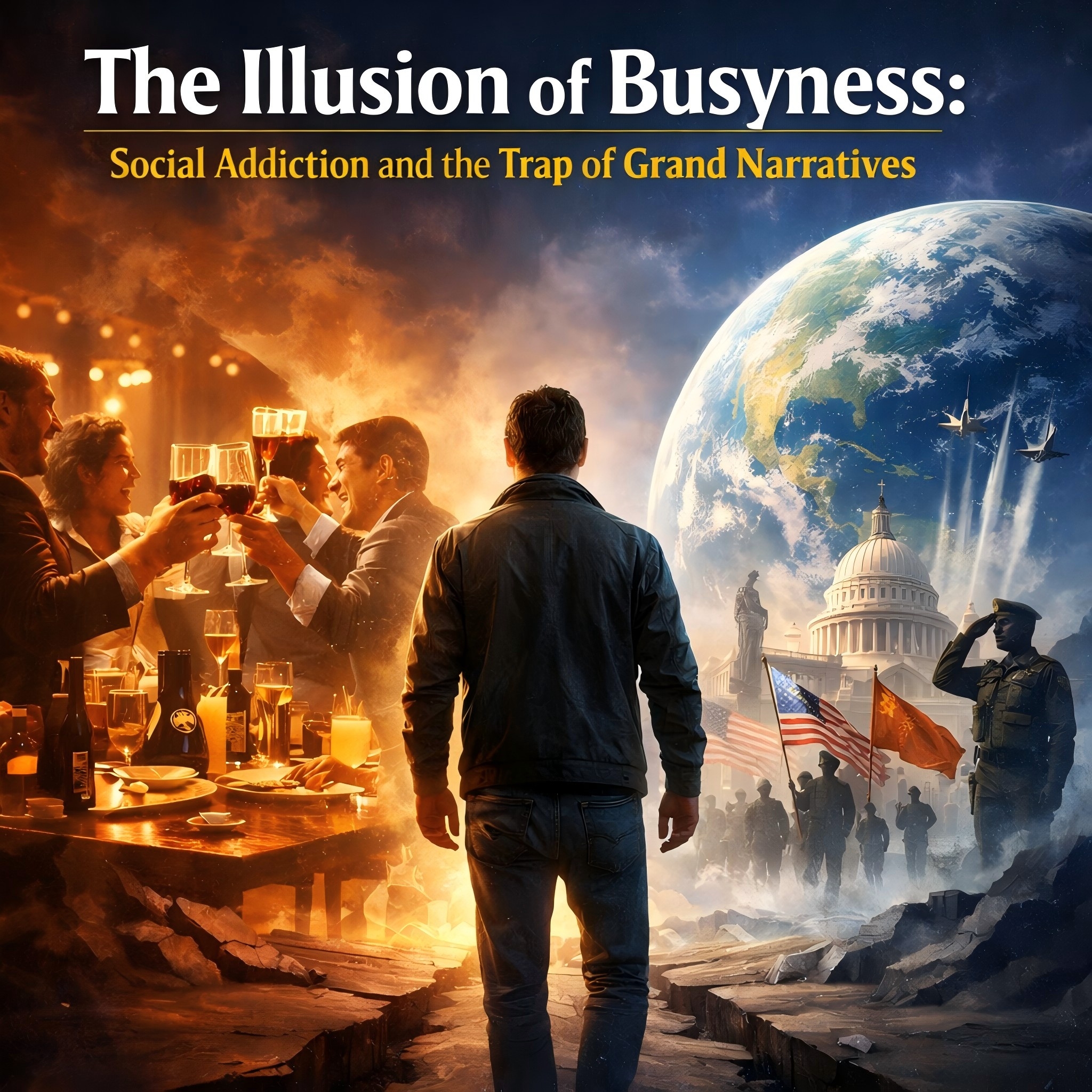
There are roughly two ways people live their lives as “the grass waiting to be cut.”
One group throws themselves into crowds—constantly attending dinners, maintaining connections, and sustaining their sense of importance through endless socializing.
The other group gazes at the stars, speaking endlessly about global affairs, historical trends, and geopolitical shifts, as if they were commentators on the fate of civilization.
The paths look different.
But the ending is often the same.
They both get harvested.
The real problem is that these behaviors are extremely seductive for ordinary people. They provide a powerful psychological reward: the feeling that you are important, insightful, and influential—without requiring much real progress in life.
At a lively dinner table, surrounded by clinking glasses, you may feel like someone with vast connections and influence.
While discussing world affairs online, you may feel like a thinker who sees through the illusions of history.
It feels great.
So great that some people spend decades living in that feeling.
Then one day, in their forties or fifties, they look back and realize they have achieved very little.
Their pockets are empty.
Their skills stagnated.
What do they do then?
They keep drinking.
They keep talking.
They keep debating politics and world events.
Day after day.
Time disappears. Energy fades. The abilities that should have been sharpened remain untouched. The capital that should have been accumulated never grows.
The cruelest part is this:
These habits don’t hurt immediately.
They are a slow bleed.
By the time you notice the damage, you’re already middle-aged, running out of momentum, with little time left to catch up.
Part I: The Trap of Low-Level Socializing
Some lessons are hard to understand when you’re young.
Many people only learn them after hitting the wall in middle age.
The more crowded and lively your social life is, the less valuable it often becomes.
When we are young, we think having friends everywhere is an achievement.
But by middle age, we discover something else entirely.
What drains us the most is not life itself—but inefficient social interactions.
They slowly consume your:
- time
- energy
- emotional capacity
In middle age, success is no longer about excitement.
It is about clarity.
The clarity to know:
Which relationships are worth keeping,
and which gatherings should simply be declined.
Some obligations aren’t worth even a minute of your life.
The saying “the more friends you have, the easier the road becomes” has misled countless people.
The more you believe this logic in middle age, the more likely you are to become the person everyone casually asks for favors.
You spend money on countless dinners.
You offer help whenever asked.
But when you truly face trouble—losing your job, facing illness, running out of money—the people you helped often vanish.
You thought you were building a network.
In reality, you were building a web of burdens.
Most so-called friendships are not based on affection.
They are negotiations.
They are exchanges of convenience.
If you have no real ability or value, knowing people means nothing.
That’s the naked truth.
The Worse Someone Is Doing, the Busier They Are Socializing
Some people always seem busy:
Endless dinners.
Constant group chats.
Nonstop social events.
It looks lively from the outside.
But at the core, it is anxiety.
They are afraid of:
being forgotten
being left behind
being irrelevant
So they use artificial excitement to numb their inner emptiness.
In essence, this is the same psychological mechanism as people addicted to grand narratives.
Both are attempts to escape an uncomfortable reality through loud distractions.
Truly capable people have long learned to filter out this noise.
They would rather spend time alone than waste it on meaningless social obligations.
Sometimes, not fitting in is not a weakness.
Sometimes it simply means you woke up earlier than others.
Real Networks Are Built on Strength
Here is an uncomfortable truth.
Most connections are not maintained through effort.
They appear when you become strong enough that others want to approach you.
If your schedule is full of dinners today, people may treat you like an important figure.
But the moment you stop showing up, you may realize you were easily replaceable.
Over time you may become little more than a social intermediary—someone who coordinates relationships but has little identity of their own.
The relationships that truly change your life rarely emerge from:
poker tables
karaoke rooms
casual group chats
They usually appear after years of quiet personal growth.
When your abilities rise, the nature of your relationships changes automatically.
Low-Level Circles Run on Emotional Debt
One defining trait of low-quality social circles is this:
They emphasize emotions over rules.
“I bought you dinner, so you owe me one.”
“I attended your wedding, so you must attend my cousin’s.”
“You liked my post, so I should comment on yours.”
Over time, people become trapped in endless emotional transactions.
They lose their freedom.
Higher-level circles operate differently.
Value determines exchange.
Your contribution defines your position.
There is no unnecessary politeness or empty sentiment—only clear capability and trust.
For middle-aged adults, the most dignified form of social interaction can be summarized in six words:
Let strength speak for itself.
Endless Social Events Slow Down Your Life
Many people claim they have no time:
no time to study
no time to exercise
no time to build a side business
But ask them to cancel a dinner invitation or leave a few group chats, and they immediately feel uneasy.
The problem is not lack of time.
The problem is misused time.
What you think is “networking” may actually be the slow erosion of the most valuable asset you possess:
time itself.
Look closely at people who are truly successful.
They are often strangely invisible.
They rarely attend social gatherings.
They rarely speak loudly in group chats.
They rarely chase attention.
Yet when they act, they operate on an entirely different level.
Because while others are talking, they are evolving.
Part II: The Addiction to Grand Narratives
Another group of people falls into a different illusion.
They speak constantly about:
civilizational conflicts
global power shifts
historical destiny
Listening to them, you might think they stand above history, observing the world from a grand strategic perspective.
But there is an interesting pattern.
Those most obsessed with grand narratives are often those struggling most in their personal lives.
Why?
Because grand narratives provide an incredibly convenient psychological compensation.
When life feels difficult—
when income is low, pressure is high, and the future uncertain—
people crave a way to feel significant.
Grand narratives offer exactly that.
They allow individuals to insert their personal identity into vast collective stories.
In real life, they may be ordinary.
But in the world of ideas, they feel like participants in global destiny.
It is intoxicating.
Why Grand Narratives Are So Addictive
Because they create the illusion of participation.
You feel like you are part of world history.
In reality, you are simply watching it.
When you discuss geopolitics with these people, they speak endlessly.
But ask them practical questions—
How to earn more money?
How to improve your skills?
How to change your life?
Suddenly the conversation becomes uncomfortable.
Material ambition is dismissed as vulgar.
Instead, a grand philosophical explanation appears:
“If everyone moved upward, who would clean the streets?”
It sounds profound.
But often it is simply a beautiful excuse for refusing to change one’s life.
The Core of Competition
History is not as complicated as people like to imagine.
Civilization rarely emerges out of pure morality.
More often, it grows from harsh competition.
The same principle applies to individuals.
People may try to moralize competition, soften its image, or decorate it with ideals.
But at its core, competition is about one thing:
access to resources.
The question is not whether the world is fair.
The question is whether you are prepared to navigate it.
Conclusion
Whether someone is addicted to socializing
or addicted to grand narratives,
the root problem is the same.
Both are ways of escaping reality through artificial excitement.
Grand narratives cannot fill the smallness of individual lives.
Cheap social gatherings cannot fill inner emptiness.
Real change rarely happens in noisy places.
It happens quietly—
during the years when you focus on building yourself.
When you travel across different countries and societies, you eventually realize one simple truth:
There will always be someone cleaning the streets.
There will always be someone doing the hardest work.
Your real task is simple:
Make sure that person is not you.
原文
热闹的幻觉:社交沉迷与宏大叙事的双重陷阱
韭菜的人生大致有两种活法。
一种扎进人堆里,整天混饭局、搞人情,靠社交维持存在感。
另一种仰望星空,张口世界格局,闭口时代洪流,在宏大叙事里指点江山。
看起来路子不同,结局却惊人地一致——
都是被收割。
问题在于,这两种行为恰恰是普通人最容易沉迷、也最乐在其中的事情。
它们最大的诱惑,在于能让人在几乎不付出实际代价的情况下,获得一种“我很厉害”的精神快感。
在饭局觥筹交错之间,你会觉得自己人脉广阔、呼风唤雨。
在时事评论区挥斥方遒时,你又会觉得自己洞察历史、看透世界。
这种感觉太爽了。
爽到很多人一爽就是几十年。
等到四五十岁回头一看,才发现自己口袋空空,一事无成。
于是怎么办?
继续约酒局。
继续高谈阔论。
继续骂这个骂那个。
日复一日。
时间没了,精力没了。
真正该打磨的能力烂在原地,该积累的资本一分没动。
最残忍的地方在于:
这种生活方式不会让人立刻感到痛苦。
它像慢性失血。
等你察觉的时候,往往已经人到中年,后劲不足,再想追赶也追不上了。
一、沉迷底层社交的人
很多道理年轻时看不透,非要到中年撞过南墙才明白。
社交越热闹,真正有价值的往往越少。
年轻的时候,总以为“朋友遍天下”是本事。
等到中年才发现,最能榨干你的并不是生活本身,而是那些低效社交。
它们一点点吸干你的:
- 时间
- 精力
- 情绪
人到中年,拼的不是热闹,而是清醒。
清醒到知道:
什么关系该断,
什么局根本不该去。
有些人情,从一开始就不值得你浪费一分钟。
“朋友多了路好走”这句话,骗了太多人。
中年以后,你越相信这套逻辑,就越容易变成那个谁都能随便麻烦一下的人。
人情份子出了一大堆。
可真到了你失业、缺钱、生病的时候——
那些你请过饭的、帮过忙的、出过力的,往往全部消失。
你以为自己建立的是人脉网络,
其实只是负担网络。
说穿了,大多数所谓朋友,本质不过是互相博弈、互相利用。
你没有价值的时候,认识谁都没用。
这就是现实。
越混得差的人,越忙着社交
很多人看起来很忙:
- 天天饭局
- 群聊不断
- 活动不停
表面热闹,其实只是焦虑。
他们害怕:
被遗忘
被淘汰
被边缘化
于是用一种虚假的热闹来掩盖内心的空洞。
这和沉迷宏大叙事的人,本质是一回事。
都是在用巨大的噪音,逃避自己渺小而尴尬的现实处境。
真正有能力的人,早就开始屏蔽这些噪音。
他们宁愿独处,也不愿把时间浪费在无效应酬上。
有时候,不合群不是缺点。
恰恰说明你醒得比别人早。
真正的人脉从来不是陪酒堆出来的
说句刺耳的话:
大多数人脉不是你维护来的,而是你强大之后别人主动靠上来的。
当你天天跑饭局时,你看起来很重要。
可一旦停下来,你就会发现自己不过是一个随时可以被替代的角色。
你活得越来越像一个社交中介。
最后甚至忘了自己是谁。
真正改变命运的关系,往往不会出现在:
- 麻将桌
- KTV包厢
- 群聊八卦
它通常出现在你默默进化的那几年之后。
当你能力提升、价值提升,关系自然会发生质变。
低质量圈子最爱讲感情
底层社交有一个非常明显的特征:
讲感情,不讲规则。
我请你吃饭,你得回请。
我参加你婚礼,你得来帮忙。
你给我点赞,我得回评论。
久而久之,人就变成了各种人情交易的傀儡。
越来越不自由。
而真正往上走的圈子,逻辑完全相反:
你值多少,就拿多少。
你能做什么,就给什么。
没有虚情假意,也没有无意义寒暄。
只有清晰的能力交换。
所以人到中年,最体面的社交方式只有六个字:
靠实力打交道。
你忙不完的应酬,正在拖慢你的人生
很多人说:
没时间学习
没时间健身
没时间做副业
但只要让他取消一个饭局,退出几个群聊,他马上浑身不自在。
不是没有时间。
只是时间用错了地方。
你以为自己在经营人脉,
其实是在浪费人生中最宝贵的东西:
时间。
真正混得好的人,往往长期“神隐”。
不出现在饭局,
不在群里刷存在感,
不参与各种热闹。
但一旦出手,就是另一个层级。
因为他们把时间全部用在了:
学习
进化
升级自己
而不是寒暄。
二、沉迷宏大叙事的人
另一类人,则沉迷于另一种精神麻醉。
他们的特点是:
开口文明冲突
闭口世界格局
动辄时代洪流
仿佛站在历史高处俯瞰世界。
但如果仔细观察会发现一个很有趣的现象:
越热衷宏大叙事的人,现实处境往往越普通。
因为宏大叙事提供了一种非常廉价的精神补偿。
当一个人在现实生活中:
收入微薄
压力巨大
前途模糊
他就更需要一种方式来让自己感觉“高于现实”。
于是他把个人命运塞进宏大的集体叙事里。
现实中的自己很普通,
但在精神世界里,他却站在文明与历史的制高点。
这种感觉很容易让人上瘾。
宏大叙事为什么容易让人沉迷
因为它可以制造一种错觉:
仿佛你参与了世界。
但事实上,你只是旁观。
当你和这些人聊世界格局时,他们滔滔不绝。
但如果你问一些现实问题:
怎么赚钱?
怎么提升能力?
怎么改善生活?
他们反而会不屑。
仿佛谈钱是一种庸俗。
于是他们用一种更宏大的叙事,替自己解释停滞的人生。
如果人人都往上走,谁去扫大街?
这句话听起来很深刻。
但实际上,它只是给自己不愿改变找的一个漂亮理由。
人类竞争的底层逻辑
历史其实很简单。
文明并不是凭空出现的。
很多时候,它只是野蛮之后的结果。
国家如此,个人竞争也是如此。
很多人喜欢用道德去评价历史,但现实世界往往更直接。
资源、权力、优势——
它们很少是靠讲道理得来的。
所以真正的问题不是世界是否残酷。
而是:
在这个世界里,你如何让自己不成为被淘汰的那一个。
结语
无论是沉迷社交,
还是沉迷宏大叙事,
本质上都是同一件事:
用虚假的热闹,逃避真实的人生。
宏大的叙事填不平个体的渺小。
廉价的社交也填不满内心的空洞。
真正的改变往往发生在:
那些你安静成长的日子里。
当你走过很多地方就会明白一件事:
这个世界永远有人去扫大街。
永远有人去做最底层的工作。
你真正要做的事情只有一件——
尽可能确保那个人不是你。