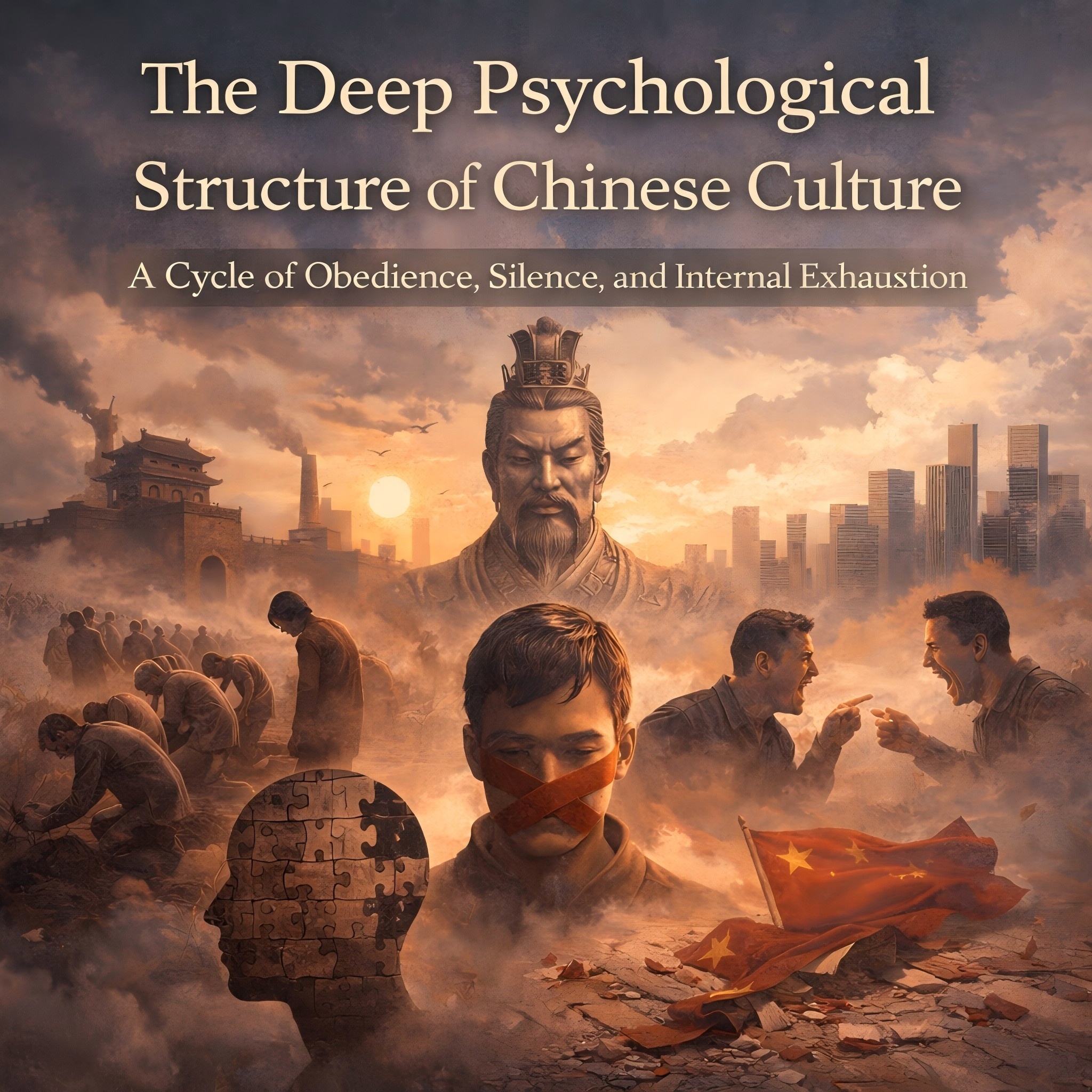
A Cycle of Obedience, Silence, and Internal Exhaustion
This is not an emotional outburst, nor a simple act of cultural criticism.
It attempts to answer a more fundamental question:
Why, within Chinese culture, is power so easily revered, truth so difficult to speak, rational discourse repeatedly silenced, and society trapped in cycles of internal exhaustion?
These phenomena are not accidental. Nor are they the failure of a single generation.
They are the result of long-standing cultural and psychological mechanisms that have shaped behavior, thought, and emotion for centuries.
I. Attachment to Power: Why the Oppressed Come to Identify with Power
The degree of tolerance—and even submission—toward authority in Chinese society is historically unusual.
People do not merely fear power; they gravitate toward it, depend on it, and psychologically identify with it. This is not simple cowardice, but a survival adaptation formed over time—what might be called the oppressed identifying with the oppressor.
History offers countless examples:
- After the Qing conquest and the massacres of Yangzhou and Jiading, public praise of “benevolent rule” re-emerged within a decade, and even the humiliation of forced hairstyle changes was reinterpreted as tradition.
- Qin Shi Huang’s book burnings, mass conscription, and brutal punishments were later reframed as the necessary cost of unification.
This is not forgetfulness, but a coping logic:
When resistance feels impossible,
revering power provides psychological safety.
Within the paternalistic imagination of family-state unity, authority becomes internalized as a protector, and obedience is reframed as rationality.
II. The Group as Truth: How the Individual Disappears
In Chinese culture, once one enters a group, individual judgment often vanishes.
Phrases like “the people’s eyes are sharp” or “everyone thinks so” routinely replace independent reasoning.
History shows that large-scale mass movements rarely stem from rational consensus; they arise from psychological mobilization:
- The Red Turbans, the White Lotus sects, the Boxer Rebellion
- The Taiping Heavenly Kingdom, which institutionalized blind belief through salvation narratives
In group psychology, there is no judgment—only imitation.
No reasoning—only alignment.
What repeats throughout Chinese history is not democratic progression, but a familiar pattern:
Mass mobilization → the rise of the strong → renewed oppression
III. Rhetoric Over Knowledge: A Cultural Amplifier of the Dunning–Kruger Effect
In many settings, those who speak the loudest and with the greatest certainty are rarely the most knowledgeable.
This is the Dunning–Kruger effect, amplified culturally.
Society consistently rewards not doubt or verification, but:
- Fluency of speech
- Decisive tone
- Clear political or moral positioning
From the rigid prose of the imperial examination system to modern performative discourse, reciting, asserting, and signaling alignment often matter more than understanding.
The result:
- Those who think deeply remain silent, because the cost of honesty is high
- Those who think shallowly speak loudly, because the cost is minimal
Gradually, the culture shifts from seeking truth to seeking comfort.
IV. Punishing Those Who Stand Out: The Crab Mentality
In Chinese society, standing out is often not a privilege, but a liability.
Historically and socially, excellence invites suspicion rather than protection:
- Wang Anshi’s reforms provoked collective backlash
- Zhang Juzheng stabilized the state, only to be purged after death
- Confucius’ ideas endured, but he himself never held lasting power
This creates a widespread survival strategy:
Conceal ability.
Avoid visibility.
Minimize responsibility.
“Don’t stand out” and “keep your head down” are not life philosophies—they are cultural warning signals.
V. Black-and-White Thinking: The Elimination of the Middle Ground
Chinese culture is deeply hostile to ambiguity.
You are either with us or against us.
Either loyal or treacherous.
This binary logic has been reinforced since antiquity—book burnings, literary inquisitions, and ideological purges all served to eliminate plural perspectives.
In such an environment:
Partial agreement is treated as opposition.
The disappearance of the middle ground leads to the collapse of public reason itself.
VI. Rhetoric Over Logic: Why What “Sounds Right” Rarely Holds Up
Traditional culture prizes eloquence, symmetry, and moral posture, but has long neglected logical argumentation and evidentiary reasoning.
- “Heaven’s mandate” shifted from explaining nature to legitimizing power
- Identity attacks (“Are you even Chinese?”) replace rational debate
- Moral coercion (“Parents are always right”) substitutes for logic
The outcome:
The vaguer the language, the deeper it sounds.
The clearer the statement, the more dangerous it becomes.
When language loses precision, thinking is forced into the shadows.
VII. Pseudo-Moderation: Avoidance Disguised as Wisdom
The doctrine of moderation is often reduced in practice to:
- “Better fewer problems than more”
- “Endure it and move on”
This is not conflict resolution—it is conflict suppression.
From tolerating corruption because “we can’t do without this person”
to hiding domestic abuse under “family shame must stay inside”,
the result is structural internal injury.
VIII. Collective Amnesia and Scapegoats
Chinese culture simultaneously glorifies a five-thousand-year civilization while selectively forgetting its failures.
Disasters are blamed on villains, traitors, or external forces—
never on institutions or cultural mechanisms themselves.
This scapegoating allows emotional release, but blocks systemic repair.
IX. Cultural Aphasia: Why Truth Becomes Unspeakable
Speaking truth gradually comes to be seen as impolite.
From the historical fate of outspoken figures to modern “self-censorship,” people learn not expression, but silence.
A paradox emerges:
Meaningless words are safe to say.
Meaningful words are dangerous.
This is not individual timidity—it is cultural aphasia.
Conclusion: From Cultural Confidence to Cultural Diagnosis
These problems are not the failure of a single era,
but the product of long-running cultural conditioning.
What we face is not an emotional crisis, but a cultural metabolic disorder:
- An inability to absorb criticism
- An inability to release pressure
- An inability to build psychological immunity
Real change begins not with pride, but with diagnosis.
Before cultural confidence,
we need cultural clarity.
To see these structural patterns is not self-denial—
it is the first step toward genuinely becoming oneself.
原文
中国文化心理的深层结构:顺从、失语与内耗的循环
为什么在中国文化中,权力容易被崇拜,真话难以出口,理性反复失语,而社会始终在内耗中循环?
这些现象并非偶然,也不只是某一代人的问题,而是由一整套长期运转的文化心理机制所塑造。
一、对权力的依附:被压迫者为何会认同压迫
中国社会对权力的忍耐与服从,在世界范围内都极为罕见。
我们并不只是害怕权力,而是亲近权力、依附权力,甚至在心理上认同权力。这种现象并非简单的懦弱,更像是一种长期形成的心理适应机制——一种“被压迫者对压迫者的认同”。
历史中屡见不鲜:
- 清兵入关后,扬州、嘉定屠城,但不到十年,民间已开始歌颂“圣君仁政”,连剃发易服的屈辱也被解释为祖制;
- 秦始皇焚书坑儒、徭役极重,却在其死后不久就被重新包装为“功过相抵”的统一象征。
这并非简单的健忘,而是一种生存逻辑:
当反抗无望,崇拜压迫者,反而能让人获得心理安全。
在父权—家国一体的想象中,权力被内化为“保护者”,顺从被等同为理性。
二、群体即真理:个体如何在集体中消失
在中国文化里,一旦进入群体,个体判断便迅速退场。
“人民的眼睛是雪亮的”“大家都这么认为”,
往往被用来替代个人思考。
历史上多次大规模群众运动表明,所谓“民意沸腾”,往往源自心理操控而非理性共识:
- 红巾军、白莲教、义和团;
- 太平天国以救世叙事煽动群众,将盲信制度化。
群体状态下,没有判断,只有模仿;
没有理性,只有附和。
中国历史反复上演的,并非民主的进程,而是:
群情动员 → 强者上位 → 新一轮压迫。
三、话术胜于知识:达克效应的文化温床
在许多场合,最敢发言、最确信自己正确的人,
往往并非最有见识的人。
这正是达克效应在文化层面的放大。
社会长期奖励的不是怀疑、谦逊与求证,而是:
- 语言流畅,
- 态度坚决,
- 立场鲜明。
从科举时代的八股文,到现代话术型表达,
会背、会说、会表态,常常比理解本身更重要。
结果是:
- 有思想的人保持沉默,因为说真话成本过高;
- 没想清楚的人反而高声断言,因为几乎没有代价。
文化逐渐从“求真”转向“求顺耳”。
四、惩罚出头者:螃蟹心理与系统性嫉妒
在中国社会,“出头”往往不是荣誉,而是一种风险。
从历史到现实,表现突出者更容易遭遇围攻而非支持:
- 王安石变法触动既得利益,被士大夫集体反噬;
- 张居正改革短暂中兴,死后即被清算;
- 孔子思想伟大,却终生不得其位。
这种螃蟹心理塑造出一种普遍人格策略:
藏拙、保守、避责、不显山露水。
“不要出头”“闷声发财”,
不是人生智慧,而是文化发出的生存警告。
五、非黑即白:二元对立对思考的封杀
中国文化对模糊地带极不友好。
你不是朋友,就是敌人;
不是支持,就是反对。
这种二元思维自先秦以来不断强化,
焚书坑儒、文字狱,
本质上都是对多元视角的清除。
在这样的语言环境中:
不完全认同,也会被视为敌对立场。
中间地带消失,公共理性空间随之坍塌。
六、修辞压倒逻辑:为何“听起来对”却经不起推理
中国传统文化极度重视文采、排比与姿态,
却长期忽视逻辑论证与证据体系。
- 天命从解释自然,演变为篡位合法性;
- 身份质疑(“你还是不是中国人”)取代理性讨论;
- 伦理绑架(“父母永远是对的”)替代逻辑推演。
结果是:
越模糊,越显深刻;
越直白,越显危险。
语言一旦失去精确性,思考便只能在暗处打转。
七、伪中庸:以退让掩盖问题的文化习惯
中庸之道在现实中,常被简化为:
- 多一事不如少一事,
- 忍一忍就过去。
这不是处理冲突的智慧,而是对冲突的长期压抑。
从纵容贪腐的“离不开这个人”,
到民间的“家丑不可外扬”,
整个社会逐渐形成结构性内伤。
八、失忆与替罪羊:逃避反思的历史机制
一方面强调五千年文明的伟大,
另一方面却对历史真相高度选择性遗忘。
失败被归咎于“奸臣”“坏人”“外部势力”,
制度与文化本身却从不进入反思范围。
这种替罪羊机制,使社会长期停留在情绪宣泄,
却无法进入系统修复。
九、失语症:为什么真话越来越难说
在中国文化中,说真话逐渐被视为一种失礼。
从敢言者的历史命运,到现实中的“慎言”,
人们学会的不是表达,而是自我消音。
最终形成悖论:
没价值的话可以随便说,
有价值的话却不能说。
这不是个体怯懦,而是文化性的失语。
结语:从文化自信,到文化诊断
这些问题,并非某一代人的失败,
而是千年文化机制反复训练的结果。
我们面对的,不是情绪问题,
而是一种文化代谢障碍——
- 无法吸收批判,
- 无法释放压力,
- 无法建立心理免疫。
真正的改变,始于停止美化与装睡。
文化自信之前,
我们更需要文化诊断。
看见这些结构性病灶,
并不意味着否定自己,
而是第一次,尝试真正成为自己。