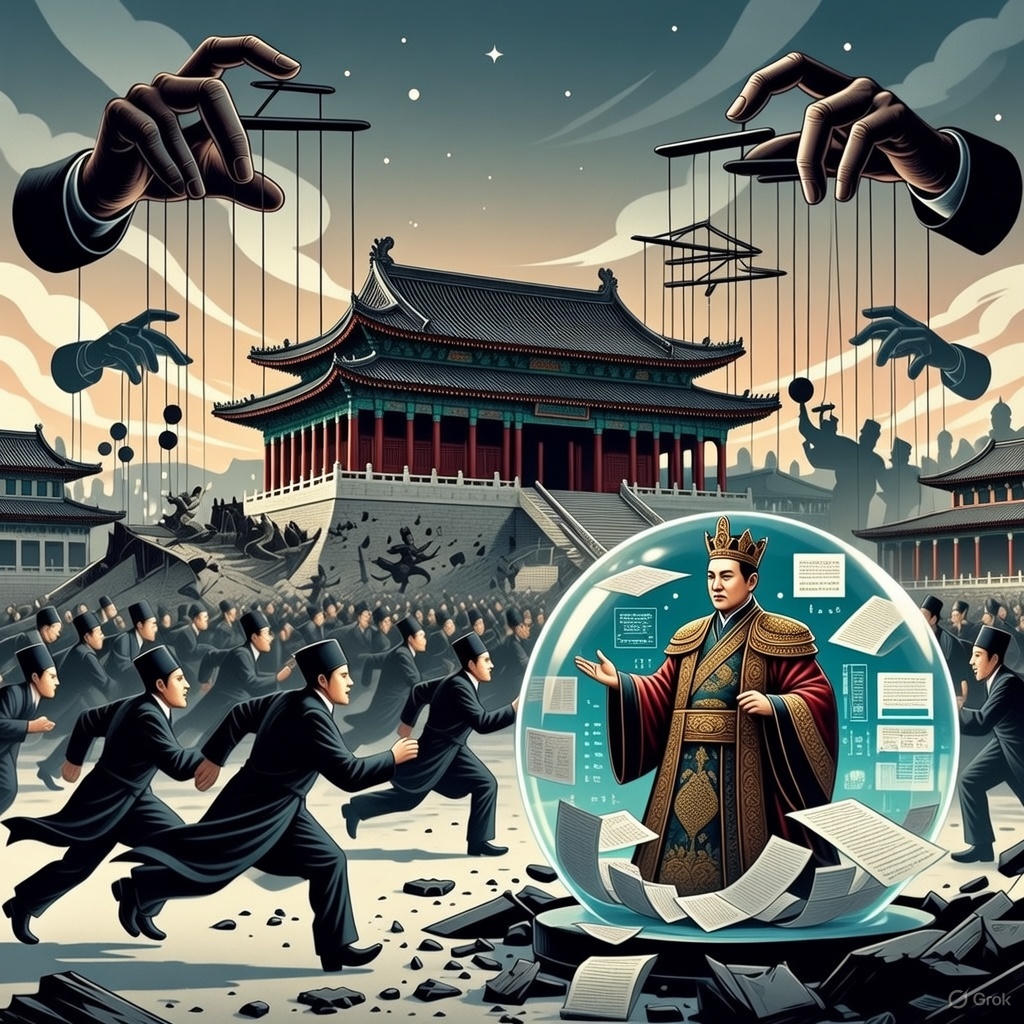
When a dynasty runs out of money, loses credibility, and begins to fall apart from within, it may still look fierce on the surface—thrashing, roaring, baring its teeth. But anyone with clear eyes knows the truth: it doesn’t have much time left.
A dynasty, like a human being, has a life cycle. It is born, it grows, it gets sick, and it ages. The problem is that when a person suffers multi-organ failure and all vital signs are collapsing, even if that person is cruel, incompetent, or utterly detestable, doctors will still attempt resuscitation—if only to follow procedure. If that is true for an individual, it is even more true for a dynasty.
This is why history repeatedly presents us with a strange but familiar scene:
the closer a dynasty is to death, the more obsessed it becomes with reform.
Some dynasties—like the Ming—collapsed abruptly, clean and quick. Others—like the late Tang or the Qing after the Boxer Uprising—managed to survive a few more years by precariously maintaining a delicate balance among competing forces. But this kind of “survival” is merely the maintenance of vital signs. Authority is already gone.
And during this interval—from systemic organ failure to official death—someone will inevitably step forward. It might be the supreme ruler, entrenched interest groups, or emotionally charged but intellectually underpowered mass movements. The Boxers were a classic example: questionable motives, limited intelligence, but tremendous capacity to accelerate disaster in the wrong direction.
They all share the same illusion:
maybe if we shock the heart one more time, the dynasty can still be saved.
And thus, “reform” enters the stage.
Why Do Dying Dynasties Become Abnormally Frenetic?
Ordinarily, a person nearing death becomes quiet—there simply isn’t enough strength left to struggle. Dynasties, however, behave very differently.
A dynasty moving from prosperity to decline, and then sliding toward collapse, rarely waits calmly for the end. On the contrary, the closer it gets to death, the more it displays a kind of pathological hyperactivity.
You begin to see scenes like these:
The emperor works day and night—today announcing reforms, tomorrow rebranding slogans.
Policies are rolled out at an absurd pace: one new document per day, one institutional reshuffle per week.
Senior bureaucratic posts resemble public restrooms—people in, people out, one batch after another.
It all looks extraordinarily diligent, as if corruption is being purged and decay reversed.
But in reality, this is often nothing more than the final convulsions of a dying system.
Naturally, questions arise:
Is the last ruler simply stupid?
Was the reform direction wrong?
Was the effort insufficiently ruthless?
The answer, more often than not, is no.
Truth One: It’s Not That the Ruler Is Stupid—or Blind
It’s true that many last rulers were mediocre. But they were not collectively brain-dead. More importantly, by the final stages of a dynasty, the problems are as obvious as an elephant in the room. Anyone who isn’t blind can see them.
The real issue is this:
the system itself is fundamentally broken and has lost its capacity for self-repair.
Under such conditions, reform is no longer “repair.” It becomes a violent disturbance imposed on a system that is barely holding together. And when a system survives only by maintaining a fragile equilibrium, the harder you shake it, the faster it collapses.
History offers no shortage of examples.
In the Ming dynasty, the postal relay system was abolished to reduce corruption and ease fiscal pressure—a perfectly reasonable idea. Yet among those dismissed was a man named Li Zicheng.
Closer to modern times, consider the Qing dynasty’s constitutional reforms. The plan itself was absurd: thirteen cabinet members, seven from the Aisin-Gioro clan, nine Manchus. But even so, it was technically a step away from absolute autocracy toward constitutional governance.
The result?
Five months later, a single gunshot in Wuchang, and the Qing dynasty was finished.
Gorbachev’s reforms. Louis XVI reopening the Estates-General. The motives were not necessarily evil, and the reformers were not necessarily foolish. Yet the outcomes were strikingly consistent: the patient never made it off the operating table.
Why?
Truth Two: The First Fatal Condition—The Ruler’s Information Bubble
Many people believe “information bubbles” are a product of the internet age. They are not.
Long before algorithms and big data, human beings were already masters at constructing information cocoons—for thousands of years.
The more centralized the system, the thicker the ruler’s information bubble.
During the Opium War, when British troops were defeating Qing forces at casualty ratios approaching one to one hundred, the reports Emperor Daoguang received each day claimed:
“Another great victory over the barbarians” or “local people heroically resisted foreign devils.”
Yuan Shikai, the self-styled Hongxian Emperor, went even further. His son thoughtfully curated a “custom newspaper” just for him. Every day it reported nationwide popular support, people weeping and begging him to ascend the throne. Actors were even hired to perform tearful “petitions.” A man shrewd enough to survive a lifetime of political intrigue ultimately fell flat on his face here.
This was not an isolated case—it was structural inevitability.
When a person holds absolute power over life and death, those around him will inevitably ask themselves:
from which angle should we deceive him for maximum effect?
Opposition, protests, and strikes are suppressed. Even inspections require hired actors. To understand reality, the ruler must rely on professional liars. This is not a personnel problem—you could replace everyone, and two years later you’d still have the same liars.
Under such conditions, a blind man riding a lame horse attempts reform. The outcome is entirely predictable.
Truth Three: The Second Condition—A Rigid Interest Structure
Every dynasty locks in its interest-allocation “genetics” at the moment it seizes power.
Liu Bang rose with the Pei County military clique, hence “no Liu blood, no kingship; no military merit, no nobility.”
The Qing had the Eight Banners.
The Ming had imperial clans.
At its core, this is always the same story: the royal house dividing the cake with its base.
During periods of expansion, this structure is highly efficient. But once circumstances change, it becomes untouchable.
When the state is strong, they take the largest share of the cake.
When the state weakens, their share remains off-limits.
Thus, when crisis finally arrives, the ruler faces a brutal reality:
there seem to be many paths forward, but in fact, not a single one is viable.
Every reform proposal crashes into the same wall:
“Ancestral laws must not be changed.”
Truth Four: The Third Condition—Systemic Backlash from Interest Groups
Long-term rule inevitably produces deeply entrenched interest groups.
They control rule-making, enforcement, interpretation—and can even redirect imperial edicts themselves toward outcomes that benefit them most.
Reform taxation?
They pass the burden straight down to the bottom.
Clean up officialdom?
They produce impeccable evidence to send non-allies to the chopping block.
Break monopolies?
They are perfectly willing to paralyze entire sectors, ignite public outrage, and leave the ruler trapped on all sides.
Thus, reform becomes a grand spectacle:
thunderous in appearance, meaningless in effect.
Its only tangible outcome is higher social friction.
Why Is No One Willing to Take the First Step?
The answer is simple:
whoever concedes first, dies first.
The moment someone relinquishes their share, it is immediately devoured by their peers. And that person becomes the first sacrificial offering of the collapsing dynasty.
This produces a grotesque form of collective rationality:
Everyone collapsing together is acceptable.
But whoever “awakens” first is finished first.
The result?
Everyone knows where the problem lies.
What must be changed cannot be changed.
What can be changed changes nothing.
And the harder you struggle, the closer you get to the cliff.
Conclusion: The Ending Was Written from the Beginning
Reforms at the end of a dynasty are never a cure.
They are adrenaline shots.
They make the patient briefly lucid, violently convulsive, and seemingly full of life—
at the cost of dying faster, and more completely.
History has told this story countless times already.
Telling it once more will not change the ending.
原文
王朝最后的改革,总是加速崩溃?
当一个王朝财政枯竭、信用破产、统治集团离心离德的时候,即便它表面上还在张牙舞爪、看起来凶得很,明眼人其实都清楚:这玩意儿能喘气的日子,已经不多了。
王朝和人差不多,也有生命周期。会出生,会成长,会生病,也会衰老。问题是,当一个人多器官衰竭、生命体征全面下滑时,哪怕这个人再坏、再该死,临床上也总要抢救一下,至少走个流程。个人尚且如此,何况一个王朝。于是我们在历史上反复看到一个诡异但熟悉的场景:越是快不行的王朝,越喜欢折腾改革。
有的王朝,像大明,直接“嘎嘣脆”地挂掉了;有的王朝,像晚唐、庚子事变之后的清朝,在各方势力勉强维持微妙平衡的前提下,还能苟延残喘几年。但这种“活着”,本质上只是维持生命体征,权威早已丧尽。而在这段从“器官衰竭”到“正式死亡”的过程中,总会有人跳出来——可能是最高统治者,可能是既得利益者,也可能是脑子不太好但情绪极其饱满的群众。比如义和拳这种,动机可能不纯,智商也不高,但往往能起到极强的反向加速作用。他们共同抱着一种幻想:是不是再给王朝垫一下心脏起搏器,就能抢救回来?
于是,“改革”登场了。
为什么临终王朝反而异常亢奋?
通常来说,一个人临终前会比较安静,因为已经没力气折腾了。但王朝不一样。一个王朝从鼎盛走向衰败,再滑向崩塌,大概率不会安安静静等死,而是越接近死期,越呈现出一种病态的亢奋。
你会看到这样的景象:万岁爷废寝忘食,今天要改革,明天要优化口号;
政策出台的频率高得离谱,一天一个新文件,一周一次机构调整;
高级官僚的位置更像公共厕所,来了一波又一波,换了一茬又一茬。
看起来异常勤政,仿佛一切都在“除弊革新”。
但问题是——这往往正是王朝临终前的那几下抽搐。
于是有人开始问:
是不是末代皇帝智商不行?
是不是改革方向选错了?
是不是用力不够狠?
答案往往是否定的。
真相一:不是皇帝太蠢,也不是问题看不见
说实话,末代统治者里确实不乏能力平平者,但也没到“集体弱智”的程度。更重要的是,到了王朝末年,问题早已大到像房间里的大象——只要不瞎,谁都看得见。
真正的问题在于:
整个系统已经彻底失调,丧失了自我修复能力。
在这种状态下,任何改革都不是“修复”,而是对一个脆弱平衡系统的强烈扰动。而当系统本身已经靠勉强平衡吊着一口气时,你动得越狠,塌得越快。
历史上这种例子并不少见。
远一点的,有明朝裁撤驿站体系,初衷是削减低效腐败、减轻财政负担——听起来完全合理。结果裁员名单里,出现了一个叫李自成的人。
近一点的,有清末君主立宪。方案当然扯淡:十三个内阁成员,七个爱新觉罗,九个满人。但再怎么说,从“主子奴才治天下”往“立宪”方向挪了一步,按理也算进步。
结果呢?
五个月后,武昌一声枪响,大清彻底下线。
类似的还有戈尔巴乔夫的改革、路易十六重启三级会议。改革的动机未必邪恶,改革者也未必愚蠢,但结局高度一致:病人全都没能下得了手术台。
为什么?
真相二:第一个致命病灶——统治者的信息茧房
很多人以为“信息茧房”是互联网时代的产物,其实完全不是。
在大数据出现之前,人肉大数据制造的信息茧房,已经存在了几千年。
越是集权的体制,统治者的信息茧房越厚。
鸦片战争时期,当英国士兵用一比一百的战损比,把清军打得满地找牙时,道光皇帝每天收到的奏章却是:
“今日又大败洋人”“某地民众拒奸洋鬼”。
洪宪皇帝袁世凯,更是被儿子贴心地“定制”了一份报纸。每天打开一看,全国人民嗷嗷待哺,哭着求他登基。隔三差五,还有安排好的演员来痛哭流涕“劝进”。这位精明了一辈子的人精,最终就在这里栽了个翻不了身的大跟头。
这不是个别现象,而是结构性必然。
当一个人掌握了生杀予夺的权力,他身边的人就一定会研究:
从哪个角度蒙他,效果最好。
反对、抗议、罢工被全面压制,连视察都得用演员。统治者想了解现实世界,只能依赖身边那群“语言艺术家”。这不是换一拨人就能解决的问题——换你在那个位置待两年,你也会成为艺术家。
在这种情况下,一个“盲人骑瞎马”的统治者,开始推动改革,结果基本可想而知。
真相三:第二个病灶——僵化的利益结构
每一个王朝,在“打天下”的那一刻,就已经确定了自己的利益分配基因。
刘邦靠沛县军工集团起家,于是有了“非刘姓不得封王,非军功不得封侯”;
清朝有八旗;明朝有宗室;
本质上,都是皇室与基本盘在分蛋糕。
在王朝上升期,这套结构效率极高;但一旦环境变化,它就会变成不可触碰的禁区。
国家强盛时,他们拿走最大那块蛋糕;国家衰弱时,动谁都不能动他们的奶酪。
于是,当危机真正来临,皇帝会发现一个残酷现实:看起来路很多,其实一条都走不通。
每一条改革路径,都会撞上那堵写着“祖宗之法不可变”的墙。
真相四:第三个病灶——利益集团的系统性反噬
长期统治,必然催生盘根错节的利益集团。
他们掌握规则制定权、执行权、解释权,甚至能把皇帝的旨意本身,重新导向对自己最有利的结果。
你要改革税制?
他们能把新税负,原封不动转嫁给底层。
你要整顿吏治?
他们能用滴水不漏的证据,把“不是自己人”的官员送上铡刀。
你要动垄断特权?
他们敢让整个行业直接瘫痪,搞到民怨沸腾,让你里外不是人。
于是,改革变成了一场热闹的表演:
看似雷霆万钧,实则毫无进展;
唯一的成果,是更高的社会摩擦成本。
为什么没人愿意迈出第一步?
答案很简单:
谁先让利,谁先死。
只要有一个人率先放弃利益,他那部分资源立刻会被同类瓜分殆尽,而他本人,也会成为王朝崩塌的第一个祭品。
于是形成一种诡异的集体理性:
大家一起完蛋没问题,
但谁先“觉悟”,谁先完蛋。
结果就是:
所有人都知道问题在哪;
该改的地方不能改;
能改的地方,改了也没用;
越折腾,离悬崖越近。
结语:结局从一开始就已经写好
所以,王朝末年的改革,从来不是“救命药”,而更像一针肾上腺素。
它能让病人短暂清醒、剧烈抽搐、看起来生机勃勃,
但代价是——死得更快,也更彻底。
这样的故事,历史已经讲过无数遍了。
再多讲一遍,也不会有什么意外。