— Finding a Way to Live When the Rules No Longer Work
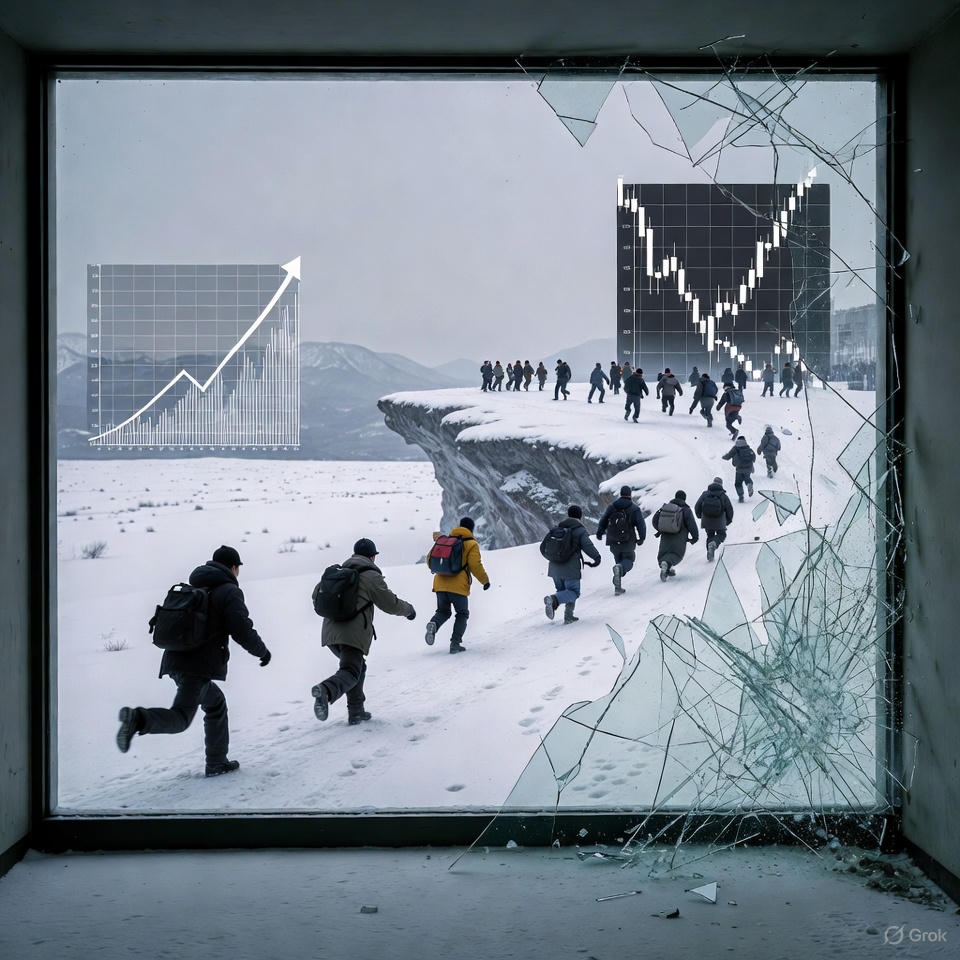
When the glass wall of the old world shatters, we finally realize:
we’ve been living inside a game designed by someone else.
The first snow of this “late-dynasty” winter arrived earlier than usual. The news still praises prosperity, the economic numbers still look impressive, yet ordinary people feel their wallets getting lighter and their lives more pressured. Jobs are disappearing, wages stagnate, and living costs are accelerating like someone stepped on the gas pedal.
Everything appears to be improving, yet no one genuinely feels their days becoming easier.
The gap between narrative and reality is one of the classic signs of a dynasty’s final years—an era still draped in grandeur on the surface while deep cracks quietly spread underneath.
Many people continue running on the familiar track, believing diligence and obedience will lead to a stable and dignified future. But the more they run, the more they discover the path doesn’t end in achievement—it ends on a cliff.
The algorithms we once relied on no longer function, and new ones have not yet formed.
1. When the Old World Begins to Loosen: The Unreliability of Rules
For decades, life followed a simple and predictable logic:
- follow the rules
- work hard
- wait for the future to reward you
In times of growth, this formula truly worked. It helped many families achieve stability and upward mobility.
But when a system begins to weaken, the first thing to collapse is often the reliability of its rules.
- Promises written into policies become blurry
- “Stable jobs” cease to be stable
- “Predictable career paths” suddenly vanish
- Hard work no longer guarantees progress
- Experience slowly turns into a burden
- Career transitions become increasingly difficult
Trust doesn’t shatter in a single moment. It erodes quietly through countless small disappointments.
When more and more people realize:
The old way simply stops working—
that is a clear sign the era has changed.
2. The Real Test of Our Time: When Old Logic Stops Making Sense
Most people think the greatest danger in a turbulent era is chaos itself.
But for ordinary individuals, the truly fatal risk is something subtler:
Using the logic of yesterday to navigate the world of tomorrow.
For decades, the path to success was straightforward:
- more effort → better life
- more obedience → more stability
- more diligence → more opportunity
- more compliance → less risk
This made sense in an era fueled by rapid growth.
But in an era of stagnation, contraction, and uncertainty, these rules become a trap.
To keep living meaningfully in a narrow, shifting space, we must refresh our internal operating system—our worldview, our assumptions, our sense of direction.
3. From a Player to a Programmer: Seeing the Code Behind the Rules
Most people treat society like a linear, predictable RPG:
- clear tasks
- fixed leveling routes
- stable rewards
- predictable outcomes
But real life does not work that way.
When the system becomes unstable, we can no longer simply “follow instructions.” Instead, we must look at the game through the eyes of a programmer, asking fundamental questions:
- Who designed this rule?
- What purpose does it serve?
- Who benefits the most from it?
- Who is included, and who is excluded?
- Does it still work in today’s world?
- If it fails, what are my alternatives?
Once you can ask such questions, you stop being a passive participant and begin shaping your own path through uncertainty.
This is the starting point of cognitive freedom.
4. The Hacker’s Perspective: Finding Survival Space in Unfriendly Systems
Seeing through rules is not about becoming cynical; it’s about acting more effectively.
After the “programmer perspective,” the next step is what I call the hacker perspective—practical strategies for surviving inside imperfect or even deteriorating systems.
The process includes four steps:
Step 1: Stay Quiet, Observe First
The more chaotic things become, the less useful it is to react emotionally.
Remain silent.
Observe.
Study people who seem calmer, wiser, more experienced:
- What choices do they make?
- How do they navigate uncertainty?
- Where do they put their energy, and where do they hold back?
Observation is the lowest-cost training tool in turbulent times.
Step 2: Test the Boundaries and Rebuild Your Map of Reality
Rules written on paper rarely match the real rules in practice.
Start by pushing small boundaries:
- leave work on time occasionally
- decline unreasonable demands
- give yourself space to step back
- allow yourself not to be “perfectly compliant”
- gently expand your personal boundaries
You’ll discover the world is less rigid—and less punitive—than you were taught.
This gradual testing helps rebuild your confidence and sense of agency.
Step 3: Use the Rules Instead of Being Used by Them
Every system has contradictions and loopholes.
People who thrive in difficult times know how to navigate them without harm.
Examples:
- The company wants “innovation”?
→ Deliver zero-risk innovation: refinements, improvements, visual adjustments. - Mandatory training sessions?
→ Use them to network internally. - Leadership values appearances?
→ Give them appearances, while protecting your substance. - Strong performance pressure?
→ Identify tasks that offer high reward with low personal cost.
This isn’t manipulation.
This is finding breathable space inside a tightening structure.
Step 4: Cognitive Freedom—The Rarest Currency in Turbulent Times
Cognitive freedom means:
- not worshiping rules blindly
- not over-identifying with authority
- not being captured by dominant narratives
- not mistaking emotion for truth
- not living someone else’s version of life
This is the most valuable ability in a late-dynasty era.
Someone with cognitive freedom remains steady even when the world is shaking.
They maintain clear judgment, avoid extreme decisions, and act with both caution and independence.
5. A Letter to You, Walking Through the Cracks of This Era
Our generation carries heavy responsibilities.
We take care of parents, raise children, pay mortgages, navigate careers—and do all this while living through one of the most uncertain periods in recent history.
We may not change the world like heroes in stories, nor influence the grand trends like those with power or capital. But we can still live with awareness, dignity, and clarity.
We can still choose to:
- resist blind obedience
- resist outdated mindsets
- refresh our worldview
- preserve personal boundaries
- build resilience quietly
- grow in ways that uncertainty cannot stop
At the end of a dynasty, the snow does not fall to bury people.
It falls to remind us:
Winter has arrived, and with it comes the need for a new way of living.
So I hope, in this complicated, noisy, sometimes absurd era, you can hold onto three things:
- clarity in chaos
- rhythm under pressure
- a quiet willingness to move forward despite uncertainty
The snow will melt.
A new world will eventually emerge.
And you—steady, thoughtful, awake—will walk through it.
原文
雪落王朝末年:写给在时代夹缝中前行的人
——在规则失效的年代,寻找个人的生存之道
当旧世界的玻璃幕墙轰然碎裂,我们才突然意识到:
原来自己一直生活在别人设计的游戏里。
那场比往年来得更早的雪,悄无声息地落在这个时代的屋檐上。新闻里依旧唱着繁荣,经济数据依旧漂亮,但普通人的钱包却越来越轻。工作岗位减少、工资增长停滞、生活成本却像被按下加速键一般一路上扬。
明明一切看起来都“在变好”,却没人真的觉得日子更轻松了。
现实和叙事之间的巨大落差,正是王朝末年的特征之一——表面依旧华丽,但裂缝已经从内部悄然蔓延。
许多人仍像过去几十年那样努力奔跑着,相信只要勤勤恳恳、遵规守矩,就终会换来一份体面的未来。只是跑着跑着,才突然发现:道路尽头不是终点,而是悬崖。
过去的算法开始失效,新的规则却尚未生成。
一、当旧世界开始松动:规则不再可靠
过去我们习惯的逻辑是简单而清晰的:
- 遵守规则
- 勤奋努力
- 静待未来兑现回报
在增长时代,这套逻辑确实让许多人过上了体面稳定的生活。
但当大环境开始松动,规则的可靠性率先下降。
- “写在制度里”的承诺开始变得模糊
- “稳定单位”不再稳定
- “按部就班”不再有效
- 经验正悄悄变成枷锁
- 跨行业、跨职业的路径变得更加崎岖
信任往往不是被“一次重大事件”击碎的,而是被许多不易察觉的小变动慢慢侵蚀。
当多数人开始发现:
按老路走不通了。
那说明时代确实已经变了。
二、时代的真正考验:旧逻辑的失效
王朝末年的真正考验不是动荡本身,而是人们是否能在动荡中更新自己的“思维操作系统”。
最大的风险不是环境恶化,而是:
继续用旧世界的规则玩新世界的游戏。
过去几十年的成功模式是清晰的:
- 更努力 → 更好生活
- 更听话 → 更稳定
- 更勤奋 → 更有未来
- 更顺从 → 更少风险
这在增长时代确实成立,但在存量时代、变化时代,它反而会让人受伤。
要想在夹缝中活下去,我们必须更新对世界的理解方式。
三、从“玩家视角”到“程序员视角”
多数人都把社会当成一款“线性可预测的 RPG 游戏”:
- 任务清晰
- 升级路径明确
- 奖励可预计
- 努力总有回报
但真实世界并不是这样的。
在体系不稳时,我们不能再当“只会按指令行动的玩家”,而要像“程序员”一样拆解规则,理解底层逻辑。
程序员视角提出的问题:
- 这条规则是谁制定的?
- 它存在的目的是什么?
- 谁从中获益最大?
- 规则涵盖谁、排除谁?
- 它现在是否仍然有效?
- 若失效,我有什么替代方案?
当你能问出这些问题,你就不再被动,而是在构建自己的“时代求生手册”。
四、黑客视角:在规则缝隙中找到生存策略
看清规则不是为了愤怒,而是为了行动。
以下四个步骤,都能在生活中实际用得上。
1. 第一步:闭嘴,观察
越是混乱,越不要急着表达情绪。
保持安静、观察环境,你会看到:
- 哪些规则正在崩塌
- 哪些仍然有效
- 谁适应得更快
- 谁在无意识陷入风险
- 哪些选择值得借鉴
- 哪些路永远走不通
观察是低成本的生存训练。
2. 第二步:试探边界,更新认知
规则的真实边界往往与表面描述不同。
在生活里,从小处试探:
- 偶尔准点下班
- 偶尔拒绝不合理要求
- 偶尔给自己一点空间
- 偶尔让自己不那么“听话”
- 偶尔把个人边界轻轻往前推一点
你会发现:世界并没有想象的那么可怕。
这种“边界感的重建”会让你拥有更真实的底气。
3. 第三步:利用规则,而不是被规则压垮
每套体系都有漏洞和矛盾,真正聪明的人会从缝隙里穿过去。
- 公司要创新 → 可以做“零风险创新”
- 单位要学习活动 → 可以借机拓展人脉
- 领导要形式效果 → 可以给足形式但保留自己
- 绩效驱动 → 可以找到“高回报、低消耗”任务
这不是投机,而是 在不友好的体系中寻找可生存的角落。
4. 第四步:认知自由,是乱世最稀缺的资源
认知自由意味着:
- 不迷信规则
- 不盲从权威
- 不被叙事綁架
- 不把情绪当真相
- 不把“别人说的生活”当成自己的生活
这是王朝末年最重要的能力。
一个拥有认知自由的人,无论走到哪里,都不会过度依附于外界的框架,也不会随时代的情绪剧烈波动。
五、写给在夹缝中前行的你
我们这一代人,很不幸也很幸运。
不幸在于:
我们赶上了大变局、大调整、大洗牌。
幸运在于:
我们能活在一个节点,一个可以见证大结构更替的时代。
而生活本身不会因为时代复杂就停下来。
我们依然要吃饭、工作、照顾家人、寻找意义、经营关系。
身处这样一个夹缝时代,你不必成为英雄,也不必承担时代使命,只需要做到:
- 不盲从
- 不沉睡
- 不被旧规则绑架
- 保持学习与更新
- 在缝隙中找到自己的节奏
- 用更柔韧的方式活下去
在这个复杂世界里,愿你拥有这样三样能力:
在混乱中保持清醒,
在压力下保持节奏,
在不确定里保持一种向前的意愿。
雪终会融化,新世界也终会出现。
而你,只需要稳稳地走过去。