Let me start with a simple question:
Do you think you belong to the bottom of society?
Many people would say yes.
They commute on crowded trains, earn modest salaries, eat cheap takeout, live in tiny rented apartments. “If this isn’t the bottom,” they might ask, “what is?”
But here’s the uncomfortable truth:
If you have the leisure to read essays like this, you are not at the bottom.
Not even close.
The Bottom Is Not What You Think
Delivery workers, security guards, janitors — are they the bottom?
Yes. But they are the upper tier of the bottom.
Below them are the drifters — people who work one day and disappear for three. They float at the margins of the system.
And below even that?
The truly invisible.
Like cockroaches, they don’t appear under bright lights. They only emerge quietly at night to salvage what remains of life.
The homeless.
Abandoned elderly.
People without legal identity.
Those with severe physical or mental disabilities who have fallen completely outside the social machine.
Most people living in daylight know almost nothing about them. Our understanding is abstract, imagined.
In a growing society, that ignorance doesn’t cost much.
In a declining one, it becomes dangerous.
Because when the tide goes out, people don’t fall gently — they drop.
And suddenly, the “bottom” is no longer distant.
The Bottom Is Not a Group — It’s a System
The bottom is not defined by job titles.
It is a system.
A survival logic.
An operating mode outside the awareness of the comfortable majority.
I grew up in a place people called a “no-man’s zone.”
Large gang fights weren’t common, but small-scale violence was routine. Students fought. People died. I lost two classmates in middle school — beaten to death.
In that environment, the local heroes weren’t entrepreneurs or scholars. They were gang figures.
Knowledge itself was rare. I once met someone who sincerely asked me how to write the most basic Chinese character for “middle.”
That wasn’t a joke. It was the ecosystem.
If you didn’t want to be bullied, the simplest solution was to join the bullies.
I never fully crossed that line. But I saw enough.
Later, I left that world. I entered what we call “normal society.”
People reasoned. They negotiated. They didn’t pull knives during arguments.
For years, I believed this was the natural state of humanity.
I was wrong.
Civilization Is a Thin Layer
Recently, I’ve noticed something unsettling.
People raised in stable, middle-class environments are confused.
They ask:
Why do some people default on debts without shame?
Why does minor conflict escalate into violence?
Why does public authority retreat?
Why does “whoever is softer gets crushed” seem to be the rule?
Their worldview is cracking.
To me, it feels like the server has rolled back to an earlier version.
Being familiar with chaos doesn’t mean liking it.
You can survive in the wilderness without wanting to live there.
But you understand something they don’t:
Order is not permanent.
Civilization is often a luxury supported by economic growth.
When growth stalls, the polish fades.
And the raw structure underneath reappears.
The “Basementization” of Society
I call this process social basementization.
Not because everyone will become homeless tomorrow.
But because the behavioral logic of society begins shifting toward bottom-level survival mode.
What defines that mode?
- Extreme resource scarcity
- Zero-sum competition
- Erosion of predictable rules
- Contracts that no longer hold
People often talk about “the poor hurting each other.”
But this isn’t about morality.
It’s about survival strategy under pressure.
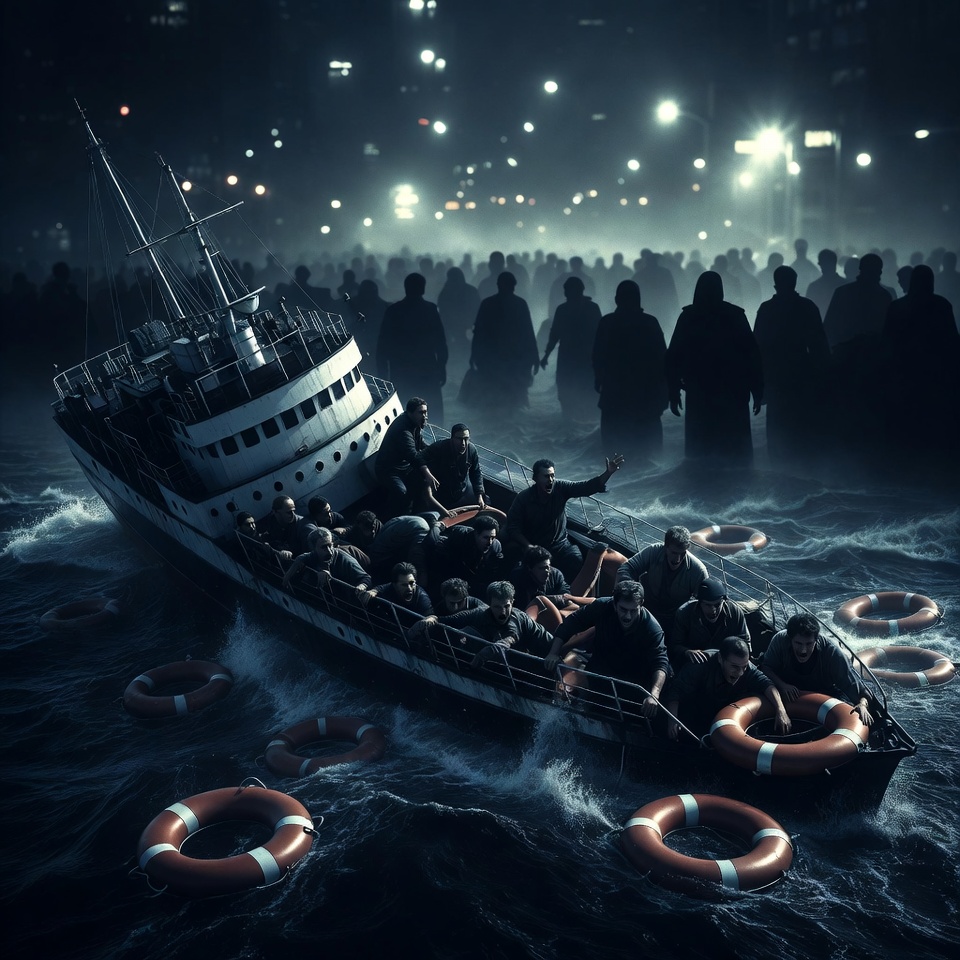
On a sinking ship, there is no elegant game theory.
There is only the scramble for a life ring.
If you get more, I may drown.
That isn’t chess.
That’s desperation.
When the Social Contract Breaks
A functioning society rests on one promise:
If you follow the rules, you will be protected.
When that promise collapses, the moral framework of the “civilized” becomes obsolete overnight.
Those who were raised to believe in fairness, institutions, and predictability feel betrayed.
It is not personal weakness.
It is structural dislocation.
When civilization logic clashes with survival logic, something breaks inside people.
The adjustment that follows is painful.
It may feel like evolution.
It may feel like regression.
From Mocking the Bottom to Becoming It
First, we mock the bottom.
Then we try to understand it.
Eventually, we risk becoming it.
The real question is not whether this shift is happening.
The real question is:
When order recedes, how do we survive without losing ourselves?
That conversation continues.
If you’d like, I can also:
- Sharpen this into a more provocative political essay
- Reframe it in academic / sociological language
- Adapt it into a YouTube narration script
- Or compress it into a viral X (Twitter) thread version
Tell me which platform you’re targeting, and I’ll optimize it precisely for that audience.
原文
当秩序退潮:我们如何一步步走向“底层化”
你觉得自己是社会的底层吗?
很多人可能会回答:是啊。我每天挤地铁挤公交去上班,拿着微薄的工资,吃着油腻的外卖,住在狭小的出租屋里,还有谁比我更底层?
如果你也这么想,我只能说一句:可能是“富裕”限制了你的想象力。
甚至可以这么说——凡是还能有闲暇看这些内容的人,不但不算底层,甚至离真正的底层还很远。
什么是底层?
外卖员、保安、清洁工算吗?
算。但那只是“底层中的上层”。
再往下,是三和大神那类人——做一天玩三天,漂浮在社会边缘,这是底层中的中层。
而真正最底层的呢?
说句可能有点冒犯的话——像蟑螂一样。
在灯火通明的白天你看不到他们,只有夜深人静时,他们才会出来“捡一点生活”。
他们包括无家可归的流浪者,被遗弃的老人,与社会系统断裂、没有身份的人,还有身心严重失能、彻底失去劳动能力的人。
绝大多数生活在阳光下的人,对这些人几乎一无所知。我们的认知,多半靠想象。
在一个正常向上的社会,这没什么问题。但在一个稳步下行的社会里,当越来越多的人守不住原有的生活,像下饺子一样跌落,每个人都会越来越多地接触到底层。
如果这时还对底层一无所知,那问题就严重了。
底层不是一群人,而是一种系统
在我看来,底层不是某种职业,也不是某类人。
底层是一套独立运行的系统,是一种存在于大多数人认知之外的意识形态。
要理解这一点,我得说点自己的经历。
我成长的地方,并不算安定。外人称那里是“三不管地区”。
大规模群架不常见,但小规模斗殴几乎每天都有。学生也一样。
我初中三年,学校里死过两个学生——被打死的。
在那种环境里,年轻人的偶像是“浩南哥”。
如果你崇拜罗德曼,那已经算“有文化”。
我认识一个人,有次认真问我:“‘中’字怎么写?”
这不是段子,这是现实。
在那种地方成长,如果不想天天被欺负,最简单的办法就是——加入他们。
我没有真正混进去,但各种灰色边缘的事情也见过不少。
我见识过底层社会的暴力与无序,而且是从小开始。
后来离开了那个环境,慢慢回到所谓“正常社会”。
我发现人是可以讲道理的,是可以克制的。
争执不需要掏刀。
现在身边的人评价我“温和”。
他们不会知道,我曾经因为被威胁,把家里的斩骨刀藏在书包里,背了两个星期上学。
还好,最后什么都没发生。
文明的外壳正在剥落
这些年,我脑子里总会冒出一句话,来自《三体》:
在这样的时代,野蛮人反而有用。
很多文明出身的人正在困惑:
- 为什么有人欠钱不还还理直气壮?
- 为什么一点小矛盾就要动手?
- 为什么公权力开始退缩?
- 为什么“谁软弱,谁被欺负”?
他们的三观在崩塌。
而我,只是觉得——服务器回档了。
熟悉这种环境,不代表喜欢。
就像你能在荒野生存,不代表你愿意吃生肉。
只是你知道,秩序从来不是理所当然的。
所谓文明,有时只是经济上行期维持出来的体面外壳。
当资源撑不住,外壳就裂开了。
露出的,是底色。
全社会的“底层化”
我给这个现象起了个名字:
全社会底层化。
不是说明天大家都去睡桥洞。
而是说——
整个社会的行为模式,正在向底层逻辑靠拢。
那套逻辑是什么?
零和博弈。
资源极度稀缺。
秩序不再可靠。
规则不再兑现。
底层互害,并不是道德低劣,而是生存策略。
在沉船上抢救生圈,不存在优雅。
你多一口,我可能就饿死。
这不是棋局,这是求生。
当契约失效
社会的本质是契约。
“守规则会被保护”
这是文明社会最基础的承诺。
当这个承诺失效,文明人的行为逻辑就作废了。
他们用理性框架理解世界。
但世界正在变得非理性。
于是,认知先崩塌。
不是某个人的错,而是结构失序。
文明逻辑与生存逻辑发生冲突,产生系统性崩溃。
个体能做的,只有一次被迫的进化——
或者说退化。
从嘲笑到底层,到成为底层
曾经我们嘲笑底层。
后来理解底层。
再后来,可能成为底层。
真正的问题不是“会不会”,而是——
当秩序退潮时,我们如何活下去?