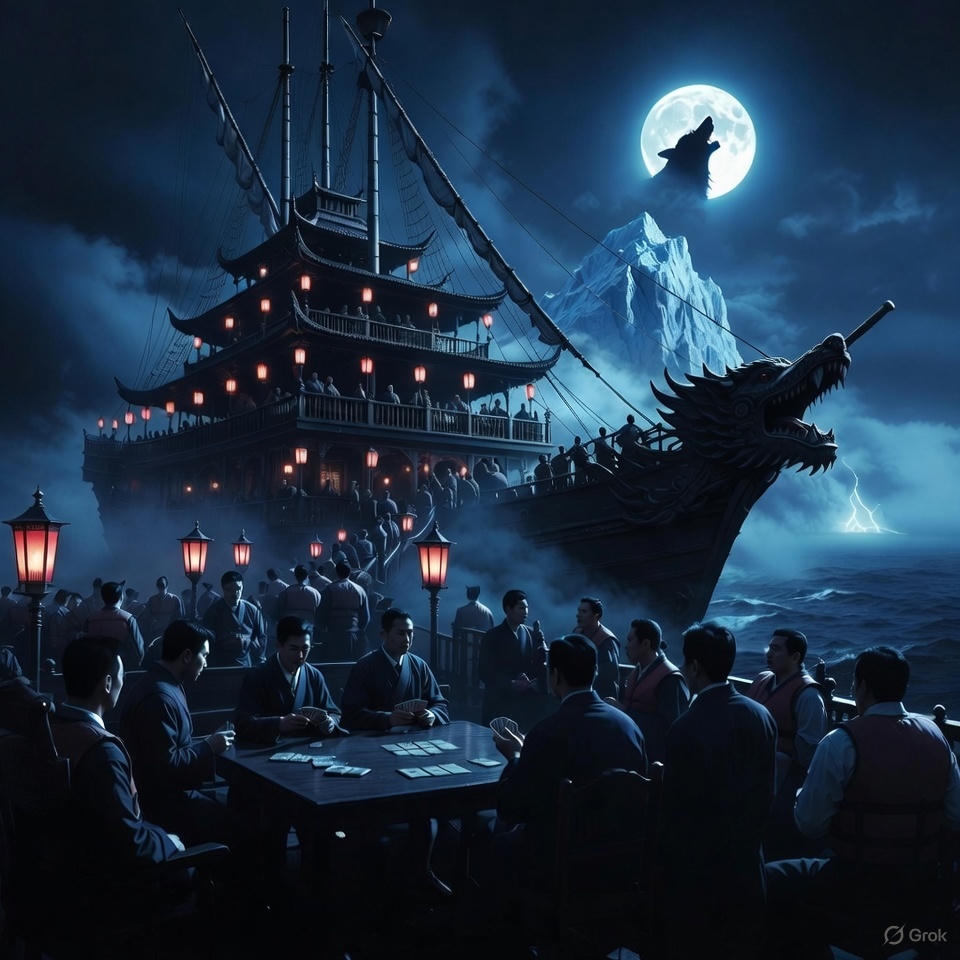
When a dynasty faces the collapse of both its economy and legitimacy, the situation worsens day by day. At this point, rulers often struggle to find effective ways to turn the course of the ship around. Eventually, it seems like everyone is destined to accelerate towards the iceberg. During this “garbage time,” people are like passengers on the deck, watching the iceberg grow ever closer, cursing while putting on life vests and making futile preparations. Of course, some people, whether due to ignorance or optimism, continue “playing music and dancing.”
Meanwhile, another group aboard the ship—from the noble captain to the ordinary sailors, to the hardworking boiler workers—these “institutional personnel” control, to some extent, the fate of the ship. However, most of them too are doomed to crash into the iceberg along with the ordinary passengers. So, what expressions will be on their faces as the iceberg looms larger? What thoughts will cross their minds? This is an often overlooked perspective. It seems that everyone assumes that people within the system should mechanically execute orders like NPCs until the system crashes and they silently go offline.
However, both in history and in reality, this group often includes true social elites, with resources far beyond those of ordinary people. Logically, they are the protagonists of society, while we, the “chives,” are the NPCs. Therefore, when discussing the collapse of a dynasty, we cannot ignore these people. In this article, we shift the perspective from the outside to the inside and speculate on what interesting things will happen within the ruling group as it heads toward the iceberg. First, we need to dispel a misconception. In the subconscious of the masses, the ruling group is often imagined as an almost omniscient and omnipotent “Cthulhu,” like Big Brother, always watching everyone, extending countless tentacles to control everything. They unite to oppress the masses and squeeze wealth—after all, “officials protect each other, and corrupt officials thrive together.” Rationally, we know this is unrealistic, and society is not simply black and white, but we are still subconsciously influenced by this view. After all, we have been educated in a binary world: light and dark, righteous rebels and cold-blooded slave masters. It’s like in the movies when the brutal Long-Legged Edward ties the freedom fighter William Wallace to the scaffold, and the protagonist shouts “freedom,” igniting the entire crowd—this is the plot most familiar to the public.
But in reality, no one is a monolithic villain. The world is never divided into “good guys” on one side and “bad guys” on the other, fighting until the end. Any group, even a small team, is difficult to make entirely cohesive. Remember when you were in school, could the few naive kids in the dorm ever be completely united? Even in a boys’ dorm, let alone a girls’ dorm with “five people, six groups,” how much more complex is a ruling group made up of numerous individuals with different motives, plotting against each other, especially when the group faces a major crisis?
In fact, any large organization—whether it’s a political party, an interest group, or a multinational company—finds it difficult to align everyone’s interests. Infighting is often more vicious than external battles: you hold my secrets, I dig up your dirt; when opportunities arise, people rush in and turn on each other with precision. It’s like playing Mahjong—you need to defend against the player on your left, keep an eye on the one on your right, and watch the opponent across from you. This is the norm.
Therefore, what we perceive as the invincible “Cthulhu” (or “Leviathan”) is actually a monster made up of individual “cells” each with their own ulterior motives. Its sensory system often malfunctions, and even when it doesn’t, its responses are slow. When its limbs are cold, its brain mistakenly thinks it needs further cooling; when the left hand doesn’t know what the right hand is doing, they often end up fighting. It is neither omniscient nor omnipotent—it’s more like a “Frankenstein” suffering from the aftereffects of a stroke. On the eve of a dynasty’s collapse, this group, bound together purely by interests, is bound to put on a spectacular drama.
A similar scenario played out over a hundred years ago during the Qing Dynasty under the “wise” leadership of Emperor Xuantong, Regent Zaifeng, and Empress Dowager Longyu. A gunshot in Wuchang set off a series of events: Premier Yuan Shikai led a coup, provincial governors like the Jiangsu governor declared independence, local military forces and generals defected, and even low-level officials went on strike. Among them were many opportunists who took advantage of the situation to seize public assets for themselves. These were just the visible ones—many others were fence-sitters, openly proclaiming loyalty to the emperor during the day but secretly contacting revolutionaries at night. Who among them hadn’t once shouted “Long live the emperor!” at the top of their lungs? Who hadn’t been one of the Qing Dynasty’s “loyal ministers” or “pillars of the state”? Who hadn’t sworn to the court that they would fight the revolutionaries to the death and protect the Qing Dynasty for eternity?
From a distance, the Qing court appeared unified and strong, with wise officials and loyal ministers everywhere. Even though there were rebels in Wuchang, they would soon be crushed. This seemingly ironclad dynasty seemed invulnerable, with another 300 years of prosperity in store. But as the dynasty neared its end, all sorts of defections, betrayals, and backstabbing happened—”Sorry, I’m an undercover agent,” and “Sorry, I’m the undercover agent’s undercover agent.” There were of course direct conflicts, but the undercurrent was even harder to understand—the complex drama of a collapsing dynasty. Until the final moment, no one could predict what would happen. In this historical tide, billions of tiny particles float aimlessly in the current, making any attempt to predict the outcome akin to a fool’s dream.
History, as it has done countless times before, will likely unfold in ways that ordinary people can’t imagine. But this doesn’t prevent us from speculating, from a human and logical perspective: what kind of dilemmas will each level of the group face? How will they respond? How will their responses affect the big picture? This can help us build a framework for understanding how a dynasty collapses from within.
Let’s start by imagining the core of the ruling elite—typically composed of the highest leaders (such as the emperor) and their trusted confidants. Does the emperor spend his days cleaning golden toilets, planting vegetables, with snacks like fried dough sticks in his drawers, eating fried dough sticks dipped in sugar every day? We’ve never seen it, so we don’t know. But the challenges they face are obvious:
First, the shrinking economic pie leads to a “not enough cake to share” situation. The higher-ups are not loners; they are high because there is a large group of underlings helping them climb. Why do these underlings support them? Because they can rise and make money by following them. But now, it’s unclear whether they can still get promoted, and the chances of making money have greatly narrowed. The once lucrative projects (like land and real estate) are no longer profitable, engineering projects are becoming less profitable, and tax revenue is visibly shrinking. Everyone is tightening their belts. How can you appease your underlings? And how can your underlings appease theirs? You can’t expect everyone to go hungry. “Boss, it’s tough for us down here.” Thus, competition for existing resources becomes fiercer. “Dog-eat-dog” is no longer about biting hair; it’s about tearing flesh. Within such a large group, everyone must eat—your people are full, but mine are starving. These conflicts often happen below the surface, unnoticed by the public, much like how ordinary people can’t sense the battles of highly skilled martial artists. By the time the public notices, the situation is often already beyond saving.
Second, the general environment itself is problematic, but the issues stemming from it are even more complex. When problems arise, someone has to take the blame. How do we assign blame? Do we distribute the responsibility evenly or blame a few scapegoats? The emperor can’t take the blame, can he? But no one is willing to take the fall. To make someone willingly take the blame, you must offer a larger incentive, or else resentment will build.
Third, the ruling elite faces unique issues: the succession problem. Anyone who has watched palace intrigue dramas knows how lively the competition for succession in the Kangxi era was. Back then, only princes were eligible, and bloodlines were crucial. Now, anyone can compete, and who wouldn’t want to? After all, besides personal effort, history also plays a role. The issue of succession isn’t just about one or two people; it involves entire factions and officials behind each prince. Who rises and who falls involves immense stakes, often ending in bloodshed.
Fourth, during a crisis, there will be reformists hoping for change, conservatives wanting to maintain the status quo, and opportunists preparing to jump ship. When the crisis truly arrives, moderates will advocate for compromise, hardliners will advocate for repression, and centrists will try to mediate. With so many competing interests and conflicts, different factions will align and fight behind the scenes. This widespread “dog-eat-dog” behavior leads to insecurity among the rulers, making them increasingly distrustful of those around them. The more they doubt, the more they purge, and the more they purge, the more distrust grows, creating a vicious cycle. Ultimately, this leads to irreparable division within the ruling elite. One famous example of such division is the Taiping Rebellion’s “Nanjing Chicken Dinner” incident: the ruling faction led by Yang Xiuqing was wiped out, while Shi Dakai fled, greatly weakening their strength. Even though Hong Xiuquan ended up “laughing last” and dying peacefully, it wasn’t long before his family was exterminated and his son executed.
Moving on to the middle class. Usually, when the upper echelon fights, the ones most affected aren’t the small players but the larger middle management. They are the first to feel the turbulence in the ruling class and, because of their special position, are more attuned to public sentiment than the high-ups who live in a bubble. As the dynasty’s future becomes more uncertain, most middle managers will behave like the bureaucrats of the Qing Dynasty—talking loyally during the day, pretending to follow difficult orders, and at night secretly observing the situation and preparing an escape route.
Of course, how they prepare varies. Many people will try to make as much as they can before the end. During such times, who cares how ugly it looks? This often leads to behavior that breaks common sense and human decency. In the end, they hope to make a small gesture to appease the public, while privately preparing to escape with their families and wealth before the iceberg hits.
But no matter what path they choose, the middle management will no longer be purely loyal to the higher-ups. Instead, they will prioritize their personal. Even if the upper class does make efforts at reform, they may face resistance from the middle management who feel their interests are being harmed, causing reform to fail. This dynamic greatly reduces the overall effectiveness of the regime, further weakening the already fragile authority of the dynasty, accelerating its collapse.
Finally, we turn to the lower classes—ordinary soldiers, police, and Grassroots civil servants —those who directly face the public and maintain social order. The lower classes are just ordinary people, relying on their jobs to support their families and raise their children to be good citizens. Like most workers, they privately complain about their leaders and are dissatisfied with their colleagues. Even though their incomes are slightly better than the average person’s, it doesn’t create much of a gap—they are part of the people too.
So, when the overall environment deteriorates, especially when finances are drained, the first to be hit are the lower ranks. We’ve discussed this logic before—Li Zicheng, the famous “rebel” of the Ming Dynasty, was dismissed and became unemployed during this period. When a dynasty enters “garbage time,” the Basic-level face the problem of reduced legitimate income and increased costs for receiving gray income. It’s simple: when the economy is good, corruption and bribery are overlooked, but during a downturn, taking advantage of one’s position to harm others’ finances may trigger illegal retaliation. Income cuts will cause many people’s loyalty to fade—after all, money is real, and loyalty bought with money is still loyalty. Now that money is scarce, loyalty wanes, which is perfectly normal.
On the other hand, since the Basic-level are part of the people, they are the first to feel the public’s dissatisfaction and anger. They are more likely to empathize and sympathize with the masses. When facing widespread protests, they must weigh where to stand—not out of moral awakening, but simply based on the benefits and risks: do they stand in opposition to the public and express loyalty to the increasingly stingy “boss,” or do they just go through the motions and appease the situation?
In conclusion, when a dynasty faces a financial crisis and loses its legitimacy, there will inevitably be a series of internal changes. These changes manifest in the form of internal strife and division among the ruling elite, opportunism and passive resistance in the middle class, and indecision and wavering loyalty in the Basic-level . In the end, it’s all about the balance of cost and benefit, and when the cost of loyalty becomes too high, groups will choose to abandon the sinking ship without hesitation.
Therefore, the collapse of a dynasty is not a “heroic battle between good and evil” but rather a murky game of werewolf—when “night falls, close your eyes,” no one knows who holds which identity card. Moreover, in this game, the identity cards are not fixed and can change at any time based on individual needs and the situation at hand. Isn’t this a dramatic, fascinating game? To be honest, it’s a grand spectacle—as long as you can stand by and watch. But if you are an ordinary citizen caught in it, what you’ll feel is nothing but desolation.
原文
天黑请闭眼:一场王朝崩塌的狼人杀
当一个王朝面临经济与合法性崩盘的时候,大环境会一天比一天差。这时,统治者往往难以拿出有效手段扭转这艘大船的航向。最终,所有人仿佛命中注定般加速朝冰山撞去。在这段“垃圾时间”里,大家就像甲板上的乘客,看着越来越近的冰山,心里一边骂娘一边穿救生衣,做着各种聊胜于无的准备。当然,也有些人不知是迟钝还是心大,依然“接着奏乐接着舞”。
但与此同时,船上还有另一群人——从高贵的船长到普通的水手,再到苦哈哈的锅炉工,这些船上的“体制内人员”或多或少操控着整条船的命运。然而如今,他们中的绝大多数也注定要和普通乘客一起撞向冰山。那么,当这些人看着越来越大的冰山时,脸上会是什么表情?心里又在想些什么?这是一个常被忽略的角度。似乎所有人都默认,体制内的人就该像NPC一样机械执行程序,直到系统崩溃、默默下线。
然而无论是历史还是现实,这群人中都不乏真正的社会精英,手握远超常人的资源。按理说,他们才是社会的主角,而我们这些“韭菜”反倒是路人NPC。因此,谈论王朝崩塌时,这群人绝不可忽视。在这期内容里,我们把视角从外部拉到内部,猜一猜在撞向冰山的过程中,统治集团内部会发生哪些有趣的事?首先要破除一个误区。通常,在大众潜意识里,统治集团被想象成一个近乎全知全能的“克苏鲁”,像老大哥一样时刻盯着每个人,伸出无数触手控制一切。他们团结一致压榨民众、盘剥财富——毕竟“官官相护,蛇鼠一窝,天下乌鸦一般黑”。理智上我们知道这不现实,社会也并非非黑即白,但下意识仍容易这么想。毕竟从小接受的教育多是二元对立:光明与黑暗,正义的反抗者与冷血的奴隶主。就像电影里残暴的长腿爱德华将自由斗士威廉·华莱士绑上刑台,主角高喊“freedom”点燃全场——这才是大众熟悉的剧情。
但现实中,没有人是铁板一块的反派。世界从来不是好人站一边、坏人站另一边,双方杀得昏天黑地。任何集团,哪怕是小团队,内部都很难铁板一块。大家可以回想学生时代,寝室里那几个单纯的小屁孩能做到事事团结吗?男生寝室尚且如此,更别说“五个人六个群”的女生宿舍,更何况是人数庞大、构成复杂、各怀鬼胎、互相拆台的统治集团?尤其在团伙遭遇重大危机时,内部更难以一致。
实际上,任何大型组织——无论是党派、利益集团还是跨国公司——都很难在任何事情上让全员利益一致。内斗往往比外战更加狠厉:你捏着我的把柄,我挖着你的黑料;看见好处冲得快,甩起锅来稳准狠。就像打麻将,要防上家、看死下家、盯住对家,这才是世间的常态。
因此,我们眼中无可匹敌的“克苏鲁”(或叫“利维坦”),其实是由一个个各怀鬼胎的“细胞”组成的怪物。它的神经感知常常失灵,就算不失灵也反应迟缓;四肢冰凉时,大脑却以为还需降温;左手不知右手在干什么,右手又常和肚脐眼打架。它既不全知,也不全能,更像一个患中风后遗症的“缝合怪”。而在王朝崩塌的前夜,这样一个纯粹因利益纠结起来的团伙,必然会上演一出精彩大戏。
类似的戏码在一百多年前就上演过。当时在我大清宣统皇帝、监国摄政王载沣、隆裕皇太后的“英明”领导下,武昌一声枪响,上至内阁总理大臣袁世凯带头逼宫,中至江苏巡抚等封疆大吏率先独立,各地军队、提督纷纷倒戈,下至底层衙役集体罢工。其中还有不少“机灵鬼”趁机将公家财物搬回自家。这还只是主动跳出来的,至于那些骑墙观望、首鼠两端者——白天挂龙旗大谈忠君爱国,晚上私下联络革命党——更是满坑满谷。这些人里,以前哪个不是“吾皇万岁”喊得震天响?哪个不是我大清的“忠臣孝子”“股肱之臣”?哪个没在朝堂上痛哭流涕,誓与革命党决一死战、保卫大清江山万万年?
远远看去,我大清朝廷上下一心、众志成城,贤良满朝、忠臣遍地。纵然武昌有宵小跳梁,也不过转眼灰飞烟灭。这般铁桶江山,再来三百年也不算多。所以越是王朝末年,各种跳反、叛变、背刺、“对不起我是卧底”“对不起我是卧底的卧底”越是令人眼花缭乱。其中当然有正面冲突,但暗流之下更是难以看懂的“王朝崩塌众生相”。不到最后一刻,谁也不知道会发生什么。在这股历史洪流中,上亿乃至十亿的微小粒子在流体中做随机布朗运动,任何人想预测走势,无异于痴人说梦。
历史大概会像以往无数次那样,以芸芸众生想不到的方式拉开大戏帷幕。但这不妨碍我们从人性与逻辑角度猜测:集团内部各阶层会面临何种困境?如何应对?他们的应对又会对大局产生何种影响?这能帮我们搭建一个理解王朝如何从内部崩塌的基础框架。
首先,来猜猜高层核心圈——通常由最高领导(如皇帝)及其亲信构成。皇帝是不是每天挑金粪桶种菜、坐金马桶、左边抽屉放油条右边抽屉放白糖、天天吃油条蘸白糖?咱没见过,真不知道。但他们面临的困难是明摆着的:
第一,经济蛋糕不断缩小,导致高层利益分配出现“蛋糕不够分”的局面。高层从来不是孤家寡人,之所以站得高,是因为下面有一大票小弟当人梯。小弟为什么顶你?因为跟着你能升官发财——不然还能为什么?别告诉我是为了理想,这种笑话太冷了。现在能不能升官不知道,至少发财的路子窄了很多。以前闭着眼捞钱的项目(如土地、房产)玩不转了,工程项目油水越来越少,税收也肉眼可见地变少。大家都勒紧腰带过紧日子,你拿什么安抚小弟?小弟又拿什么安抚他们的小弟?总不能让大家跟着饿肚子吧?“大哥,你这样搞我们下面人很难做啊。”因此,对现有利益的争夺会更激烈。“狗咬狗”已不是一嘴毛的问题,是真的会咬下肉来。这么大社团,兄弟都要吃饭,你的人吃饱了,我的人还饿着。这种争夺多在水面下进行,普通人难以察觉,就像大乘境界修仙者打架,凡人感知不到。真让一般人都察觉时,往往已是油尽灯枯、鱼死网破的地步。多数情况下还没到那种程度,打打停停,也能坐下来谈,有人居中调停分配,让多数人多少分到一点。但无论如何,只要无法逆转蛋糕变小且越来越小的现实,矛盾就会一直存在,就像旱季的非洲草原,动物饿得眼冒绿光——这是变不了的。这是最基础的一层。
第二,大环境不好本身是个问题,而由此衍生的问题更多。既然出问题,就要有人负责。那么多“锅”该怎么甩?是平均分配一人背一口,还是找几个替罪羊全背上?总不能让“万岁爷”背吧?问题是谁也不愿当背锅侠。要让人心甘情愿背锅,就得拿出更大利益收买,否则谁都会心怀怨恨。期间的推诿、扯皮、撕咬,精彩程度可想而知。
第三,高层还有特殊事项:继承问题。看过宫斗剧都知道康熙朝“九子夺嫡”多热闹。那时比赛还限定皇子参加,进决赛先看血统。现在不用考虑那么多,人人都有希望,不争一争怎能甘心?毕竟除了个人奋斗,也要考虑历史进程。继承人问题绝非只牵扯一两人,而是各皇子背后整个系统的官员。谁上位谁下台,涉及天大的利益,到后期经常要见血。
第四,面临困境时,高层会出现希望改良的“改革派”、想维持现状的“保守派”、准备跳船的“提桶跑路派”。等危机真正来临,又会出现主张妥协的“温和派”、主张镇压的“强硬派”、两边和稀泥的“中间派”。这么多现实诉求、利益纠葛,注定让各派合纵连横、私下斗得不亦乐乎。如此大范围的“狗咬狗”,也会让统治者缺乏安全感,越发怀疑身边人。越怀疑越清洗,越清洗越不放心,形成恶性循环。最终,这必然导致高层内部不可逆转的撕裂。这种撕裂最著名的例子,当属太平天国的“南京城吃鸡大赛”:杨秀清等实权派全族被端,石达开提桶跑路,实力大减。虽然后来洪秀全笑到最后、死得及时,但没过几年就以全家被灭、儿子遭凌迟收场。历史上的高层撕裂,大多要以肉体消灭才能平息。
聊完高层,再看中层。通常,高层神仙打架最先遭殃的不是小鬼,而是中层这些“大鬼”。他们能最直观感受到高层动荡,同时因位置特殊,不像高层那样不食人间烟火、易生信息茧房,而是能清晰察觉民意变化。随着王朝前景越来越不明朗,从人性出发,大多数中层必然会像我大清官僚那样:白天大谈忠君爱国,装模作样敷衍上面越来越难完成的命令;晚上在家暗中观察局势,偷偷准备后路。
当然,“准备后路”方式因人而异。很多人会在末日来临前尽可能多捞一笔——这种时候谁还在乎吃相难不难看?所以过程中常能看到各类突破常识、击穿人性的事发生。最后稍微应付民众、敷衍了事给个交代就行,只盼在撞上冰山前,能带着老婆孩子、金银细软跳船跑路。另一种树大根深不好跑或舍不得跑的,先捞一笔蛰伏起来,等灾年过去,“你东家还是你东家”——当然想归想,能否实现是另一回事。还有一种可能为将来做准备,暗中积攒实力,指望不管发生什么,都能凭手中实力领到新时代的“船票”——当然不能是普通票,必须是头等舱,毕竟高风险博高回报,能理解。
但不管采取哪种路径,都意味着中层不再一味忠于上层,更多考虑个人利益。同理,即使上层真有积极改革,也可能因损害中层利益而遭抵制,最终胎死腹中。中层的骑墙观望和大捞好处,无疑会让整个机制效率低下,严重拉低政权执行力,进一步削弱王朝本就不多的威信,加速崩塌。
最后,看看包括普通士兵、警察和基层公务员的底层。他们是直面民众、维持社会秩序的一线执行人。底层也是普通人,需要这个饭碗养家糊口,也会教育孩子做个好人。和大多数打工人一样,他们背地里骂领导傻叉,看同事不爽。即使收入待遇比一般人稍好,也不足以拉开本质差距,他们本身也是民众的一部分。
因此,当大环境遭遇困境,尤其财政枯竭时,首先受冲击的就是底层人员的收入和福利。我们在第一期聊过这个逻辑——明朝著名“反贼”李自成同志就是在这时期惨遭裁员失业的。当王朝进入“垃圾时间”,体制底层要面对的问题是:一方面合法收入减少,另一方面灰色收入的获取成本越来越高。道理很简单:经济向好时,你吃拿卡要,别人骂两句就过去;但在百业萧条时,再用手里的合法伤害权挡别人财路,就得掂量别人会不会用非法伤害权动你生路。收入锐减会让许多人的忠诚打折扣——毕竟钱最实在,哪有那么多理想主义?用钱买来的忠诚也是忠诚。现在钱少了,忠诚度降点,再正常不过。
另一方面,因为体制基层本身就是民众一员,民间对上层的不满与愤怒,他们感受最直观,甚至自己也深受其害,所以更容易对民众产生共鸣和同情。某天面对普遍民怨和抗议时,他们不得不权衡屁股该坐哪边——这不是因为道德觉悟或弃暗投明,而是取决于事情本身的收益与风险:是坚决站在民众对立面,向这个给钱越来越少的老板表忠心(像孟加拉国警察那样冒全家挂路灯的风险),还是应付差事、该放水就放水,意思一下能交差就行?当社会思潮越来越明显,民众反制越来越果决,基层维稳力量就不得不拿起笔,好好计算其中的利害关系。
总结来说,当一个王朝陷入财政危机并丧失合法性时,其内部必然出现一系列变化,具体表现为:高层的撕裂与内斗、中层的观望与投机、底层的应付与动摇。其实万事万物说穿了,无非成本和收益问题,对哪个阶层都一样。当维持忠诚的代价远高于背叛的收益时,不用口号、不用命令,利益集团自会选择止损,就像股东抛售濒临破产的公司股票,不带半点犹豫。 因此,王朝的崩塌不会是一场“勇者斗恶龙”式的对决,而更像一场规则模糊的狼人杀——在“天黑请闭眼”时,谁也不知道别人扣的身份牌是什么。更何况在这局游戏里,身份牌还不是固定的,会根据个人需要和场上形势随时改变。这么一场大戏,是不是很精彩、很有趣?平心而论,这确实是一出盛况——前提是你能站在局外旁观。但如果一个小老百姓深陷其中,感受到的恐怕只有悲凉。