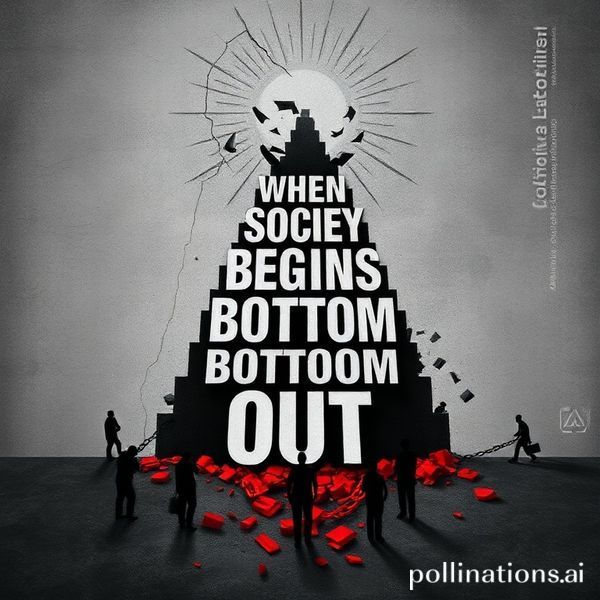
The Ecology and Behavioral Logic of a Bottom-Heavy Society
When High Pressure, Low Security, and Fierce Competition Become the Norm
In the previous article, we arrived at a troubling conclusion:
Modern society is undergoing a historical process of collective downward drift—what I call the bottomization of society.
This is undoubtedly a painful and friction-filled process.
But it does not mean we are about to replay the familiar scenes from history textbooks—
Mass refugees, raging wars, rebel armies competing for territory.
After all, this is the 21st century.
“Battle royale for survival” as a literal way of life is outdated.
Extreme material deprivation—where an entire family shares a single pair of pants—will most likely not return.
But that does not mean the situation is reassuring.
What is truly happening is more subtle, yet far more profound:
The social contracts that once held society together are failing.
Order is eroding slowly but steadily.
Upward mobility is being systematically blocked.
As the outer shell of civilization begins to peel away, society starts to resemble a structure we already know all too well—
A slum-like social ecosystem.
I. The Three Core Conditions of a Bottomized Society
Whether we look at slums, the animal kingdom, or a society undergoing bottomization, they all share three indispensable characteristics:
- High pressure
- Low security
- Fierce competition
Remove any one of these, and the system collapses.
But when all three are present, people across different eras and regions begin to exhibit strikingly similar behaviors.
This is not a moral issue.
Nor is it a cultural one.
It is the result of environmental pressure shaping human behavior.
In this article, we use the behavioral logic of the social underclass to ask a simple but unsettling question:
If this path continues, what will society evolve into?
II. Why I Can Speak About the Bottom Layer
I am not observing from a safe distance.
I grew up near Nanyao Railway Station in Kunming, a classic “no-man’s-land.”
- Group fights were routine
- Gangs fought, students fought
- During my three years in middle school, fights—and serious injuries—were almost weekly events
In that environment, role models weren’t top students.
They were figures like street bosses from crime movies.
If someone admired Dennis Rodman, that was already considered “cultured”—
because many people couldn’t even pronounce the letters NBA correctly.
Violence and disorder were not exceptions.
They were the norm.
III. An Extreme Case: The Perfect Executor of Bottom Logic
When I was young, I knew someone whose moral emptiness and psychological distortion remain unmatched in my memory.
At thirteen or fourteen—too young for crimes that make headlines—he had already mastered the survival algorithm of the bottom layer:
- Ruthlessly pursuing girls, rapidly possessing them, quickly discarding them
- Beating ex-girlfriends with new girlfriends if they refused to break up
- Extorting money afterward
- Responding to minor jealousy among friends with extreme violence
- Deriving visible pleasure from domination and humiliation
Back then, I thought he was simply a monster.
Decades later, I realized something far more disturbing:
He wasn’t an anomaly.
He was an extreme sample naturally selected by the bottom-layer ecosystem.
IV. The Bottom Is Not About Poverty—It’s a Survival System
When people hear “the bottom,” they think of poverty.
But in my view, lack of money is actually the least important feature.
What truly defines the bottom is this:
Middle-class values completely fail there.
Common traits include:
- No long-term planning, only immediate payoff
- Obsession with gambling, lotteries, superstition
- Hostility toward anyone who succeeds (the crab mentality)
- Extreme concern for “face”
- Strong persecution paranoia
- Glorification of violence
- Anti-intellectualism and disdain for formal knowledge
From a middle-class perspective, these behaviors look irrational and short-sighted.
But within a bottom-layer environment, they are often the most rational choices available.
V. Why “Living in the Moment” Becomes Rational
Long-term planning requires a stable, predictable environment.
In bottomized conditions:
- Tomorrow’s employment is uncertain
- Savings can vanish overnight due to illness, accidents, or violence
- The link between effort and reward has already broken
In such circumstances, “live for today” is not indulgence—it is risk minimization.
This logic is not confined to the poor.
Just look at the dominant strategies in China’s stock market:
quick entry, quick exit, emotional and policy-driven speculation.
Strategy follows environment.
VI. Why Mutual Harm Becomes Inevitable
Because the system becomes zero-sum—or even negative-sum.
When everyone believes the cake will not grow, and may even shrink:
- If you gain more, I get less
- If you escape, I sink deeper
This is the root of the crab mentality.
In such an environment, success is not inspirational—it is threatening.
VII. “Face” as the Only Hard Currency
When wealth, power, and status are absent, face becomes the only valid currency.
No retaliation = no strength
No strength = eventual annihilation
Excessive retaliation, verbal aggression, and hypersensitivity are all low-cost ways to defend survival boundaries.
VIII. Reexamining That “Human Trash”
Everything about him—
- Maximizing short-term gain
- Persecution paranoia
- Excessive violent retaliation
- Obsessive display of victory
Perfectly aligned with bottom-layer survival logic.
He was not simply a bad person.
He was a product of a specific social environment.
Conclusion: The Problem Is Not “Them,” but the Environment
The real danger is not how bad individuals can be.
The real question is:
Will future social conditions make it easier to mass-produce such individuals?
As long as society operates under sustained conditions of:
- High pressure
- Low security
- Fierce competition
Human behavior will continue drifting toward bottom-layer logic—toward jungle law.
And that leaves us with one final question:
How do you survive in such an environment—without being completely assimilated by it?
原文
当社会开始底层化:一套正在扩散的生存逻辑
底层社会的生态与行为逻辑——当高压力、低保障、强竞争成为常态
上期我们聊到一个判断:
当今社会正在经历一场“全民底层化”的历史进程。
这一定是一个极其痛苦、充满摩擦的过程,但它并不意味着我们会立刻回到教科书里那套熟悉的剧本——
流民四起、烽烟遍地、十八路反王逐鹿中原。
毕竟已经是 21 世纪了,“全民吃鸡”这种娱乐方式,早就过时了。
那种极端意义上的绝对物质匮乏——比如一家人只剩一条裤子轮流穿——大概率不会再出现。
但这并不代表情况乐观。
真正正在发生的,是另一种更隐蔽、也更深刻的变化:
维系社会运转的契约正在失效,秩序在缓慢崩坏,个体的上升通道被系统性堵死。
当文明的外壳开始剥落,整个社会的运行方式,会越来越接近一种我们并不陌生的形态——
贫民窟式的社会生态。
一、三大特征:底层社会的基本生态条件
无论是贫民窟、动物世界,还是正在发生的“全民底层化”,它们都有三个不可或缺的共同特征:
- 高压力
- 低保障
- 强竞争
少了其中任何一条,这套生态都无法成立。但只要三者齐备,不同时间、不同地域的人群,都会演化出高度相似的行为模式。这不是道德问题,也不是文化差异,而是环境对人的系统性塑形。
这一期,我们就借“社会底层”的行为逻辑,来推演——如果这条路继续走下去,社会会演化成什么样。
二、我为什么敢聊底层?
我不是站在安全距离外做观察。
我成长的地方,是昆明南窑火车站一带,典型的“三不管地带”。
- 群架是日常
- 社会人动手,学生也动手
- 我念初中的三年里,学校周边几乎每周都有打架,甚至重伤事件。在那样的环境里,被年轻人崇拜的不是学霸,而是“浩南大哥”。如果有人喜欢罗德曼,那已经算“有文化”了——因为很多人连 “NBA” 三个字母都读不顺。
暴力和无序不是例外,而是常态。
三、一个极端个案:底层逻辑的“完美执行者”
我少年时期认识过一个人。他的道德下限和人格扭曲程度,是我此生仅见。十三四岁,没到杀人放火的年纪,却已经把底层社会的生存算法运用得炉火纯青:
- 对女孩死缠烂打、迅速占有、迅速抛弃
- 不愿分手就联合新女友殴打前任
- 打完还要顺手敲诈一笔
- 对朋友极端占有,一点风吹草动就诉诸暴力
- 并且从中获得明显的快感
当年我只觉得他是个彻头彻尾的人渣。几十年后再回头看,我却意识到一件更可怕的事:
他不是偶然的怪物,而是底层生态“自然筛选”出的极端样本。
四、底层不是“穷”,而是一整套生存逻辑
很多人一提底层,第一反应是“没钱”。
但在我看来,没钱反而是底层特征中最不重要的一条。
真正重要的是——中产的价值体系,在底层完全失效。
比如:
- 不做长期规划,只追求当下回报
- 痴迷彩票、赌博、玄学
- 对成功者充满敌意(螃蟹效应)
- 极端在意面子
- 强烈的被迫害妄想
- 崇尚暴力、反智、鄙视知识
如果你用中产视角去评判这些行为,你会觉得它们愚蠢、短视、不理性。但在底层环境中,它们恰恰是理性的结果。
五、为什么“活在当下”反而是理性选择?
因为任何长期规划,都需要一个稳定、可预期的外部环境。
而在底层社会:
- 明天是否失业不可预测
- 积蓄随时可能因疾病、事故、暴力而清零
- 努力与回报之间的因果关系已经断裂
在这种环境里,“今朝有酒今朝醉”不是放纵,而是一种风险最小化策略。
这套逻辑并不只存在于底层。你看看 A 股的主流玩法就知道了——快进快出、情绪博弈、政策博弈。
环境决定策略。
六、为什么底层必然互害?
因为这是一个零和,甚至负和博弈。
当所有人都默认蛋糕不会变大,甚至还在缩小时:
- 你多一口,我就少一口
- 你上岸了,就意味着我更沉
这就是螃蟹效应的根源。
在这种环境里,成功不是榜样,而是威胁。
七、面子:底层社会唯一的硬通货
当财富、权力、地位全部缺席时,面子就成了唯一的“通行证”。
不反击 = 没实力没实力 = 随时会被吞噬
所以,过度反击、语言暴力、极端敏感,本质上都是在用最低成本维护生存边界。
八、回头再看那个“人渣”
他所有的行为——
- 吃干抹净、只看当下
- 被迫害妄想
- 过度暴力反击
- 沉溺于“胜利展示”
都完美符合底层生存逻辑。
他不是偶然出现的坏人,而是在特定社会土壤中,被系统培养出的产物。
结语:问题不在“他们”,而在环境
真正值得警惕的不是某一个人有多坏,而是——未来的社会环境,会不会越来越容易批量生产这样的人?
当社会长期运行在:
- 高压力
- 低保障
- 强竞争
之下,人的行为逻辑必然会不断向底层、向丛林法则靠拢。
那么问题就只剩下一个:
在这样一个环境里,如何生存,而不被彻底同化?